
| Previous Site | Next Site |
Earth Science Conservation Review
| Ballycastle Pellet Chalk | Antrim |
| Site number: | 110 | ||
| ESCC: | EC | ||
| Locality Type: | Cliff, Coastal section | Status: | ASSI |
| Grid Reference: | D118417 Centroid | ||
| Google maps: | 55.21014,-6.24371 | ||
| County: | Antrim | Council area: | Causeway Coast & Glens Borough Council |
| Period: | Cretaceous | ||
| Stages: | Campanian, Maastrichtian | ||
| Lithostrat: | Ballycastle Chalk Member, Ballycastle Pellet Chalk, Ulster White Limestone Formation | ||
| Site Description | |
|---|---|
 | |
| Highlights: | |
The Ballycastle Pellet Chalk is the best example in Northern Ireland of a soft, poorly lithified chalk from which a representative calcareous microfauna can be obtained; typical Ulster White Limestone facies are too well cemented to allow recovery of such microfossils. They indicate a late Campanian to Maastrichtian age for the deposit. | |
| Introduction: | |
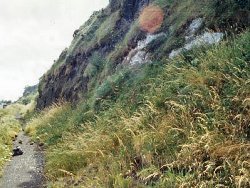
The Ballycastle Pellet Chalk outcrops over a steeply inclined area of some 50 square metres at the foot of the cliff immediately on the landward site of an artificial walkway approximately 400 metres north-west of Ballycastle harbour (Grid Ref. 34/118417). It overlies typical Ulster White Limestone, forming a rather irregular mass enveloped by the lowest basalt flow above. It is one of very few occurrences in Northern Ireland where late Cretaceous coccolith limestone, commonly known as Chalk, is relatively poorly cemented. Its palaeontological significance lies in the diverse calcareous microfauna which has been obtained from it, calcareous microfossils normally being unrecoverable from typical well-cemented Ulster White Limestone. The unusual nature and context of the Ballycastle Pellet Chalk was noted first by McHenry (1895) and was described in greatest detail by Wilson and Robbie (1966). It was discussed by McGugan (1959, 1974), with the main micropalaeontological descriptions being published by Barr (1966) and McGugan (1957). | |
| Description: | |
An artificial walkway extends along the foot of the cliffs at Portnagree for about half a kilometre to the north-west of Ballycastle Harbour. For the first few hundred metres the cliffs are of the Lower Basalt Formation, the base of which lies close to the level of the footpath. Gently dipping ledges of the Ulster White Limestone Formation lie seaward of the path. About 400 metres from the harbour the base of the basalt rises up into the cliff above the Ulster White Limestone. A short distance south-east of this point a patch of chalky material several metres in length and height can be seen within the lower part of the basalt cliff; this is the Ballycastle Pellet Chalk. In August 1997 the lower part of the exposure was much overgrown with grass and herbaceous weeds so that only about the uppermost two metres or so was clearly visible. The exposed chalk is relatively soft and displays cuboidal weathering and vague subhorizontal jointing or bedding. A few broken and angular flint nodules and some small 'rotten' basalt clasts were observed. A small patch of obviously pelletal chalk, with small pisoid-like pellets 2-3 mm across, was visible amongst the vegetation about three metres from the top. Examination of a block of the Pellet Chalk in the collections of the Ulster Museum (ac. no. K18537) showed it to consist of numerous, mostly rounded, ellipsoidal pellets up to about 5 mm across, many with an orange coating of iron oxide. A few (<5%) dark brown clasts of ?mudstone, perhaps representing fragments of weathered basalt, were also present. The site appears to have been mentioned first by McHenry (1895, p. 138) who described it as a "lenticular deposit, several yards thick, between the Chalk and overlying basalt ... [and] consists of well rounded and water-worn pebbles and detritus of the underlying Chalk". He considered that it might be early Eocene in age. A much fuller description of the outcrop is given in the Geological Survey Memoir for Ballycastle (Wilson and Robbie 1966). They described the exposure as 11 metres (36 feet) long and 4.3 metres (14 feet) thick at maximum. It is underlain by near horizontal Ulster White Limestone and overlain by the lowest basalt flow. There is a near vertical contact, aligned north-north-east, between the Pellet Chalk and Ulster White Limestone at the northern end of the exposure, with the lowest basalt flow descending steeply from this point down to path level at the southern end of the exposure. Several thin horizons of non-chalk debris, including pebbles of red, brown or grey-green marl, angular flints and cobbles of decomposed basalt up to 0.3 metres across were visible at that time. 200 metres further to the north-west the upper foreshore exposes an irregular area, with maximum dimensions of some 15 metres by 5 metres, in which the Ulster White Limestone appears highly disrupted. Broken flints and blocks of basalt up to 0.5 metres across are embedded within it while an irregular mass of rather soft, pinkish pellet chalk extends northwards from a roughly circular depression some 5 metres across in which soft pellet chalk and broken flints still adhere to the walls. A ten metre wide vent breccia is clearly visible in the cliff behind, cutting through at least 15 metres of basalt flows above the limestone-basalt unconformity. Of the 14 members which Fletcher (1977) recognised within the Ulster White Limestone, the Ballycastle Chalk Member represents the stratigraphically highest unit which has been recognised. It forms the chalk cliffs and platform immediately west of Ballycastle Harbour and appears not to be present elsewhere in Ireland. This sequence was recognised by Wood (1967) as Maastrichtian in age on the basis of macrofaunal evidence. It is upon this 'normal facies' of the Ballycastle Chalk Member that the 'Pellet Chalk' lies. The palaeontological importance of Ballycastle Pellet Chalk site stems from the poorly lithified nature of the 'Pellet Chalk', which has allowed for the recovery of a relatively diverse calcareous microfauna from a stratigraphic position above that of any 'normal' member of the Ulster White Limestone Formation. No definitive list of microfossil taxa for the site is available since the various accounts of Barr (1966) and McGugan (1957) did not differentiate between taxa recovered from this site and from other sources within the Ulster White Limestone Formation. | |
| Importance: | |
The Ballycastle Pellet Chalk is of great micropalaeontological significance since very few opportunities arise to recover any calcareous microfauna from the Ulster White Limestone on account of its well-indurated nature. The Ballycastle Pellet Chalk is the best example of a 'soft' or 'pellet' chalk in Northern Ireland. Other examples have been recorded although most are temporary or difficult to access. These 'pellet chalks' are thought to represent the accumulated residues derived from the reworking of 'normal' Ulster White Limestone facies. The microfauna indicates that the source of the Ballycastle Pellet Chalk spanned the Campanian-Maestrichtian boundary and thus probably was contemporaneous with the 'normal' facies Port Calliagh and Ballycastle Chalk Members currently exposed just to the northwest of the Pellet Chalk outcrop. | |
| Interpretation: | |
The unusual lithology and setting of the Ballycastle Pellet Chalk has been commented upon for more than a century. McHenry (1895) described it as consisting of "well rounded and water-worn pebbles and detritus of the underlying Chalk" and concluded that it might be of early Eocene age, the overlying basalts at that time being considered Eocene, rather than Palaeocene, in age. The lithology of the Ballycastle Pellet Chalk is unusual in the context of the Northern Ireland Cretaceous, where indurated, low porosity limestones are the norm, but it is not unique. McGugan has described similar soft chalks from Ballintoy (McGugan 1959) and White Park Bay (McGugan 1974), as well as from within hollow flints from the so-called 'clay with flints' developed intermittently at the contact between the Ulster White Limestone Formation and the base of the Lower Basalt Formation. McGugan (1974) ascribed the formation of these soft chalks to post-Cretaceous reworking prior to burial beneath basalt flows, perhaps aided by explosive volcanism breaking up the limestone to form, in effect, a chalk tuff containing microfossils and basalt fragments. Undoubted chalk-rich tuff is exposed on the foreshore immediately west of Ballycastle Harbour and has been described in Wilson & Robbie (1966) as containing cobble-grade fragments of basalt, chalk and flint in a matrix of comminuted chalk and devitrified volcanic glass; many of the chalk fragments are darkened near their contact with the glass shards. The close association of a vent breccia cutting through basalt flows immediately above an exposure of brecciated and 'pelleted' chalk, 200 metres west of the main pellet chalk outcrop, also suggests there may be a link between volcanism and pellet chalk formation. However, the Ballycastle Pellet Chalk, although at roughly the same level as the chalky tuff, differs significantly from it. There is no evidence of any baking of the sediment, as might be expected for a volcaniclastic deposit. Furthermore, the configuration of the deposit, particularly its occurrence within an irregular hollow in the 'normal' Ulster White Limestone facies, and the restriction of basalt fragments to particular horizons within the 'pellet chalk' suggests that it is a colluvial deposit which accumulated at the foot of a basalt-capped chalk slope. Similarly, the brecciated Ulster White Limestone and pinkish pellet chalks 200 metres to the north-west of the main outcrop suggest emplacement of this particular deposit into a karst fissure or doline by a debris flow mechanism. The basalt clasts are only poorly rounded and unweathered, suggesting little transport or residence time on the surface before being incorporated into the breccia. If they do not represent volcanic 'bombs' then they must have been derived from the erosion of pre-existing lava flows very close at hand. Indeed, it is possible that the chalk breccia was 'bulldozed' into its present position by an advancing lava flow, from which the basalt clasts were derived. The precise mechanism by which the soft lithologies of the Ballycastle Pellet Chalk, and similar deposits discussed above, have been preserved is unclear. Observations made on the palaeokarst surface of the Ulster White Limestone immediately beneath the Antrim Basalts indicate that even prior to burial beneath the first lava flows much, if not all, of the limestone succession had acquired the low porosity and oblique joint set which pervades it today. Hence the diagenetic processes which changed it from a soft chalk to a hard limestone must have occurred very early in its history and it is difficult to visualise how this degree of diagenesis might be reversed to produce soft chalk once again. The conclusion would seem to be that the formation of these deposits mostly predates the main phase of diagenesis, although it seems possible that cavities within flints may have afforded some degree of protection against diagenesis for any chalk which they had enveloped during their own formation. However, the hardness of the grains in the Ballycastle Pellet Chalk, noted by Hancock (1976), indicates a significantly more complex sequence of events involving either partial cementation of the chalk from which the Pellet Chalk was derived or else partial de-cementation of an originally well-cemented unit. The late Campanian to Maastrichtian age for the pellet chalks may be of significance, perhaps suggesting that this part of the late Cretaceous succession remained unlithified until the early Palaeocene. However, palaeokarst features in the uppermost beds of the Ulster White Limestone on the shore at Ballycastle, which represent the youngest Cretaceous strata preserved in Northern Ireland, do not support such a scenario. The palaeontological significance of the Ballycastle Pellet Chalk lies in the rich microfauna which it has yielded. McGugan (1957) listed 87 species of Campanian-Maestrichtian foraminifera from hollow flints of the 'clay with flints' deposits and the Ballycastle Pellet Chalk together although he did not, in most instances, specify the particular source of each taxon. Furthermore, he stated that the list included only "some of the foraminifera found in the derived deposits [Ballycastle Pellet Chalk] and in the hollow flints of the Clay with Flints", thereby implying that the microfauna is still more diverse. Barr (1966) recorded a further three species from the Ballycastle Pellet Chalk. Although most of the microfauna from the Ballycastle Pellet Chalk comprises taxa which span the Campanian- Maestrichtian boundary, at least two taxa, Globorotalites conicus and Neoflabellina rugosa, are unknown post-Campanian while Osangularia lens is a Maestrichtian index species. This indicates that the sequence from which the pellet chalk was derived spanned the Campanian-Maestrichtian boundary. As such it is roughly contemporaneous with the Port Calliagh Chalk Member and Ballycastle Chalk Member of the 'normal' Ulster White Limestone facies, which also span the boundary (Wood 1967, Fletcher 1977) and are exposed in the cliff to the northwest. Although the 'normal' facies contains a modest macrofauna, the pellet chalk has, to date, yielded only microfossils. Peake and Hancock (1961) recorded that a specimen of Echinocorys ciplyensis was found in the 'Pellet Chalk', indicating an horizon high in the Lower Maestrichtian, but Wood (1967) confirmed that this was not from the Ballycastle Pellet Chalk but from a similar deposit at Cape Castle Quarry on Knocklayd Mountain, just to the south of Ballycastle. The soft chalk exposed at White Park Bay (McGugan 1974) yielded 50 species but is no longer exposed and hence is not suitable for designation as a palaeontological ASSI. Both the White Park Bay and Ballycastle occurrences yielded predominantly Campanian-Maestrichtian taxa including, at each of the sites, two taxa which are exclusively Maestrichtian in distribution. | |
| Conclusions: | |
The Ballycastle Pellet Chalk is the best exposed, best documented and most easily accessible of the soft 'pellet chalks' which have been encountered at various sites in Northern Ireland. The mechanisms by which it formed and was emplaced remain unclear but its relatively poorly lithified nature has allowed for the recovery of a diverse foraminiferal assemblage indicating a latest Campanian to Maastrichtian age. | |
| Notes: | |
For general information and references on the Palaeontology of Northern Ireland see Key Site 109 - Palaeontological sites of N. Ireland - Introduction For other site specific information and references on the Palaeontology of Northern Ireland see Key Site 111 - Ballypalady Plant Bed, Key Site 112 - Carrick Lough, Bunnahone Lough and the Sillees River, Key Site 113 - Faragandoo, Key Site 114 - Minnis North Mudflow, Key Site 115 - Moyola River, Key Site 116 - Mullynaskeagh Clay Pit, Key Site 117 - Murlough Bay, Key Site 118 - Portnaloub, Key Site 119 - Sillees River, Glenasheevar, Key Site 120 - Tircrevan Burn, and Key Site 121 - Tullyconnell. | |
| Keywords | |
|---|---|
| Rocks: | Chalk |
| Fossil Groups: | Foraminifera |
| Fossil List: | Globorotalites conicus , Neoflabellina rugosa , Osangularia lens |
| Measurements | |||||
|---|---|---|---|---|---|
| Length: | 11m | Width: | Height: | 4.3m | |
| Depth: | Area: | 50m2 | |||
| Access | |
|---|---|
| Approach: | At the foot of the cliff immediately on the landward site of an artificial walkway approximately 400 metres north-west of Ballycastle harbour. |
| Management: | |
Access to the Pellet Chalk outcrop is easy, via an artificial walkway along the base of the cliffs west of Ballycastle. Currently the exposure is in rather an overgrown state, but relatively little work would be required to expose the full succession once again. The description given by McHenry (1895) shows that, despite the relatively soft nature of these 'pellet chalks', this particular exposure has changed remarkably little over the last hundred years. It indicates that the exposure is considerably more robust than might be expected and that removal of the vegetation cover which currently covers part of it would not pose a significant threat through increased rates of erosion. | |
| Uses | |
| Uses: | The site is near the foot of a cliff several hundred metres from the harbour and fronted by an artificial walkway. Landuse is entirely recreational. |
| References (9) | |||
|---|---|---|---|
| Barr, F.T., 1966. The foraminiferal genus Bolivinoides from the Upper Cretaceous of the British Isles Palaeontology, vol. 9, pp.220-243. | |||
| Fletcher, T.P., 1977. Lithostratigraphy of the Chalk (Ulster White Limestone Formation) in Northern Ireland. Report of the Institute of Geological Sciences, vol. 77/14. | |||
| McGugan, A., 1957. Upper Cretaceous foraminifera from Northern Ireland. Journal of Paleontology, vol. 31, pp.329-348. | |||
| McGugan, A., 1959. Upper Cretaceous Foraminifera from Ballintoy, Co. Antrim Irish Naturalists Journal, vol. 13, pp.39-40. | |||
| McGugan, A., 1974. Cretaceous Foraminifera from Whitepark Bay, Northern Ireland Irish Naturalists Journal, vol. 18, pp.12-17. | |||
| McHenry, A., 1895. Sketch of the geology of County Antrim Proceedings of the Geologists Association of London, vol. 14, pp.129-147. | |||
| Peake, N.B. & Hancock, J.M., 1961. The Upper Cretaceous of Norfolk. Transactions of the Norfolk & Norwich Naturalists Society, vol. 19, pp.239-339. | |||
| Wilson, H.E. & Robbie, J.A., 1966. Geology of the country around Ballycastle. Memoirs of the Geological Survey Northern Ireland. | |||
| Wood, C.J., 1967. Some new observations on the Maestrichtian Stage in the British Isles. Bulletins of the Geological Survey of Great Britain, vol. 27, pp.271-288. | |||
| Record type: | ESCR report | Recorded by: | Michael J. Simms, Department of Geology, Ulster Mu |
| Entered by: | E M Porter | ||
| Enlander, I., Dempster, M. & Doughty, P., 2026. Ballycastle Pellet Chalk, County Antrim, site details. [In] Earth Science Conservation Review. https://www.habitas.org.uk/escr/site.php?item=110. Accessed on 2026-11-05. |
| Previous Site | Next Site |