
| Previous Site | Next Site |
Earth Science Conservation Review
| Ballypalady Plant Bed | Antrim |
| Site number: | 111 | ||
| ESCC: | ED | ||
| Locality Type: | Cutting, Railway cutting | Status: | ASSI |
| Grid Reference: | J263874,J253867 End(s) of linear site, Not Entered | ||
| Google maps: | 54.71919,-6.03996 | ||
| County: | Antrim | Council area: | Antrim & Newtownabbey Borough Council |
| Period: | Tertiary | ||
| Stages: | Eocene, Palaeocene | ||
| Lithostrat: | Antrim Lava Group, Interbasaltic Formation | ||
| Site Description | |
|---|---|
 | |
| Highlights: | |
Ballypalady is the best known and best documented of the Interbasaltic plant localities and, during the heyday of collecting in the latter part of the last century, it was always the most important of these sites. It remains the only Interbasaltic plant locality to which access may realistically be re-established. | |
| Introduction: | |
The Ballypalady Plant Bed is located some 2 km NE of Templepatrick, in association with a railway cutting on a currently disused line between Belfast and Derry. At this point the railway cuts through the outcrop of the Interbasaltic Formation, representing a major weathering horizon between the Lower and Upper Basalt Formations of the Antrim Plateau. Plant remains at Ballypalady were first made known by Mr Rowland Smeeth in 1862 (Cole et al. 1912, p. 92). A brief description and interpretation of the Ballypalady deposit was made by Tate and Holden (1870), who included sketches and a measured section through the critical exposure. Gardner (1885) also described the locality and also gave an account of the other significant occurrences of Tertiary plant remains, at Ballintoy, at Glenarm and at Lough Neagh. McHenry (1895a, b), in accounts of the basalts and rhyolites of Co. Antrim, cited the occurrence of rhyolite clasts in the Ballypalady section as evidence for the age of the rhyolite relative to the basalts. He included an annotated sketch section of the exposure at Ballypalady and cited several genera of plants recovered from the Ballypalady Plant Bed and from a similar deposit at Glenarm. At that time the Ballypalady Plant Bed was considered early Eocene in age. The same sketch section was reproduced in the Belfast Memoir (Lamplugh et al. 1904) along with additional notes concerning the succession, its interpretation and further details of the plants present. A further brief description of the Ballypalady Plant Bed was given by Cole and Hallisey (1924), it being the only Interbasaltic plant locality still exposed at that time. More recent accounts include those of Watts (1970), concerned with pollen from the site, and of MacAoidh (1983), who briefly described material in the museum collections in University College Cork. | |
| Description: | |
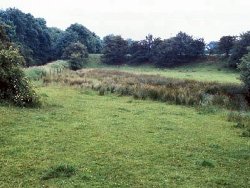
Baily (1869) was the first to describe the site and, in addition, described and figured a number of the commoner plant remains as well as two beetle elytra; Baily's account remains the only one to mention insect remains. Tate and Holden (1870) described the site in rather more detail, providing both a written description and sketches both of the vertical succession and of lateral changes in it along the north-west side of the railway cutting. Gardner (1884) also described the succession at Ballypalady, which he said comprised "laminated clay-iron-ore, fine breccias or conglomerates, and thin seams of lignite irregularly deposited and somewhat twisted", citing a thickness of 25 feet (about 8 metres) without the base apparently being exposed. He noted, however, that the section as he observed it differed from that previously described by others and suggested that the units were lenticular or at least discontinuous. Plants were said to occur throughout the finer sediments, with conifer cones sometimes extending into the coarser layers. The site was described yet again in some detail in the Geological Survey of Ireland's Memoir on the Interbasaltic Formation (Cole et al. 1912). Seymour (in Cole et al. 1912) discussed the stratigraphic and petrographic aspects of the section, which at one time had been extensively worked for iron ore. He stated that even by that time the sections were much more degraded than when they had been examined by Du Noyer more than 40 years earlier, when the quarries were still being actively worked. Seymour described the principal section as located in "the old quarry near the railway". The section at that time was about 20 feet (6 metres) high and exposed alternating coarse and fine sediments, composed largely of basaltic debris, in beds rarely exceeding "a few feet" in thickness. He stated that "the finer sediments usually contain plant remains and casts of cones, the organic material now obtainable being in a quite fragmentary condition". The adjacent railway cutting was described as exposing over much of its length essentially the same succession as seen in the quarry. Several small basaltic dykes were seen to cut the Ballypalady Plant Bed along the railway cutting and in the quarry to the west. These were cited as definite evidence that the Ballypalady beds were of greater age than the lignites and plant-bearing beds of the Lough Neagh clays, which are not known to be traversed by any dykes. The plant remains from the Interbasaltic Formation, and particularly from the Ballypalady Plant Bed, were discussed in some detail by Moss (in Cole et al. 1912). His conclusions were that considerable uncertainty existed both as to the identity of many of the plants and also to the precise age of the plant bed. Cole and Hallisey (1924) briefly described the Ballypalady Plant Bed, citing it as the only Interbasaltic plant locality still exposed at that time. They describe the leaves as occurring in a brown volcanic tuff with fragments of basalt and rhyolite. Re-examination of material in the collections of the Ulster Museum reveal that the plant bed has a silty to rather gritty texture, the sand-sized clasts being of a creamy, brick-red or grey colour. Bedding plane spacing in this material typically is from about 5 mm to 20 mm. Although the way-up of the specimens is not recorded, some show a fairly clear upwards fining from coarse sand to silt. The plant material occurs largely as impressions, with traces of carbonaceous material present in the finer sediment. Cavities left by the decay of woody plant fragments may be common in the coarser units. On some slabs there is clear evidence of preferential orientation of specimen long axes. More than 130 specimens in the collections of the Ulster Museum are recorded as from this site. A similar quantity of unlocalised material from the Interbasaltic Formation may also be from Ballypalady, judging from lithology and preservation. The flora at Ballypalady is abundant and moderately diverse, including conifers, angiosperms and pteridophytes, with both fruiting structures and vegetative material present for some. Several new taxa were described from the site, including Pinus plutonis Baily 1869, Pinus bailyi Gardner 1884, Tsuga heerii Gardner 1884 and Taxus swanstoni Gardner 1884. The angiosperms are much more poorly documented than the gymnosperms, although it is evident from the range of leaf morphologies and venations present that several distinct species are included. Watts (1970) investigated the pollen from a number of Irish Tertiary sites, among them Ballypalady, figuring several of the common pollen types at this site. He found the samples from Ballypalady to be rich in moderately well-preserved pollen, particularly of conifers, and recorded pollen of Alnus, papillate pollen of Taxodiaceae, saccate pollen similar to modern Pinus and others similar to modern Picea or Podocarpus; also pollen of Sciadopitys-type and of the 'atumescens'-Group. The total species list, compiled from Baily (1869), Tate and Holden (1870), Gardner (1883-86) and Watts (1970), and from identifications of Ulster Museum material made by Prof. Michael C. Boulter is listed below. McHenry (1895) also cites in addition Quercus and Rhamnus as occurring at Ballypalady, though he gave no further details, while Baily (1869) questionably referred a specimen to Platanatus, a species common in the Scottish interbasalt plant beds of Mull. The occurrence of Platanatus among the Ballypalady material in the museum collection at University College Cork was confirmed by MacAoidh (1983). Cryptomeria sternbergiis Goeppert, Cupressus pritchardi Goeppert, Pinus bailyi Gardner, Pinus plutonis Baily, Taxus swanstoni Gardner, Tsuga heerii Gardner, Platanatus sp., Eucalyptus oceanica Unger, Hakea sp., Celastrus sp., Daphnogene kanii Heer, Populus sp., Alnus kefersteinii Goeppert, Viburnum whymperi Heer, Macclintockia trinervis Heer, Juglans ?acuminata, Salix sp., and Magnolia ?glauca Heer. Additional taxa identified by M.C. Boulter, based on material in the collections of the Ulster Museum, are: Camptodromites major, Corylites hebredicus, Cupressoconus machenryi, Cupuliferites rubrifolia, Equisetum sp., Glyptostrobus dunoyeri, and Haemanthophyllum nordenskioldii. The site was re-examined in June 1998 and, not unexpectedly, was found to be heavily vegetated. Nonetheless, the Interbasaltic Formation and the lowermost few metres of the Upper Basalts are patchily exposed at various points along the cutting. The main features of relevance here extend southwestwards from Grid Ref. 33/263874 to 33/253867, about 200 metres north-east from the level crossing. At this southernmost point two shallow pits, each about 100 metres long and up to 30 metres wide, lie on either side of the railway. Their degraded faces rise 2-3 metres above the floor but are now largely grassed over except where eroded by the trampling of cattle. These faces are excavated largely in glacial drift but several fragments of the distinctive plant bed lithology were found and it is probable that these pits, rather than the railway cutting itself, were the main source of the plant fossils and represent the quarries mentioned by Seymour (in Cole et al. 1912). None of the rocks now exposed along the railway cutting match the plant bed lithology. Most of the larger exposures are of basalt. On the southern face towards the north-east end of the cutting a low mine entrance has exposed in its walls and roof a spherulitic ironstone passing up into a coarsely laminated unit immediately beneath the overlying basalt. Just a little further to the south-west, there are further poor exposures of ironstone amongst the vegetation while almost opposite, on the north side of the cutting, there is a clear exposure of a coarsely and irregularly laminated rock containing dark lenses of shale-like material interbedded with many pale slivers of rhyolitic and glassy material. The whole unit has the appearance of an ignimbrite and dips gently eastwards towards the mine, but it cannot be matched with any previous descriptions of the succession. | |
| Importance: | |
The Interbasaltic Plant Beds of Co. Antrim are of considerable importance, both from a palaeobotanical view and for gaining an understanding of regional palaeoenvironments during this time interval. Although plant remains have been found in some abundance at many interbasaltic sites in Co. Antrim (Cole et al. 1912), significant collections of material were made only from three sites; the iron-ore and bauxite mine at Libbert, near Glenarm; from a 'leaf-bed' associated with an Interbasaltic lignite at Ballintoy; and from the 'Plant Bed' at Ballypalady. Of these, Ballypalady was always the most important. Such plant beds are much less prevalent in the correlative basalt succession in Scotland, the only well-documented locality being that at Ardtun Head on the Isle of Mull (Gardner 1884). The preservation and context of the main plant beds at Glenarm, Ballintoy and at Ballypalady are in striking contrast to each other. At Glenarm the plants are preserved as carbonaceous films on a very pale grey aluminous bauxite while at Ballintoy they occurred in a laminated lignite. In contrast, the Ballypalady Plant Bed is preserved in a dark brown to almost ochreous sandstone to siltstone, formerly worked for its iron content. | |
| Interpretation: | |
Early accounts considered the Ballypalady Plant Bed to have been deposited from ash falls in a lacustrine environment. However, Gardner (1884) perceived that this interpretation did not fit with the coarseness of some of the sediment and its irregular bedding. Instead he considered these features to indicate deposition by running water of varying velocity. This view is consistent with the evidence obtained from re-examination of material in the Ulster Museum. The coarser clasts indicate derivation of sediment directly from erosion of adjacent weathered volcanic extrusives. The proximity of a substantial rhyolite body only a few kilometres to the west-south-west at Templepatrick (Brandon and Wilson 1975) may account for the mixture of weathered debris of both rhyolite and basalt evident in the coarser material, while the ?ignimbrite unit seen in the railway cutting near the mine entrance represents an even more proximate source of rhyolitic debris. Fining upward rhythms on a centimetre-scale indicate variations in flow, with minor floods carrying coarser sediment and plant debris into the area. Palynological and macrofloral evidence for the age of the Ballypalady plant bed is consistent with the Palaeocene age of basalt emplacement as deduced from radiometric dating. Mitchell (1981) and others (e.g. MacAoidh 1983) all assign the Ballypalady assemblage to the Arcto-Tertiary flora of warm-temperate conditions. | |
| Conclusions: | |
The Ballypalady Plant Bed was deposited by flood-borne sediments derived from the weathering and erosion of adjacent extrusive igneous rocks. Repeated minor flood events buried a rich variety of plant debris which subsequently decayed to leave well-preserved moulds within the iron-rich clastics. | |
| Notes: | |
For general information and references on the Palaeontology of Northern Ireland see Key Site 109 - Palaeontological sites of N. Ireland - Introduction For other site specific information and references on the Palaeontology of Northern Ireland see Key Site 110 - Ballycastle Pellet Chalk, Key Site 112 - Carrick Lough, Bunnahone Lough and the Sillees River, Key Site 113 - Faragandoo, Key Site 114 - Minnis North Mudflow, Key Site 115 - Moyola River, Key Site 116 - Mullynaskeagh Clay Pit, Key Site 117 - Murlough Bay, Key Site 118 - Portnaloub, Key Site 119 - Sillees River, Glenasheevar, Key Site 120 - Tircrevan Burn, and Key Site 121 - Tullyconnell. | |
| Keywords | |
|---|---|
| Rocks: | Basalt, Lignite, Tuff |
| Fossil Groups: | Plant |
| Relations: | Flood-deposited sediments |
| Measurements | |||||
|---|---|---|---|---|---|
| Length: | 100m | Width: | up to 30m | Height: | 2-3m |
| Depth: | Area: | ||||
| Access | |
|---|---|
| Management: | |
Upgrading of the railway line at Ballypalady may offer the opportunity to clear vegetation and slumped earth from some of the steeper faces to re-expose this unique Interbasaltic Formation succession. However, the current agricultural use of the land associated with the ochre pits offers little prospect for any major excavation of these parts of the site. | |
| Uses | |
| Uses: | Much of the proposed site currently lies on a disused railway line. There are proposals to upgrade the line but no work on this has yet been initiated. The two 'ochre pits' from which the main plant material is thought to have come are in areas of intensively grazed pasture and are much degraded at present. |
| References (16) | |||
|---|---|---|---|
| Baily, W.H., 1869. Notice of Plant-remains interstratified with the Basalt in the County of Antrim Quarterly Journal of the Geological Society of London, vol. 25, pp.357-362. | |||
| Baily, W.H., 1880. Report of the British Association. | |||
| Brandon, A. & Wilson, H.E., 1975. The geology of the Templepatrick area, County Antrim, Northern Ireland Bulletin of the Geological Survey of Great Britain, vol. 51, pp.41-50. | |||
| Cole, G.A.J. & Hallissey, T., 1924. Handbook of the Geology of Ireland, pp.82 Thomas Murby, London. | |||
| Cole, G.A.J., Wilkinson, S.B., McHenry, A., Kilroe, J.R., Seymour, H.J., Moss, C.E. & Haigh, W.D., 1912. The Interbasaltic rocks (Iron Ores and Bauxites) of NE Ireland. Memoirs of the Geological Survey of Ireland. | |||
| Gardner, J.S., 1883-1886. A monograph of the British Eocene Flora Palaeontographical Society, London. | |||
| Gardner, J.S., 1885. Eocene ferns from the basalts of Ireland and Scotland Botanical Journal of the Linnean Society, vol. 21. | |||
| Gardner, J.S., 1885. On the Lower Eocene Plant-beds of the Basaltic Formation of Ulster Quarterly Journal of the Geological Society of London, vol. 41, pp.82-92. | |||
| Lamplugh, G., Kilroe, J.R., M’Henry, A., Seymour, H.J., Wright, W.B. & Muff, H.B., 1904. The Geology of the Country Around Belfast. Memoirs of the Geological Survey of Ireland. | |||
| MacAoidh, C., 1983. Palaeogene plants in the museum collection of University College Cork Irish Naturalists Journal, vol. 21, pp.175-177. | |||
| McHenry, A., 1883-1884. The age of the basalts of the North-East Atlantic Proceedings of the Belfast Naturalists' Field Club, pp.225-285. | |||
| McHenry, A., 1895. On the age of the trachytic rocks of Antrim. Geological Magazine, pt. 2, pp.264. | |||
| McHenry, A., 1895. Sketch of the geology of County Antrim Proceedings of the Geologists Association of London, vol. 14, pp.129-147. | |||
| Mitchell, G.F., 1981. Other Tertiary events In A Geology of Ireland, pp.231-234 Scottish Academic Press. | |||
| Tate, R. & Holden, J.S., 1870. On the iron-ores associated with the basalts of north-east Ireland Quarterly Journal of the Geological Society of London, vol. 26, pp.151-165. | |||
| Watts, W.A., 1970. Tertiary and interglacial floras in Ireland. In Irish Geographical Studies in Honour of E. Estyn Evans., pp.17-33 Queens University of Belfast. | |||
| Record type: | ESCR report | Recorded by: | Michael J. Simms, Department of Geology, Ulster Mu |
| Entered by: | E M Porter | ||
| Enlander, I., Dempster, M. & Doughty, P., 2026. Ballypalady Plant Bed, County Antrim, site details. [In] Earth Science Conservation Review. https://www.habitas.org.uk/escr/site.php?item=111. Accessed on 2026-11-05. |
| Previous Site | Next Site |