
| Previous Site | Next Site |
Earth Science Conservation Review
| Slemish Mountain | Antrim |
| Site number: | 1116 | ||
| ESCC: | EO | ||
| Locality Type: | Crag, Crags, Inland exposure | Status: | ESCR |
| Grid Reference: | D22150540 Centroid | ||
| Google maps: | 54.88183,-6.09752 | ||
| County: | Antrim | Council area: | Mid & East Antrim Borough Council |
| Period: | Tertiary | ||
| Stages: | Eocene, Palaeocene | ||
| Lithostrat: | Antrim Lava Group, Upper Basalt Formation | ||
| Site Description | |
|---|---|
 | |
| Highlights: | |
The largest dolerite plug in Northern Ireland which displays near (Tertiary) surface features. | |
| Introduction: | |
Members of the Belfast Naturalists' Field Club (1874) and Hull (1878) recognised Slemish Mountain as a volcanic neck or plug; Symes (1886) noted its olivine-rich nature and drew attention to its vertical platy jointing parallel to the NNW elongation of the hill. Geikie (1897) mentions the thermal alteration of the country basalts. More recently Patterson and Swaine (1957) included it in their geochemical survey of Tertiary volcanic plugs in NE Ireland, and Walker (1959) made a brief reference to its shape and found the zeolite mineral gismondine. Prompted by Walkers unpublished observations, Preston (1963a) found evidence of multiple intrusion, and unusual flat-lying structures which could only have been formed at the head of a magma column close to the Tertiary volcanic surface. | |
| Description: | |
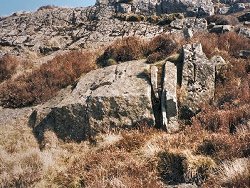
Tertiary dolerite fills a vertical conduit of oval cross-section, some 790 m long and 270 m wide. The outer contact of dolerite with the Upper Basalt Formation marks an abrupt change of slope; the lower heather covered slopes over basalt have a gradient of circa 1 in 5 along the western flank of the hill, this steepens around the northern end but flattens out down the eastern side. Exposures of basalt are few; a small radial dyke swarm appears to be centred on the plug. At the outer contact metabasalt can be found; a fine granular texture probably represents the most highly altered rock; amygdales within the basalt have recrystallized to a plagioclase-pyroxene assemblage or melted to a black glass. Small xenoliths of porcellanite occur sporadically in the endothermic zone. Above the outer contact the dolerite is well exposed in steep, sometimes precipitous crags. 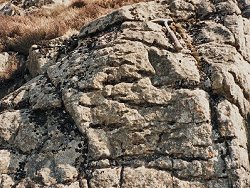 An internal contact between earlier and later dolerite is well marked where exposed. Its probable course around the hill is shown in Fig. 1, Preston (1963). The earlier dolerites D1 and D2 fill the outer part of the conduit; they are difficult to differentiate in the field, show no chilled contacts, but D2 is richer in olivine, by several percent, at the expense of pyroxene. D1 lines the wall of the conduit and carries xenoliths derived from the wall rock. It also shows flat-lying structures - layers of xenolithic dolerite confined to two horizons, see map and section in Preston (1963), which dip inwards at 10-30 degrees. 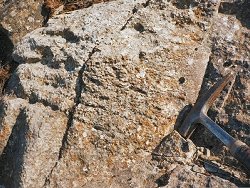 Nodular weathered dolerite appears to follow this layered structure, which is further enhanced by a well developed flat-lying jointing and veins of zeolite. The final intrusion of dolerite, D3, broke through the earlier dolerites and spread out to fill the conduit at higher level; it shows flat-lying contacts with the earlier intrusions. In places it is more olivine-rich than D2 and at the south summit of the hill it is full of raft-like xenoliths of finer-grained dolerite. These rafts together with unusually large olivine crystals have settled on to the internal contact with the underlying dolerites. The olivine xenocrysts, up to 2 cm in dia. are rounded and embayed; the embayments contain numerous octahedra of brown spinel. A small apophysis of probable D3 intersects the earlier dolerites at the SW margin of the plug, immediately SE of the fell wall that bounds the fields of Back Park farm; one contact is planar and shows an unusual columnar growth of olivine and plagioclase (Preston 1963b). | |
| Importance: | |
A fine example of a volcanic plug which offers evidence of repeated use as a feeder vent and preserves structures indicative of a lava lake established within a pit crater in the Antrim lava plateau. Occurrence of an unusual columnar crystallization of both olivine and plagioclase, and of corroded olivine xenocrysts bearing spinel. | |
| Interpretation: | |
The layered structures in the earlier intrusions, the flat-lying internal contact between them, the final injection of dolerite and the raft-like xenoliths found in this later dolerite, all point to an origin at a high level within the volcanic conduit close to the Tertiary surface. A pit crater in the lava pile probably exposed the top of the magma column rising in the vent. This magma pool or lava lake would have formed during standstill conditions, but its existence would have been dependent on a circulation system fed by rising magmatic gases from a deeper source. Circulation would have reprocessed the solidifying crust on the exposed surface, dragging it down into the lava lake where some of the raft-like fragments settled onto the floor of the lake. The rising volatiles probably entrained fresh pyromagma and olivine crystals which had been remelted under higher temperature conditions, an incongruent melting which left resorption embayments filled with spinel crystals. The columnar growth of olivine and plagioclase in an apophysis of D3 probably developed from undercooled quiescent magma at a contact melted through the earlier rock. A detailed interpretation is attempted in Preston (1963b). | |
| Conclusions: | |
This locality is well known as an unusual volcanic feeder. | |
| Notes: | |
This locality is renowned for its historical connection with St. Patrick and for its scenic value as a landmark that overlooks the Braid Valley and indeed the Lough Neagh Basin. Slemish was mapped in detail, prior to publication of the 1963 paper, after a heath fire lit up the mountain like a 'volcano'. In the aftermath of this fire, soil erosion occurred on the steeper slopes and exposed fresh bleached rock surfaces which showed every textural detail within the rocks. Since the fire new vegetation, mosses and lichens, have masked such fine detail, and many features on which the above interpretation is based are now hidden. A periodic heath fire would help to keep the geological evidence more visible. | |
| Keywords | |
|---|---|
| Minerals: | Olivine, Spinel |
| Rocks: | Dolerite, Porcellanite |
| Structures: | lava lake, multiple intrusion, plug, xenocrysts |
| Relations: | Intrusion |
| NonGeol: | Sheep grazing |
| Measurements | |||||
|---|---|---|---|---|---|
| Length: | 790 m | Width: | 270 m | Height: | |
| Depth: | Area: | ||||
| Access | |
|---|---|
| Approach: | Access to the better exposed western side of the hill is provided by a tourist road with terminal carpark which branches from the Braid Valley roads near Buckna. |
| References (10) | |||
|---|---|---|---|
| Belfast Naturalists' Field Club, 1874. Guide to Belfast and the Adjacent Counties. | |||
| Charlesworth, J.K., 1960. The geology of North-East Ireland Proceedings of the Geologists Association of London, vol. 71, pp.429. | |||
| Geikie, A., 1897. The Ancient Volcanoes of Great Britain. Macmillan & Co. Ltd, London. | |||
| Hull, E., 1878. The Physical Geology and Geography of Ireland, London. | |||
| Patterson, E.M. & Swaine, D.J., 1957. The Tertiary dolerite plugs of northeast Ireland - a survey of their geology and geochemistry. Transactions of the Royal Society of Edinburgh: Earth Sciences, vol. 63, pp.317-331. | |||
| Preston, J., 1963a. The dolerite plug at Slemish, Co. Antrim, Ireland Liverpool & Manchester Geological Journal, vol. 3, pp.301-314. | |||
| Preston, J., 1963b. A columnar crystallization of olivine and plagioclase Geological Magazine, vol. 100, pp.1-6. | |||
| Walker, G.P.L., 1959. Some observations on the Antrim basalts and associated dolerite intrusions Proceedings of the Geologists Association of London, vol. 70, pp.179. | |||
| Walker, G.P.L., 1960. The amygdale minerals in the Tertiary lavas of Ireland - III. Regional distribution Mineralogical Magazine, vol. 32, pp.503. | |||
| Walker, G.P.L., 1962. Garronite, a new zeolite from Ireland and Iceland Mineralogical Magazine, vol. 33, pp.173-186. | |||
| Map(s): | For site location see the 1:50,000 O.S. Sheet 9 (Ballymena, Larne) Discoverer series. A detailed geology map figures in Preston (1963). | ||
| Record type: | ESCR report | ||
| Entered by: | E M Porter | ||
| Last updated: | 17 Dec 2007 | ||
| Enlander, I., Dempster, M. & Doughty, P., 2026. Slemish Mountain, County Antrim, site details. [In] Earth Science Conservation Review. https://www.habitas.org.uk/escr/site.php?item=1116. Accessed on 2026-11-08. |
| Previous Site | Next Site |