
| Previous Site | Next Site |
Earth Science Conservation Review
| Portrush - Jurassic | Antrim |
| Site number: | 1205 | ||
| ESCC: | EF | ||
| Locality Type: | Coastal section | Status: | ASSI |
| Grid Reference: | C857410 Approximate | ||
| Google maps: | 55.20907,-6.65378 | ||
| County: | Antrim | Council area: | Causeway Coast & Glens Borough Council |
| Period: | Tertiary, Jurassic | ||
| Stages: | Lower Jurassic, Palaeogene | ||
| Lithostrat: | Portrush Sill, Waterloo Mudstone Formation | ||
| Site Description | |
|---|---|
 | |
| Highlights: | |
The exposures on the east side of the Portrush promontory sustained the historically classic 18th-19th century debate on the origin of basalts, between the Vulcanists who favoured a volcanic origin and the Neptunists who favoured an aqueous origin. | |
| Introduction: | |
The shore sections on the east side of the Portrush promontory show an extensive area of hornfelsed Lias shales overlying the massive dolerite of the Portrush Sill. The area has been pivotal in the discussion of the origin of basalts; between the Vulcanists who believed in a volcanic origin, and the Neptunists who postulated an aqueous origin. Whitehurst (1786) stated that the Portrush strata were of volcanic origin; a conclusion also reached by Hamilton (1790) who published his paper on the `Natural History of the Basaltes and its attendant Fossils in the Northern Counties of Ireland' and advocated a volcanic origin in opposition to the theory of aqueous deposition. The Neptunist Kirwan (1799) described the fossiliferous basalt discovered at Portrush by Richardson and regarded this as a major step in confounding Vulcanist claims. Playfair (1802) described a visit to Portrush where he correctly identified the `basalts' as `stratified stone which has acquired a high degree of induration'. Richardson (1806), the rearguard of the Neptunists stated `a variety of basalts, found in abundance at Portrush is full of pectinites, of belemnites and above all of cornua ammonis; these are dispersed through the whole mass, equally abundant in the interior and on the surface; this basalt vitrifies, and the marine substances it contains of course never could have sustained a volcanic heat'. Conybeare and Buckland (1816) showed that the indurated strata were related to the strata of the adjacent country and they concluded that the rock was no other than the slate clay of the lias formation in an indurated state. Bryce (1834) published an account of the celebrated Portrush Rock. Griffith in his Presidential address in 1835 pointed out the differences between the highly crystalline syenitic greenstone of Portrush and the tabular overlying mass of strata in Antrim and infers that `there are reasonable grounds for supposing it either to be of prior origin to the trap of the mainland, or that it is a projection from some great dyke, which has intruded itself into the lias strata'. Tate (1867) lists a variety of ammonites and bivalves from the Portrush Rock and concluded that it was of planorbis Zone age; records of abundant `Ammonites Johnstoni' presumably being misidentified echioceratids. Symes et al. (1888) gave a brief account of the Portrush Sill including details of its microscopic structure while Lacroix (1886), Cole (1906) and Thompson (1907) all studied the contact phenomena between the Lias shales and the Portrush Sill, paying particular attention to the xenoliths in the dolerite. Harris (1937) made a detailed petrographical study of the sill. The most recent studies in the area were made by Wilson and Manning (1978). | |
| Description: | |
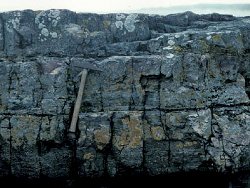
The shore sections on the east side of the Portrush promontory show an extensive area of hornfelsed Lias shales of the Waterloo Mudstone Formation overlying the massive dolerite of the Portrush Sill. At Reviggerly Point the contact between the dolerite and the hornfels is vertical and the latter shows the shales to have been severely contorted before induration. The rest of the outcrops show slabs of undisturbed hornfels, with recognisable fossils, particularly ammonites, dipping eastwards at low angles and resting on the somewhat irregular and trans- gressive surface of the sill. In the area south of Portandoo Harbour, these beds are generally about 1.8-2.5m thick, but near the Blue Pool a maximum thickness of ~7.6m is seen. Ammonites from this locality include Paltechioceras sp. and indeterminate echioceratids indicative of the raricostatum Zone. Small outlying sheets of Lias up to 0.9m thick are seen at Rock Ryan, and these are probably rafts in the upper part of the sill. The low-grade hornfels forming the `Portrush Rock' yields ammonites of the raricostatum Zone, poorly preserved specimens of Paltechioceras favrei being moderately common in the coastal exposures near Portandoo Harbour. The echioceratid ammonites in the collection of Queen's University, Belfast include Leptechioceras aff. macdonnelli and Paltecioceras sp. which confirm a raricostatum Zone age and suggest that the macdonnelli Subzone is present in these baked shales. The largest outcropping intrusion in North Antrim is the Portrush Sill which forms the promontory on which the town of Portrush is built and which extends in an arcuate chain of islands and rocks for some 4km to the NE. The base of the intrusion is never exposed and the maximum thickness seen is estimated at about 45m (Hawkes & Wilson, 1975). The upper part of the sill is chilled and of finer grain but the thickness of this chilled layer is variable, ranging from a few centimetres to 2m. Particularly where the contact is vertical there is sometimes a spectacular development of close parallel joints at right angles to the surface of the intrusion and extending, in exceptional cases, for many metres. At Reviggerly the jointing in the chilled margin is so close that it looks like foliation in the rock and the joint pattern extends for 18m from the vertical contact. Below the chilled surface layer there is a zone of massive coarse and homogeneous dolerite averaging 6m in thickness which passes down into a zone of curiously differentiated rock with bands and patches of pale-weathering zeolite-rich dolerite and spotted with dark clots of olivine-feldspar rock. This zone is up to 15m thick. The lower exposed part of the intrusion is seen in the cliffs on the west side of Ramore Head where about 18m of massive, rudely columnar dolerite rises above sea-level. Though much less variable in texture and composition than the overlying zone the cliffs show that the dolerite is not homogeneous but has bands and patches which weather differently on the spray-etched surfaces. These etched surfaces sometimes show horizontal, rarely contorted, flow banding. | |
| Importance: | |
The identification of Portrush Rock as a basalt containing a marine fauna was important in international terms and in the advancement of geological concepts. The long-running feud between the Vulcanists and Neptunists was nurtured and sustained by these rocks. The later interpretation that these deposits were Lias shales subjected to hornfelsing by intrusive rocks has enabled detailed studies of the contact phenomena to be made. | |
| Interpretation: | |
The interpretation of the Jurassic and Palaeogene rocks at Portrush has been the subject of debate since the latter part of the 18th century. The identification of the shales as being Lias deposits subjected to hornfelsing by the Portrush Sill was not made until Conybeare and Buckland in 1816 while the true nature of the intrusion was not noted prior to Griffith in 1835. | |
| Conclusions: | |
Lias beds are not well exposed in Northern Ireland. This exposure is therefore of considerable importance in the context of Irish geological studies. The relationship between the Lias shales and the Portrush Sill, especially when placed in its historical context, is of international significance. This site should be conserved. | |
| Notes: | |
For information on other Jurassic sites see Key Site 16 - Waterloo and Key Site 1206 - Tircreven Burn. For general information on the Jurassic System in N. Ireland see Key Site 1193 - The Jurassic System in N. Ireland - Introduction. | |
| Keywords | |
|---|---|
| Rocks: | Dolerite, Hornfels, Shale |
| Fossil Groups: | Ammonite, Bivalve |
| Fossil List: | Echioceras raricostatum (Zieten), Leptechioceras aff. macdonnelli |
| Structures: | joints |
| Relations: | Intrusion, Marine sediments |
| Access | |
|---|---|
| Approach: | The site can be reached from the Countryside Centre on Lower Lansdowne Road and from the public carparks to the north. The main exposures are all on the eastern side of the promontory. |
| References (15) | |||
|---|---|---|---|
| Bryce, J., 1834. An account of the celebrated Portrush Rock. Journal of the Geological Society of Dublin, vol. 2, pp.166-174. | |||
| Cole, A.J., 1906. On contact phenomena at the junction of Lias and dolerite at Portrush. Proceedings of the Royal Irish Academy, vol. 25, pp.143-200. | |||
| Conybeare, W. & Buckland, W., 1816. Descriptive notes referring to the outline of sections presented by a part of the coasts of Antrim and Derry. Transactions of the Geological Society of London, vol. 3, pp.196-216. | |||
| Hamilton, W., 1790. Natural History of the Basaltes and its attendant Fossils in the Northern Counties of Ireland., London. | |||
| Harris, N., 1937. A petrological study of the Portrush sill and its veins. Proceedings of the Royal Irish Academy, vol. Series B; 254, pp.1-36. | |||
| Hawkes, J.R. & Wilson, H.E., 1975. The Portrush Sill, County Antrim, Northern Ireland. Bulletin of the Geological Survey of Northern Ireland, numb. 51. | |||
| Kirwan, R., 1799. Geological Essays., London. | |||
| Lacroix, A., 1886. Sur les roches basaltiques du Comte d'Antrim (Irlande). C.R. Acadamie Science Paris, vol. 102, pp.453-455. | |||
| Playfair, J., 1802. Illustrations of the Huttonian theory of the Earth., Edinburgh. | |||
| Richardson, W., 1806. On the volcanic theory. Transactions of the Royal Irish Academy, vol. 10, pp.35-107. | |||
| Symes, R.G., Egan, F.W. & McHenry, A., 1888. Explanatory Memoir to accompany Sheets 7 and 8. Memoirs of the Geological Survey of Ireland. | |||
| Tate, R., 1867. On the Lower Lias of the north-east of Ireland. Quarterly Journal of the Geological Society of London, vol. 23, pp.291-305. | |||
| Thompson, J.A., 1907. Inclusions in some volcanic rocks. Geological Magazine, vol. 4, pp.490-500. | |||
| Whitehurst, J., 1786. On the Original State and Formation of the Earth., London. | |||
| Wilson, H.E. & Manning, P.I., 1978. Geology of the Causeway coast. Memoir for one-inch geological sheet 7. Memoirs of the Geological Survey Northern Ireland, HMSO, Belfast. | |||
| Record type: | ESCR report | ||
| Entered by: | E M Porter | ||
| Enlander, I., Dempster, M. & Doughty, P., 2026. Portrush - Jurassic, County Antrim, site details. [In] Earth Science Conservation Review. https://www.habitas.org.uk/escr/site.php?item=1205. Accessed on 2026-11-08. |
| Previous Site | Next Site |