
| Previous Site | Next Site |
Earth Science Conservation Review
| White Rocks - Cretaceous | Antrim |
| Site number: | 1207 | ||
| ESCC: | EC | ||
| Locality Type: | Coastal section | Status: | ASSI |
| Grid Reference: | C888408,C903413 End(s) of linear site, Not Entered | ||
| Google maps: | 55.20673,-6.60516 | ||
| County: | Antrim | Council area: | Causeway Coast & Glens Borough Council |
| Period: | Cretaceous | ||
| Stages: | Campanian, Maastrichtian | ||
| Lithostrat: | Ballintoy Chalk Member, Ballymagarry Chalk Member, Garron Chalk Member, Glenarm Chalk Member, Port Calliagh Chalk Member, Portrush Chalk Member, Tanderagee Chalk Member, Ulster White Limestone Formation | ||
| Site Description | |
|---|---|
 | |
| Highlights: | |
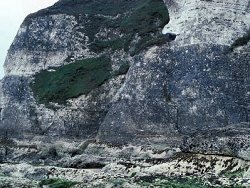
The White Rocks section contains excellent exposures of the Ulster White Limestone Formation and includes the type sections for the Portrush Chalk, Ballymagarry Chalk and Tanderagee Chalk members. The section is representative of the Cretaceous succession of the Rathlin Basin. | |
| Introduction: | |
The Mesozoic rocks at White Rocks outcrop on the north coast of Co. Antrim, 3.25km east of Portrush. The area was mapped and an explanatory memoir produced by Symes et al. (1888). The most detailed descriptions of the sequence are given by Fletcher (1977) and Wilson and Manning (1978). | |
| Description: | |
The Cretaceous exposures from Sliddery Cove into the Long Gilbert Quarry provide the best exposures in the Rathlin Basin of the Ulster White Limestone from the Ballintoy Chalk Member up to the Port Calliagh Chalk Member. Below the Portrush Chalk Member, the North Antrim Hardgrounds in the Glenarm Chalk Member and the Altachuile Breccia at the top of the Ballintoy Chalk Member are well exposed near to Sliddery Cove. 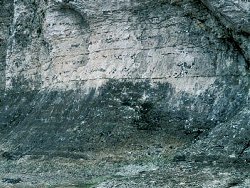 The type section of the Portrush Chalk Member, which corresponds to the `Cardiaster Beds' (Wilson, 1972) is the north wall of the eastern Long Gilbert Quarry, immediately above the main cave which passes under the Portrush to Bushmills Road. The basal contact is drawn at the bedding plane 0.61m below the prominent continuous flint seen at the top of the scree slope leading to the cave; the upper limit is taken at a persistent bedding plane 14.28m above. The Portrush Chalk Member is easily recognised in the field as the unit separating two units with giant flints- flint circles in the Garron Chalk and paramoudras in the over- lying Ballymagarry Chalk Member. The main feature of the Portrush Chalk Member is the fact that the sediment is not as massively bedded as the majority of Ulster White Limestone members. Four distinct beds have been differentiated in the Portrush Chalk Member. Bed A, 4.43m thick, is characterised by tabulate and lensoid flints which tend to be developed along bedding planes. The paucity of fossils in the lower part of the bed contrasts with the richness at higher levels. Bed B, 1.85m thick, has five levels of small, often tabular flints. Bed C, 2.36m thick, has prominent continuous tabular flint marking the base and flattened sponge markings at the top. Bed D, 5.64m thick, has two nearly continuous tabulate flint bands in the middle and the uppermost levels with abundant Inoceramus debris; the base is defined by a prominent marly bedding plane. The type section of the overlying Ballymagarry Chalk Member, equivalent to the `upper belt of giant flints' (Wilson, 1972), is in the south face of the central Long Gilbert Quarry. 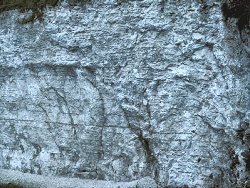 The type section of the Tanderagee Chalk Member is the prominent limestone in the middle of the south face of the central Long Gilbert Quarry. Its base is marked by the Long Gilbert Flint Band and its top is marked by a bedding plane 7.63m above. Five separate beds can be recognised. Bed A, 1.91m thick is faunally characterised by large elongate belemnites in the lowest levels. Bed B, 1.47m thick, is distinguished by numerous echinoderm fragments beneath two prominent closely spaced flint bands in the middle. Bed C, 1.25m thick has three bands of flint, the top of which may lens and form a tabular band. The bed is distinguished by crinoid columnals and a brachiopod level just below the top flint band. Bed D, 2.03m thick, contains a poorly developed bedding plane with occasional small flint nodules near the middle and a double flint band in each half. Bed E, 0.97m thick, contains a prominent flat, nearly continuous flint band 0.22m above the basal bedding plane. | |
| Importance: | |
Pre-basalt erosion has removed virtually all the Cretaceous sediments younger than the Garron Chalk Member from the Larne- Lough Neagh Basin and so the youngest Campanian and Maastrichtian chalk are only preserved in the Lagan Valley, on the Londonderry Shelf and in the Rathlin Basin. The most accessible exposures are those from Sliddery Cove up through the Long Gilbert Quarry which provide excellent exposures that are important in a national context. The White Rocks site includes the type sections for the Portrush Chalk Member, the Ballymagarry Chalk Member and the Tanderagee Chalk Member and it is advised that the site should be conserved. | |
| Interpretation: | |
The time interval represented by the Portrush Chalk Member appears to have been a period of unrest and the wavy nature of much of the sediment in the Rathlin Basin is mirrored by even more intensely disturbed sediments in the south (see Clarehill Quarry, Key Site 1217). The disturbed nature of this member is emphasised by a high shell-debris content, and the number of Inoceramus fragments reaches a maximum. The Long Gilbert Flint Band which is taken to be the position of the Campanian-Maastrichtian boundary, does not maintain its character over long distances and in many places the base of the Tanderagee Chalk Member is marked by a strongly developed flint- free bedding plane. The fauna of the Tanderagee Chalk Member is sufficiently distinct to aid recognition and the change from that in the underlying Ballymagarry Chalk Member can be recognised with relative ease. The belemnites near the base are significantly larger than in the underlying beds. In Bed B the incoming of asteroid and crinoid ossicles is a very important feature and is diagnostic of the remaining levels of the Tanderagee Chalk Member. Within the member there are several bands of thick-tested, depressed, and sub-pyramidal Echinocorys which give the whole fauna a distinct character. | |
| Conclusions: | |
The White Rocks site provides the type section for three of the youngest Campanian and Maastrichtian members of the Ulster White Limestone Formation. From the top of the Ballintoy Chalk Member exposed at Sliddery Cove to the Port Calliagh Chalk Member exposed in Long Gilbert Quarry, it allows the history of chalk sedimentation in the Rathlin Basin to be determined. Also well exposed are the prominent marker bands; the Altachuile Breccia, the North Antrim Hardgrounds and the Long Gilbert Flint Band. The site should be conserved. | |
| Notes: | |
For general information on the Cretaceous System in N. Ireland see Key Site 1194 - The Cretaceous System in N. Ireland - Introduction. For information on other Cretaceous sites see Key Site 1208 - White Park Bay, Key Site 1209 - Dunnaglea-Larry Bane Bay, Key Site 1210 - Port Calliagh-Ballycastle, Key Site 1211 - Capecastle Quarry, Key Site 1212 - Garron Point-Cloghastucan, Key Site 1213 - Glenarm Quarry, Key Site 1214 - Creggan Quarry, Key Site 1215 - Portmuck, Island Magee, Key Site 1216 - White Head, Key Site 1217 - Clarehill Quarry, and Key Site 1218 - Kilcoan, Island Magee. | |
| Keywords | |
|---|---|
| Rocks: | Flint, Limestone |
| Fossil Groups: | Belemnite, Brachiopod, Crinoid, Echinoderm |
| Fossil List: | Echinocorys sp. |
| Relations: | Marine sediments |
| Measurements | |||||
|---|---|---|---|---|---|
| Length: | ~1900 | Width: | Height: | ||
| Depth: | Area: | ||||
| Access | |
|---|---|
| Approach: | 3.25km east of Portrush. Access to the site is from the car park at the western end of the section. |
| Restrictions: | Tidal |
| Management: | |
Parts of the site are only accessible at very low tides and care should be taken with rising tides. Alternative access would be by boat. | |
| References (4) | |||
|---|---|---|---|
| Fletcher, T.P., 1977. Lithostratigraphy of the Chalk (Ulster White Limestone Formation) in Northern Ireland. Report of the Institute of Geological Sciences, vol. 77/14. | |||
| Symes, R.G., Egan, F.W. & McHenry, A., 1888. Explanatory Memoir to accompany Sheets 7 and 8. Memoirs of the Geological Survey of Ireland. | |||
| Wilson, H.E., 1972. Regional Geology of Northern Ireland. HMSO, Belfast. | |||
| Wilson, H.E. & Manning, P.I., 1978. Geology of the Causeway coast. Memoir for one-inch geological sheet 7. Memoirs of the Geological Survey Northern Ireland, HMSO, Belfast. | |||
| Record type: | ESCR report | ||
| Entered by: | E M Porter | ||
| Enlander, I., Dempster, M. & Doughty, P., 2026. White Rocks - Cretaceous, County Antrim, site details. [In] Earth Science Conservation Review. https://www.habitas.org.uk/escr/site.php?item=1207. Accessed on 2026-11-07. |
| Previous Site | Next Site |