
| Previous Site | Next Site |
Earth Science Conservation Review
| White Park Bay | Antrim |
| Site number: | 1208 | ||
| ESCC: | EC | ||
| Locality Type: | Coastal section | Status: | PART ASSI |
| Grid Reference: | D008443,D029449 End(s) of linear site, Not Entered | ||
| Google maps: | 55.23585,-6.4155 | ||
| County: | Antrim | Council area: | Causeway Coast & Glens Borough Council |
| Period: | Cretaceous, Jurassic | ||
| Stages: | Campanian, Cenomanian, Lower Jurassic, Santonian | ||
| Lithostrat: | Ballintoy Chalk Member, Ballymagarry Chalk Member, Boheeshane Chalk Member, Cloghastucan Chalk Member, Creggan Chalk Member, Galboly Chalk Member, Garron Chalk Member, Glenarm Chalk Member, Hibernian Greensands Formation, Larry Bane Chalk Member, Portrush | ||
| Site Description | |
|---|---|
 | |
| Highlights: | |
The White Park Bay section contains important exposures of the Waterloo Mudstone Formation together with excellent outcrop of the Ulster White Limestone Formation including the Oweynamuck Flint Band, the Bendoo Pebble Bed and the Altachuile Breccia. | |
| Introduction: | |
The section at White Park Bay is 10km NW of Ballycastle, Co. Antrim. The Mesozoic rocks exposed include the Waterloo Mudstone Formation, the Hibernian Greensands Formation and the Ulster White Limestone Formation. The area has attracted considerable interest. Coneybeare and Buckland (1816) noted the occurrence of Lias clay and chalk and the area was mapped and an explanatory memoir produced by Symes et al. (1888). Hume (1897) noted the `great thickness of chalk' and the presence of glauconitic sands overlying the Lias. Hancock (1961) described the sequence at the eastern end of the Bay and recognised a basal conglomerate in the Ulster White Limestone Formation which included reworked Lias clays. More recent studies have included those by Fletcher (1977) and Wilson and Manning (1978). Faunal lists of Liassic material from White Park Bay have been given by Portlock (1843), Tate (1870), Charlesworth and Preston (1960), Charlesworth (1963) and Wilson and Manning (1978). | |
| Description: | |
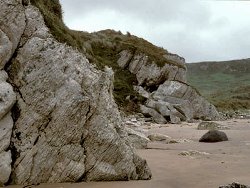
In White Park Bay the Waterloo Mudstone Formation outcrops in a gentle elongate dome bounded to the north by the Port Braddan- Ballintoy Fault. The outcrop is largely covered by landslips of Cretaceous material and accumulations of blown sand and only at three points, two at Oweynamuck and one in a waterfall section west of the school, is the unconformity between the Lias and the Cretaceous basal conglomerate exposed. Exposures of the Waterloo Mudstone Formation are in the toes of landslips and the grey Liassic mudstones are disturbed and often highly inclined. The main exposures are in the east of the Bay, near Oweynamuck. At locality 6 ~9m is exposed dipping steeply in the toe of a landslip. In another landslip exposure (locality 7) ~3m of Lias mudstones are overlain unconformably by a brown phosphatic conglomerate at the base of the Cretaceous. The Lias consists of dark grey, massive and poorly fissile micaceous mudstone, locally silty and calcareous, and containing occasional limestone nodules. Outcrops of Lias occur from time to time amongst the blown sand and landslips below the chalk cliffs. The mudstones contain an extensive fauna of ammonites, bivalves, brachiopods and gastropods. The ammonite faunas include Crucilobiceras, Enderoceras, Gemmellaroceras, `Hemimicroceras', Leptechioceras and Paltechioceras. At Oweynamuck the Lias is overlain by a concentrate of phosphatised pebbles of various provenances enclosed in a matrix of chalk heavily contaminated with glauconite grains. The concentrate is essentially a basal conglomerate incorporating material derived from the Lower Lias, together with lightly phosphatised echinoids and bivalves of Upper Cretaceous age. The basal conglomerate is overlain by a tripartite succession of `Inoceramus' chalk delimited upwards by the Bendoo Pebble Bed. These members, the Galboly Chalk, Cloghastucan Chalk, and the Creggan Chalk are well exposed at Oweynamuck and are 6.7m thick. Within the Cloghastucan Chalk Member, the conspicuous marker band, the Oweynamuck Flint Band is a semicontinuous flint up to 17cm thick and it occurs within a thin bed defined by well- marked bedding planes. At the western end of the Bay, the Bendoo Pebble Bed at the top of the Creggan Chalk Member is exposed. This is an erosion surface with associated glauconitised chalk pebbles. A marked lithological change takes place at this level with only relatively Inoceramus-free chalk found above it. In this part of the Bay the remainder of the Ulster White Limestone Formation from the Boheeshane Chalk Member to the Ballymagarry Chalk Member are exposed. At the top of the Ballintoy Chalk Member is the Altachuile Breccia which is exposed at Port Braddan. 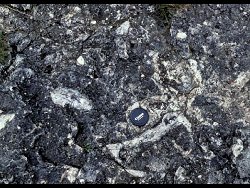 | |
| Importance: | |
The exposures of Mesozoic rocks at White Park Bay are typical of the Rathlin Basin. The Waterloo Mudstone Formation is rarely exposed in North Antrim and these outcrops have provided a diverse fauna. The lowest members of the Ulster White Limestone, the Galboly Chalk, Cloghastucan Chalk including the Oweynamuck Flint Band and the Creggan Chalk members are especially well exposed and are very accessible. This site is of national importance and should be conserved. | |
| Interpretation: | |
The faunal lists of Liassic material from White Park Bay contain ammonites whose identification suggests the presence of zones as low as that of Psiloceras planorbis and also the presence of the Prodactylioceras davoei Zone near the top of the Lias. Wilson and Manning (1978) however found no ammonites from below the raricostatum Zone or above the ibex Zone. Remani‚ Lias fossils found in the basal Cretaceous conglomerate at Oweynamuck include Coroniceras sp. from the Arietites bucklandi Zone, and `Hemimicroceras' and Paltechioceras aff. favrei from the raricostatum Zone. From the waterfall section the conglomerate contained Polymorphites costatus and Uptonia? from the Uptonia jamesoni Zone. On the published map a thin unit classified as the Hibernian Greensands Formation is shown at the base of the Cretaceous succession, resting with a major unconformity on the Lias. This deposit is an erosional relict of the uppermost part of a complex of clastic sediments which spans a stratigraphical range from Cenomanian to Santonian and the bed may be regarded as the basal unit of the Ulster White Limestone Formation. Echinoids collected from Oweynamuck include shape variants of Echinocorys indicative of the highest part of the Micraster coranguinum Zone. No exactly comparable Echinocorys have been found in N. Ireland, but it is thought likely that this fauna equates with that of the Kilcoan Sands Member or the base of the overlying Cloghfin Sponge Beds Member. In view of the fact that only a small fragment of the complex is preserved in the basal conglomerate it is uncertain how much of the Hibernian Greensands Formation was deposited in the Rathlin Basin. It is arguable that the fossils derived from the coranguinum Zone are enclosed in a matrix of post-coranguinum Zone sediment which is contaminated with glauconite derived from the erosion of pre-existing Hibernian Greensands. The Galboly Chalk and Cloghastucan Chalk members demonstrate interrupted sedimentation which is shown by minor discontinuous erosion surfaces marked by the concentration of rounded glauconitised chalk pebbles. Many of the planes etched out in the air-weathered section at Oweynamuck are probably the result of secondary diagenesis rather than primary sedimentary features, and their value in correlation is limited. The Altachuile Breccia was interpreted by Fletcher (1977) as the result of wave action on partially consolidated sediment during a period of violent weather conditions such as a hurricane. | |
| Conclusions: | |
The White Park Bay site provides an opportunity for the history of chalk sedimentation in the Rathlin Basin to be studied. Particularly well exposed are the basal Inoceramus chalk members of the Ulster White Limestone Formation. Three of the prominent marker bands used to subdivide the formation are well developed. The site should be conserved. | |
| Notes: | |
For general information on the Cretaceous System in N. Ireland see Key Site 1194 - The Cretaceous System in N. Ireland - Introduction. For information on other Cretaceous sites see Key Site 1207 - White Rocks - Cretaceous, Key Site 1209 - Dunnaglea-Larry Bane Bay, Key Site 1210 - Port Calliagh-Ballycastle, Key Site 1211 - Capecastle Quarry, Key Site 1212 - Garron Point-Cloghastucan, Key Site 1213 - Glenarm Quarry, Key Site 1214 - Creggan Quarry, Key Site 1215 - Portmuck, Island Magee, Key Site 1216 - White Head, Key Site 1217 - Clarehill Quarry, and Key Site 1218 - Kilcoan, Island Magee. | |
| Keywords | |
|---|---|
| Rocks: | Conglomerate, Flint, Limestone, Mudstone |
| Fossil Groups: | Ammonite, Bivalve, Brachiopod, Gastropod |
| Fossil List: | Paltechioceras sp. |
| Relations: | Marine sediments |
| Measurements | |||||
|---|---|---|---|---|---|
| Length: | ~3000 m | Width: | Height: | ||
| Depth: | Area: | ||||
| Access | |
|---|---|
| Approach: | Access to the site is from Port Braddan and from the car park at White Park Bay. |
| Management: | |
New exposures will occur with shifting of the sands and minor landslips. | |
| References (10) | |||
|---|---|---|---|
| Charlesworth, J.K., 1963. Historical Geology of Ireland., pp.565 Oliver and Boyd, London. | |||
| Charlesworth, J.K. & Preston, J., 1960. Geology around the University Towns: North-East Ireland, The Belfast Area. Geological Association Guide, numb. 18. | |||
| Conybeare, W. & Buckland, W., 1816. Descriptive notes referring to the outline of sections presented by a part of the coasts of Antrim and Derry. Transactions of the Geological Society of London, vol. 3, pp.196-216. | |||
| Fletcher, T.P., 1977. Lithostratigraphy of the Chalk (Ulster White Limestone Formation) in Northern Ireland. Report of the Institute of Geological Sciences, vol. 77/14. | |||
| Hancock, J.M., 1961. The Cretaceous System in Northern Ireland. Quarterly Journal of the Geological Society of London, vol. 117, pp.11-36. | |||
| Hume, W.F., 1897. The Cretaceous strata of County Antrim. Quarterly Journal of the Geological Society of London, vol. 53, pp.540-606. | |||
| Portlock, J.E., 1843. Report on the Geology of the County of Londonderry and of parts of Tyrone and Fermanagh. HMSO, Dublin. | |||
| Symes, R.G., Egan, F.W. & McHenry, A., 1888. Explanatory Memoir to accompany Sheets 7 and 8. Memoirs of the Geological Survey of Ireland. | |||
| Tate, R., 1870. Note on the Middle Lias in the NE of Ireland. Quarterly Journal of the Geological Society of London, vol. 23, pp.15-44. | |||
| Wilson, H.E. & Manning, P.I., 1978. Geology of the Causeway coast. Memoir for one-inch geological sheet 7. Memoirs of the Geological Survey Northern Ireland, HMSO, Belfast. | |||
| Record type: | ESCR report | ||
| Entered by: | E M Porter | ||
| Enlander, I., Dempster, M. & Doughty, P., 2026. White Park Bay, County Antrim, site details. [In] Earth Science Conservation Review. https://www.habitas.org.uk/escr/site.php?item=1208. Accessed on 2026-11-07. |
| Previous Site | Next Site |