
| Previous Site | Next Site |
Earth Science Conservation Review
| Glenarm Quarry | Antrim |
| Site number: | 1213 | ||
| ESCC: | ED | ||
| Locality Type: | Quarry (disused) | Status: | ESCR |
| Grid Reference: | D304156 Centroid | ||
| Google maps: | 54.9713,-5.96366 | ||
| County: | Antrim | Council area: | Mid & East Antrim Borough Council |
| Period: | Cretaceous | ||
| Stages: | Campanian | ||
| Lithostrat: | Glenarm Chalk Member, Ulster White Limestone Formation | ||
| Site Description | |
|---|---|
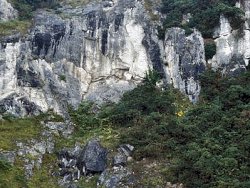 | |
| Highlights: | |
The site is the type locality for the Campanian Glenarm Chalk Member of the Ulster White Limestone Formation and is illustrative of chalk sedimentation in the Larne-Lough Neagh Basin. | |
| Introduction: | |
This site lies 1km NW of Glenarm, Co. Antrim in Parishagh townland in an area of pronounced landslipping. The area was mapped and an explanatory memoir produced by Symes and McHenry (1886). The most recent study was by Fletcher (1977). | |
| Description: | |
This description is confined to the Glenarm Chalk Member for which it is the type section. The Glenarm Chalk Member conformably overlies the Ballintoy Chalk Member. Unlike the evidence given by the North Antrim Hardgrounds in the Rathlin Basin, the only indication of interrupted sedimentation in the Larne-Lough Neagh Basin is provided by wavy bedding, associated locally with scattered green glauconitised pebbles. The member is delimited at the base by the weathered out bedding plane immediately overlying the Altachuile Breccia and at the top by a similar weathered bedding plane 8.10m above. Four beds (A-D) can be distinguished by subdivision at bedding planes and three belts of different flint types can be recognised. A basal belt contains small nodular flints which provide a marked contrast with the thin tabular flints in the upper levels of the Ballintoy Chalk Member. Within the middle belt sediment exhibits wavy bedding and flints tend to be tabular, especially in the upper part. The lower flints are more nodular. The upper belt has massive nodular flints below succeeded by thin tabular flints; a 0.03m tabular bed is developed locally just below the top of the member. The higher part of this belt is marked by the appearance in quantity of fragments of Inoceramus shell. | |
| Importance: | |
This is the type section of the Glenarm Chalk Member of the Ulster White Limestone Formation. It provides the thickest sequence in the member and provides details not available elsewhere because of non-sequences or the influence of more positive areas. It is of national importance and should be conserved. | |
| Interpretation: | |
In the Rathlin Basin the flintless band is occupied by a strongly developed hardground with associated pebble bed with a second hardground 0.5m below. This hardground complex has been termed the North Antrim Hardgrounds (Fletcher, 1977). The marked litho- logical change to chalk with massive flint nodules is paralleled by an equally significant faunal break recognised at the base of the flintless zone some 0.5m below the top of Glenarm C. These changes correspond with those described in the mucronata Zone chalk of Norfolk (Peake & Hancock, 1961). This important hardground recognised at the same position in two widely separated areas of sedimentation points to temporary shallowing on a widespread scale. The Glenarm Chalk Member reaches its maximum development in the Larne-Lough Neagh Basin and is slightly reduced in the Rathlin Basin where the non-sequences associated with the hardgrounds occur. Towards the Londonderry Shelf the Glenarm Chalk Member becomes further attenuated and includes several non-sequences. In the Lagan Valley in many parts the Glenarm Chalk Member is absent and the Garron Chalk member rests directly on a pre-Larry Bane Chalk Member sequence. | |
| Conclusions: | |
The quarry at Parishagh is the type section for the Campanian Glenarm Chalk Member of the Ulster White Limestone Formation. It is illustrative of chalk sedimentation in the Larne-Lough Neagh Basin and allows for comparison with these beds elsewhere. It should be conserved. | |
| Notes: | |
For general information on the Cretaceous System in N. Ireland see Key Site 1194 - The Cretaceous System in N. Ireland - Introduction For information on other Cretaceous sites see Key Site 1207 - White Rocks - Cretaceous, Key Site 1208 - White Park Bay, Key Site 1209 - Dunnaglea-Larry Bane Bay, Key Site 1210 - Port Calliagh-Ballycastle, Key Site 1211 - Capecastle Quarry, Key Site 1212 - Garron Point-Cloghastucan, Key Site 1214 - Creggan Quarry, Key Site 1215 - Portmuck, Island Magee, Key Site 1216 - White Head, Key Site 1217 - Clarehill Quarry, and Key Site 1218 - Kilcoan, Island Magee. | |
| Keywords | |
|---|---|
| Rocks: | Flint, Limestone |
| Fossil Groups: | Belemnite, Sponge |
| Fossil List: | Echinocorys ex. gr. subglobosus, Inoceramus sp. |
| Relations: | Marine sediments |
| Measurements | |||||
|---|---|---|---|---|---|
| Length: | Width: | Height: | ~10 m | ||
| Depth: | Area: | ||||
| Access | |
|---|---|
| Approach: | 1km NW of Glenarm. Access to the site is from the gateway leading into the quarry. |
| Management: | |
At present it is beginning to become overgrown but some structures are still well exposed. The main danger to the site would be from landfill. | |
| Threats: | Use as a landfill site. |
| References (3) | |||
|---|---|---|---|
| Fletcher, T.P., 1977. Lithostratigraphy of the Chalk (Ulster White Limestone Formation) in Northern Ireland. Report of the Institute of Geological Sciences, vol. 77/14. | |||
| Peake, N.B. & Hancock, J.M., 1961. The Upper Cretaceous of Norfolk. Transactions of the Norfolk & Norwich Naturalists Society, vol. 19, pp.239-339. | |||
| Symes, R.G & McHenry, A., 1886. Explanatory memoir to accompany sheet 14. Memoirs of the Geological Survey of Ireland. | |||
| Record type: | ESCR report | ||
| Entered by: | E M Porter | ||
| Last updated: | 6 Jun 2005 | ||
| Enlander, I., Dempster, M. & Doughty, P., 2026. Glenarm Quarry, County Antrim, site details. [In] Earth Science Conservation Review. https://www.habitas.org.uk/escr/site.php?item=1213. Accessed on 2026-11-06. |
| Previous Site | Next Site |