
| Previous Site | Next Site |
Earth Science Conservation Review
| White Head | Antrim |
| Site number: | 1216 | ||
| ESCC: | EF | ||
| Locality Type: | Coastal section | Status: | ESCR |
| Grid Reference: | J475913 Centroid | ||
| Google maps: | 54.74843,-5.70926 | ||
| County: | Antrim | Council area: | Mid & East Antrim Borough Council |
| Period: | Cretaceous | ||
| Stages: | Santonian | ||
| Lithostrat: | Cloghfin Sponge Beds Member, Ulster White Limestone Formation | ||
| Site Description | |
|---|---|
 | |
| Highlights: | |
White Head is the type section for the Cloghfin Sponge Beds Member, the basal member of the Ulster White Limestone Formation. | |
| Introduction: | |
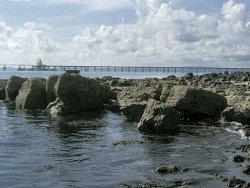
The White Head site is on the foreshore on the east coast of Co. Antrim, immediately south of the town of Whitehead. The Cretaceous sequence from the Cloghfin Sponge Beds Member to the Glenarm Chalk Member of the Ulster White Limestone Formation is unconformably overlain by Palaeogene basalts. Hume (1897) called the basal beds of the White Limestone, the `Spongiarian Zone' and stated that `in the lower portion the sponges are closely crowded'. The area was mapped and an explanatory memoir produced by Hull (1876). Hancock (1961) renamed the bed the `Sponge Bed'. The lowest part of the Ulster White Limestone Formation was described by Reid (1964). More recent studies have been by Fletcher (1977) who called the bed the Cloghfin Sponge Beds Member, and Griffith and Wilson (1982). | |
| Description: | |
At White Head the Cloghfin Sponge Beds Member reaches its maximum thickness of 1.73m. Three separate beds can be seen. The basal bed takes on a distinctive cobbly appearance on weathering and it has been referred to as the `cobble bed'. Bed B consists of more evenly bedded and slightly less glauconitic chalk with a high proportion of orange-brown pseudomorphs, these being particularly common near the base. Bed C is also rich in sponges, but it is only sparsely glauconitic. The marked wavy bedding tends to be accentuated by weathering giving this a distinctive appearance. Bed C terminates in a bedding plane and is overlain by a thin (0.18m) unit of parallel bedded limestone containing pale yellow sponges; this is the base of the Galboly Chalk Member. The famous sponge fauna comprises almost exclusively hexactinellids, of which typical species are Camerospongia fungiformis, Etheridgia mirabilis, Eurete cf. formosum, Leptophragma striatopunctata, Rhizopoterian spp., and Wollemannia laevis; the only lithistid, Callopegma obconicum, is rare. | |
| Importance: | |
The section at White Head is the type section of the Cloghfin Sponge Beds Member of the Ulster White Limestone Formation and is also the thickest occurrence of that member. It is of national importance and should be conserved. | |
| Interpretation: | |
The sponges show much evidence of reworking and are believed to be derived. Reid (1958) recognised two faunal divisions based on the common species of Rhizopoterion: a lower division characterised by R. cf. tubiforme and an upper division with R. cribosum in which the sponges are more complete and less strongly phosphatised. The boundary between these two faunal divisions appears to fall within Bed C. All three beds of the Cloghfin Sponge Beds Member yield the characteristic flat-topped variants of Echinocorys which characterise the Uintacrinus socialis Zone in southern England. Actinocamax verus enters at the base of Bed B and is not uncommon: this belemnite is particularly characteristic of the socialis Zone in southern England, and its occurrence in the Cloghfin Sponge Beds Member together with the flat topped Echinocorys appears to support a socialis age for the whole member, with the sponges having been reworked from sediments of latest coranguinum age. No definite specimens of the zonal index fossil have been found to date but worn and indeterminate crinoid brachials are known from Bed C. The site lies within the Hillsport Basin, and the Cloghfin Sponge Beds Member thins rapidly to the south and does not occur on the Knockagh Axis. | |
| Conclusions: | |
The exposure at White Head has attracted much attention. It is the type section of the basal member of the Ulster White Limestone Formation, the Cloghfin Sponge Beds Member. It is the thickest sequence of this member in the Hillsport Basin, indeed in N. Ireland. The rapid cutting out of the member to the south can be attributed to the Knockagh Axis, an important more positive area during chalk sedimentation. | |
| Notes: | |
For general information on the Cretaceous System in N. Ireland see Key Site 1194 - The Cretaceous System in N. Ireland - Introduction. For information on other Cretaceous sites see Key Site 1207 - White Rocks - Cretaceous, Key Site 1208 - White Park Bay, Key Site 1209 - Dunnaglea-Larry Bane Bay, Key Site 1210 - Port Calliagh-Ballycastle, Key Site 1211 - Capecastle Quarry, Key Site 1212 - Garron Point-Cloghastucan, Key Site 1213 - Glenarm Quarry, Key Site 1214 - Creggan Quarry, Key Site 1215 - Portmuck, Island Magee, Key Site 1217 - Clarehill Quarry, and Key Site 1218 - Kilcoan, Island Magee. | |
| Keywords | |
|---|---|
| Rocks: | Limestone |
| Fossil Groups: | Belemnite, Sponge |
| Fossil List: | Actinocamax verus , Camerospongia fungiformis , Etheridgia mirabilis , Leptophragma striatopunctata , Rhizopoterion cribosum |
| Relations: | Marine sediments |
| Access | |
|---|---|
| Approach: | Immediately south of the town of Whitehead. Access to the site is from the parking area south of the railway station via a tunnel under the railway line. |
| References (8) | |||
|---|---|---|---|
| Fletcher, T.P., 1977. Lithostratigraphy of the Chalk (Ulster White Limestone Formation) in Northern Ireland. Report of the Institute of Geological Sciences, vol. 77/14. | |||
| Griffith, A.E. & Wilson, H.E., 1982. Geology of the country around Carrickfergus and Bangor. Memoir of the Geological Survey of Northern Ireland, Sheet 29 (N. Ireland). | |||
| Hancock, J.M., 1961. The Cretaceous System in Northern Ireland. Quarterly Journal of the Geological Society of London, vol. 117, pp.11-36. | |||
| Hull, E., 1876. The country around Antrim, Larne and Carrickfergus. Memoirs of the Geological Survey of Ireland. | |||
| Hume, W.F., 1897. The Cretaceous strata of County Antrim. Quarterly Journal of the Geological Society of London, vol. 53, pp.540-606. | |||
| Reid, R.E.H., 1958. Remarks on the Upper Cretaceous Hexactinellida of County Antrim. Irish Naturalists Journal, vol. 12, pp.236-243. | |||
| Reid, R.E.H., 1964. The Lower (pre-Belemnitella mucronata) White Limestone of the east and north-east of County Antrim. Irish Naturalists Journal, vol. 17, pp.105-129. | |||
| Reid, R.E.H., 1971. The Cretaceous rocks of north-eastern Ireland. Irish Naturalists Journal, vol. 1, pp.105-129. | |||
| Map(s): | GSNI (1994) 1:50,000 Geological Sheet 21 (Larne). | ||
| Record type: | ESCR report | ||
| Entered by: | E M Porter | ||
| Enlander, I., Dempster, M. & Doughty, P., 2026. White Head, County Antrim, site details. [In] Earth Science Conservation Review. https://www.habitas.org.uk/escr/site.php?item=1216. Accessed on 2026-11-07. |
| Previous Site | Next Site |