
| Previous Site | Next Site |
Earth Science Conservation Review
| Eagles Rocks | Tyrone |
| Site number: | 129 | ||
| ESCC: | EO | ||
| Locality Type: | Crag, Crags | Status: | ESCR |
| Grid Reference: | H717838 Centroid | ||
| Google maps: | 54.6976,-6.88792 | ||
| County: | Tyrone | Council area: | Mid Ulster District Council |
| Period: | Precambrian | ||
| Stages: | Moinian | ||
| Lithostrat: | Central Tyrone Inlier, Corvanaghan Formation | ||
| Site Description | |
|---|---|
 | |
| Highlights: | |
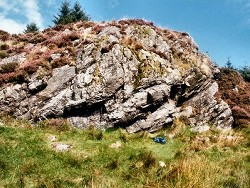
The site contains high quality outcrops of the Corvanaghan Formation allowing study of lithological variation within the Formation as well as structural features such as beddingcleavage relationships and folding. | |
| Introduction: | |
Eagles Rock forms part of the pre-Dalradian (Moinian?) Central Tyrone Inlier. The site consists of a series of crags and is located in the southern corner of Davagh Forest, about 3km north-east of Dunnamore. Access to the site is gained from the forest track which skirts the southern slope of Beleevnamore Mountain then, leaving by the path at [H710 840] and trekking across recently forested peat moorland. Portlock (1843) mapped the lenticular form of the Central Inlier, and distinguished its rocks from the "Metamorphic Rocks (hornblendic type)" which surround it (Tyrone Volcanic Group and Tyrone Plutonic Complex, Geological Survey of Northern Ireland, 1995). However, Portlock failed to differentiate between the "Mica Schists" of the Inlier and the Dalradian rocks which form the nearby southern Sperrin Mountains. On the first edition of the one inch to one mile scale geological map (Geological Survey of Ireland Sheet 26 (Draperstown) 1882), rocks in the area of the Central Tyrone Inlier were described as "Schists and Gneisses". Although the metasedimentary lithologies of the Inlier were clearly distinguished from the surrounding "Pyroxene Rocks" of the Tyrone Plutonic Complex, both were nevertheless categorised as, "Probably of Pre-Cambrian or Upper Laurentian age". In the Geological Memoir which accompanied Sheet 26, Nolan (1884) outlined key differences between "schist and gneiss" in the central portion of the Tyrone Inlier and chloritic schists elsewhere on the map (Tyrone Volcanic Group and Dalradian). Nolan also described, the lithologies of the Central Inlier in some detail, and what was thought to be a gradational boundary between the quartzose schist and gneiss at the core of the Inlier and the surrounding hornblendic rocks (Tyrone Plutonic Complex). Cole (1900) presented a more detailed description of the petrology of what he referred to as the "Central Axis" in Tyrone. He stated that "the gneissic core of eastern Tyrone appear to owe it's characters to the intimate intrusion of ancient aplitic granite magma into pre-existing and fairly basic schists". Cole's interpretation differed from Nolan's and Portlock's in one key respect. Cole observed that the gabbros and the granite of Slieve Gallion were emplaced successively either side of, but did not seem to have penetrated, a pre-existing gneissic mass. Hartley (1933) considered the Central Tyrone Inlier to be Dalradian. He produced the earliest detailed maps of the Inlier and described the rocks as "granulitic quartz-feldspar biotite schists and muscovite-biotite gneisses". Hartley believed that these rocks most likely originated as, "a recrystallised ... and highly folded series of banded arenaceous and argillaceous sediments". He viewed the Central Inlier simply as a repetition of the "Sperrin Schists" and claimed that the higher (sillimanite) metamorphic grade of the Inlier was a result of impregnation of the Central Inlier by granitic veins. During the 1960's, the Geological Survey of Northern Ireland mapped the south-western end of the Tyrone Inlier. On the second edition of the Geological Survey Sheet 34 (Pomeroy, Geological Survey of Northern Ireland, 1979) a clear distinction was made between "siliceous granulite and quartzo-feldspathic gneiss" of the Central Inlier (referred to for the first time as the Corvanaghan Formation), and the surrounding Tyrone Basic Plutonic Complex. Both groups of rock were however still ascribed a Dalradian age and it was observed that the Central Inlier was unconformably overlain by the Ordovician volcanic rocks of the Tyrone Volcanic Group (Cobbing et al., 1965; Geological Survey of Northern Ireland, 1979). The most recent data available (Hutton, pers. comm.; Earls et al., 1996) indicates that the Tyrone Central Inlier is in the region of 650Ma based on Rb-Sr dates for muscovite and feldspars in two pegmatites which cross-cut the Inlier. Furthermore, Hutton has pointed to the presence of significant hornblende, biotite, chlorite (green bed?) assemblages which may indicate an affinity with the Grenville Terranes of Northern America rather than with other Northern British Moinian Terranes. | |
| Description: | |
Eagles Rocks lie directly SE of the Beleevnamore Fault, a major structure which marks the NW boundary of the Tyrone Central Inlier. The site contains abundant outcrop of pale grey and buff weathered, well foliated, granuloblastic, quartz-feldspar-biotite psammite, quartz-biotite semipelite and pale grey arkose or arkosic quartzite?.
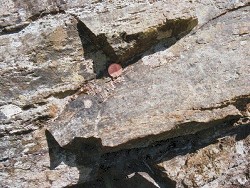 These strata are lithologically banded with bedding parallel to the dominant regional schistosity. Both sets of structure dips at between 25° and 45° W. In some of the more quartzitic and arkosic lithologies it is possible to recognise weak variegated laminations which may represent original fine-scale sedimentary bedding. These beds also have what appear to be channel-like bed-forms. It is apparent that all rocks at this site have experienced a complex deformation. There are numerous tight minor folds and large quartz augens defined by the deformation of the very early-formed quartz "sweats". However, the predominantly arenaceous nature of the rocks mitigates against the formation and preservation of multiple cleavages seen elsewhere in the Central Tyrone Inlier. | |
| Importance: | |
Eagle Rocks is a site of national importance offering access to a wide variety of mainly arenaceous strata, representative of the Corvanaghan Formation. The site is of particular interest because of the presence of quartzitic and arkosic lithologies not commonly seen elsewhere in the Central Tyrone Inlier. | |
| Interpretation: | |
The rocks at this site are part of the Central Tyrone Inlier, a fragment of pre-Dalradian Proterozoic crust which now forms part of the Tyrone-Girvan Sub-Terrane of the Midland Valley Terrane (Bluck et al., 1992). Some doubts still surround the exact status and origin of these rocks and the fact that the Central Inlier is in sheared and faulted contact with the surrounding rocks (Tyrone Intrusive Complex) only serves to obscure the status of the Inlier. The predominance of quartz and alkali feldspar rich psammites and schists points to a predominantly siliciclastic sedimentary protolith. However, recently it has been suggested (Hutton, pers. comm.) that the inlier may be more mafic than hitherto thought. Hutton has pointed to certain lithological similarities with the Grenvillian "greenstone" belts in North America and has also raised the possibility that the Central Inlier may be part of a Gondwanaland Type Assemblage and therefore have shared affinities with basement in southern rather than northern Britain. During pre-Caledonian times, the rocks of the Central Inlier underwent intense deformation resulting in at least 3 identifiable phases of folding. This deformation was accompanied by high grade metamorphism (sillimanite grade). The Central Tyrone Inlier could conceivably represent in situ autochthonous metamorphic basement to the Midland Valley Terrane, alternatively, and more likely, it may be an allochthonous terrane, a slice of basement formed elsewhere and transposed to it's present position by major sinistral strike slip or transpressional faulting (Hutton, 1987). | |
| Conclusions: | |
Eagles Rock is a site of national importance offering an opportunity to study a wide range of lithologies and structures representative of the Corvanaghan Formation. This site forms an important part of the Central Tyrone Inlier which remains one of the least understood and most enigmatic component "terranes" of the Precambrian basement of Northern Ireland and will no doubt be the subject of future scientific studies. | |
| Notes: | |
For information and references on other sites within the Pre-Dalradian Central Tyrone Inlier see the following site: Key Site 128 - Oughtmore Mountain For information and references on sites within the Pre-Dalradian Lough Derg Inlier see the following sites: Key Site 125 - Croagh Mountain Key Site 126 - Gadalough Key Site 127 - Larkhill For general information on the Pre-Dalradian rocks of Northern Ireland see the following site: Key Site 123 - The Pre-Dalradian Rocks of Northern Ireland For information on the Dalradian rocks of Northern Ireland see the following site: Key Site 124 - The Dalradian Rocks of Northern Ireland For general information and an extensive reference list on the Precambrian of Northern Ireland see the following site: Key Site 122 - An Introduction to the Precambrian of Northern Ireland | |
| Keywords | |
|---|---|
| Rocks: | Arkose, Pelitic rock, Psammite, Quartzite, Semi-pelitic rock |
| Structures: | boudinage |
| Access | |
|---|---|
| Approach: | Access to the site is gained from the forest track which skirts the southern slope of Beleevnamore Mountain then, leaving by the path at [H710 840] and trekking across recently forested peat moorland. |
| Management: | |
The site is located within the southern part of Davagh Forest in an area of recently planted trees. To date the planting has not obscured any of the key outcrops at Eagles Rock or compromised access to it. However, continued vigilance is necessary to maintain access, especially if, at some future date, Davagh Forest is extended towards the south. The principle features of geological interest can be seen at a number of alternative outcrops within the limit of the site, consequently there is no reason to impose sampling or hammering restrictions. | |
| References (8) | |||
|---|---|---|---|
| Bluck, B.J., Gibbons, W. & Ingham, J.K., 1992. Terranes Memoirs of the Geological Society of London, vol. 13 In Atlas of palaeogeography and lithofacies, pp.1-4. | |||
| Cobbing, E.J., Manning, P.I. & Griffith, A.E., 1965. Ordovician-Dalradian Unconformity in Tyrone Nature, vol. 206 numb. 4989, pp.1132-1135. | |||
| Cole, G.A.J., 1900. On metamorphic rocks in eastern Tyrone and southern Donegal Transactions of the Royal Irish Academy, vol. 31, pp.431. | |||
| Earls, G., Hutton, D.W., Wilkinson, J., Moles, N., Parnell, J., Fallick, A. & Boyce, A., 1996. The gold metallogeny of north-west Northern Ireland Geological Survey of Northern Ireland, Technical Report, numb. GSNI/96/6 GSNI. | |||
| Hartley, J.J., 1933. The geology of north-eastern Tyrone and the adjacent parts of County Londonderry Proceedings of the Royal Irish Academy, vol. 41 pt. B. | |||
| Hutton, D.H.W., 1987. Strike-slip terranes and a model for the evolution of the British and Irish Caledonides Geological Magazine, vol. 125 pt. 5, pp.405-425. | |||
| Nolan, J., 1884. Explanatory memoir to accompany Sheet 26 of the maps of the Geological Survey of Ireland Memoirs of the Geological Survey of Ireland. | |||
| Portlock, J.E., 1843. Report on the Geology of the County of Londonderry and of parts of Tyrone and Fermanagh. HMSO, Dublin. | |||
| Map(s): | GSI (1882). 1:63,360 Geological Sheet 26 (Draperstown), Dublin, OS for GSI GSNI (1979). 1:50,000 Pomeroy, Northern Ireland Sheet 34, Solid, Southampton, OS for GSNI GSNI (1995). 1:50,000 Draperstown, Northern Ireland Sheet 26, Solid, BGS, Keyworth, Nottingham | ||
| Record type: | ESCR report | ||
| Entered by: | E M Porter | ||
| Last updated: | 6 Jun 2005 | ||
| Enlander, I., Dempster, M. & Doughty, P., 2026. Eagles Rocks, County Tyrone, site details. [In] Earth Science Conservation Review. https://www.habitas.org.uk/escr/site.php?item=129. Accessed on 2026-11-06. |
| Previous Site | Next Site |