
| Previous Site | Next Site |
Earth Science Conservation Review
| Craig | Tyrone |
| Site number: | 131 | ||
| ESCC: | EO | ||
| Locality Type: | Crag, Crags, Pit | Status: | ESCR |
| Grid Reference: | H523981 Centroid | ||
| Google maps: | 54.82843,-7.1862 | ||
| County: | Tyrone | Council area: | Derry City & Strabane District Council |
| Period: | Precambrian | ||
| Stages: | Dalradian | ||
| Lithostrat: | Dungiven Formation | ||
| Site Description | |
|---|---|
 | |
| Highlights: | |
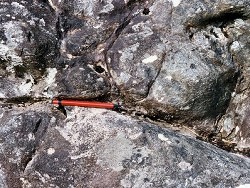
Craig offers an excellent opportunity to examine exposures of pillowed basalt lavas which form part of the Dungiven Formation (Middle Dalradian). These lavas retain many original morphological features despite having undergone regional metamorphism and deformation. Within this comparatively compact site, there are exposures of other rock types commonly associated with the Dungiven Formation. | |
| Introduction: | |
Craig is located in Carrickayne Townland about 8 km north-east of Plumbridge on the Carrickayne Road between Plumbridge and Park. The site straddles the Carrickayne Road and consists of a series of craggy outcrops and a pit in close proximity to the small cluster of dwellings and outbuildings. The rocks at Craig all belong to the Dungiven Formation, the uppermost lithostratigraphic division of the Tayvallich Subgroup of the Argyll Group (Middle Dalradian) in the Sperrin Mountains, see table below. The predominant lithology at Craig is basaltic pillow lava. These rocks were originally represented as basaltdolerite intrusions on the first edition of the one-inch geological map (Geological Survey of Ireland, 1884) and in the accompanying memoir (Nolan et. al., 1884) they were described as "peculiar green rock (which)....forms a boss on the roadside at Craig, associated with limestone". Hartley (1938) referred to the basic rocks at Craig as epidiorites (extrusive type) and correlated them with outcrops of similar rocks in both directions along strike, at Butterlope and at Stranagalwilly. He also correctly identified these as pillow lavas comparing them with the pillow lavas at Artigarvan and Strabane which had recently been described by McCallien (1936). Hartley mapped the "extrusive epidiorites" as a discrete horizon but did not include them as part of the Dungiven Formation. Arthurs (1976) broadened the definition of the Dungiven Formation to include the basic lavas and arenaceous rocks as well as the limestone, and it is this broader definition which remains in current usage. TABLE TO BE ADDED Dalradian stratigraphy and ESCR sites in the southern Sperrin Mountains. | |
| Description: | |
The principle outcrop at Craig is situated [H524 981], directly north of the Carrickayne Road and consists of massive, fine-grained, equigranular, amphibolitised basalt pillow lavas. These rocks have experienced variable tectonic strain and have developed a weak bedding parallel foliation (140/35NE) with some tectonic stretching (plunging 20/058), the latter causing some elongation and rodding of the pillow structures. Individual pillows are up to 1m in diameter and, despite deformation, retain many original morphological features including, clearly visible chilled margins or "skins", gas vesicles and radial fracture patterns. Most pillows display the classic tripartite junctions with adjacent pillows and many have characteristic compaction features such as flattened bottoms and sagging which indicate that the succession is probably right-way up and is younging towards the north-east. Hartley (1938) found that the pillow lavas and the deeply weathered "spongy" inter-pillow material have broadly comparable mineralogy and concluded that the material between the pillows, which now consists of zoisite, quartz and actinolitic amphibole, may represent a highly altered "sediment" of similar composition to the pillow lavas. South of the Carrickayne Road, further outcrops of lava occur at the western edge of the site [H522 979]. Although these rocks are more strongly deformed and have a variably penetrative schistosity, they still display some pillow forms which indicate that both dip and direction of younging is towards the NE. Other metasedimentary components of the Dungiven Formation occur in the vicinity of Craig. There are outcrops of light grey coloured, massive crystalline limestone in a small disused quarry pit at [H5245 9798] about 150m east of the main dwellings at Craig. This limestone appears to be separated from the overlying pillow lavas by a mixed arenaceous member comprising coarse-grained quartz-biotite psammite with distinctive blue detrital quartz, semipelite and black pelitic schist. This mixed unit is well exposed at a locality close to and just north of the Carrickayne Road [H526 982]. At this outcrop, the strata are folded about a NE plunging minor fold axis (F3?) and have a strongly crenulating axial planar crenulation fabric (S3?). | |
| Importance: | |
The Craig site contains outcrops of relatively undeformed Dalradian pillow lava of a quality unrivalled elsewhere in Northern Ireland and offers a unique opportunity to study morphological features diagnostic of pillow lavas. Tentative correlations already suggested between the Craig and the Artigarvan and Strabane pillow lavas (Hartley, 1938) remain to be tested by the Geological Survey of Northern Ireland's ongoing mapping programme. There is a high probability that the outcrops at Craig will continue to play an important role in helping to understand the stratigraphy and structure of the Sperrin Mountains. It is also likely that the Craig lavas will feature in petrological and geochemical studies currently been planned to characterise Middle Dalradian volcanic activity in Northern Ireland and Scotland. | |
| Interpretation: | |
The Craig pillow lavas represent a major volcanic interval within the Dalradian stratigraphy. The close association of lava, limestone and quartzite indicates that volcanic activity took place within or in close proximity to the comparatively shallow water of a marine shelf environment. The extent to which the lavas interacted with water during or after eruption must remain open to question. Gower (1972) claimed not to have recognised many of the classic pillow lava features (chilled skins, concentric amygdale trails, way up criteria) at Craig. Gower also suggested that the fact that the pillows and the pillow matrix have similar composition pointed to a "budding" process from a parental flow and that the pillows, "probably formed at the top of a body of magma which intruded at a shallow depth into unconsolidated sediment". | |
| Conclusions: | |
Craig is an outstanding site which has featured in the geological literature for many years. The site contains the best exposure of Dalradian pillow lavas in Northern Ireland and will continue to be a key locality for those studying the Dungiven Formation and volcanic rocks within the Dalradian. | |
| Notes: | |
For site specific information and references on other Dalradian sites in the Sperrin Mountains, Londonderry and Tyrone see the following sites: For Central and Southern Sperrin Mountains: Key Site 130 - Butterlope Glen Key Site 132 - Mullaghcarbatagh Key Site 133 - Henry's Bridge, Glensass Burn Key Site 134 - Oughtboy Burn Key Site 135 - Garvagh Burn Key Site 136 - Barnes Gap Key Site 137 - Barnes Burn Key Site 138 - Golan Burn Key Site 139 - Glendarragh Burn, Glenlark Key Site 140 - Mountfield Old Quarry Key Site 141 - McNally's Burn, Broughderg For North Sperrin Mountains and Londonderry: Key Site 142 - Letterbrat Quarry Key Site 143 - Banagher Glen Quarry Key Site 144 - Strabane Quarry Key Site 145 - Glenmornan River, Artigarvan Key Site 146 - Balix Hill Key Site 147 - Drain Quarry Key Site 148 - Kildoag Quarry Key Site 149 - Loughermore Mountain Key Site 150 - Burntollet and Tamnymore Wood Key Site 151 - Dog Leap, Limavady Key Site 152 - Kittybane Quarry Key Site 153 - Prehen Quarry Key Site 154 - Creevagh Hill Old Quarry For site specific information and references on other Dalradian sites in North-east Antrim see the following sites: Key Site 155 - Benvan Key Site 156 - Escort Port Key Site 157 - Torr Head Key Site 158 - Altmore Burn Key Site 159 - Leckpatrick Point Key Site 160 - Carnaneigh Key Site 161 - Loughan Bay Key Site 162 - Loughareema Channel Key Site 163 - Knocknacarry Bridge Key Site 164 - Cushendun Bay and Rock Port For general information on the Dalradian rocks of Northern Ireland see the following site: Key Site 124 - The Dalradian Rocks of Northern Ireland For general and site specific information on the Pre-Dalradian rocks of Northern Ireland see the following site: Key Site 123 - The Pre-Dalradian Rocks of Northern Ireland For general information and an extensive reference list on the Precambrian of Northern Ireland see the following site: Key Site 122 - An Introduction to the Precambrian of Northern Ireland | |
| Keywords | |
|---|---|
| Rocks: | Basalt, Lava, Limestone, Pillow lava |
| Access | |
|---|---|
| Management: | |
The key outcrops at Craig lie within areas of enclosed pasture land in close proximity to occupied dwellings and outbuildings. With the exception of the disused limestone pit which could prove vulnerable to infilling, all of these outcrops are probably sufficiently robust to withstand most conceivable pressures. Particular attention should be paid to conserving the pillow lavas on the weathered face of the main crag at Craig [H524 981] and if possible, this part of the site should be protected from indiscriminate hammering. This is a key site which should be protected. Because of its close proximity to occupied dwellings, care and sensitivity should be exercised at all times when accessing this site. | |
| Threats: | Infilling of limestone pit. |
| Uses | |
| Uses: | Pasture land |
| References (5) | |||
|---|---|---|---|
| Arthurs, J.W., 1976a. The geology and metalliferous mineral potential of the Sperrin Mountains area Geological Survey of Northern Ireland Special Report. | |||
| Gower, P.J., 1972. The Middle-Upper Dalradian Boundary with special reference to the Loch Tay Limestone (Thesis) Unpublished PhD thesis, University of Liverpool. | |||
| Hartley, J.J., 1938. The Dalradian rocks of the Sperrin Mountains and adjacent areas in Northern Ireland Proceedings of the Royal Irish Academy, vol. 44 pt. B. | |||
| McCallien, W.J., 1936. A note on Dalradian Pillow lavas Proceedings of the Royal Irish Academy, vol. 43, pp.13-22. | |||
| Nolan, J. & Egan, F.W., 1884. Explanatory memoir to accompany Sheet 18 of the maps of the Geological Survey of Ireland Memoirs of the Geological Survey of Ireland. | |||
| Map(s): | GSI (1884). 1:63,360 Geological Sheet 18 (Dungiven), Dublin, OS for GSI | ||
| Record type: | ESCR report | ||
| Entered by: | E M Porter | ||
| Enlander, I., Dempster, M. & Doughty, P., 2026. Craig, County Tyrone, site details. [In] Earth Science Conservation Review. https://www.habitas.org.uk/escr/site.php?item=131. Accessed on 2026-11-06. |
| Previous Site | Next Site |