
| Previous Site | Next Site |
Earth Science Conservation Review
| Cashel Quarry - Carboniferous | Fermanagh |
| Site number: | 187 | File Number: | G94 |
| ESCC: | ED | ||
| Locality Type: | Quarry (disused) | Status: | ASSI |
| Grid Reference: | G979474 Centroid | ||
| Google maps: | 54.37571,-8.03229 | ||
| County: | Fermanagh | Council area: | Fermanagh & Omagh District Council |
| Period: | Carboniferous | ||
| Stages: | Asbian, Visean | ||
| Lithostrat: | Dartry Limestone Formation | ||
| Site Description | |
|---|---|
 | |
| Highlights: | |
The limestones exposed in Cashel Quarry occur near the top of the Dartry Formation and comprise a most unusual and unique suite of sediments. Near the base of the section is a thin palaeokarst horizon that contains an abundant macrofauna. | |
| Description: | |
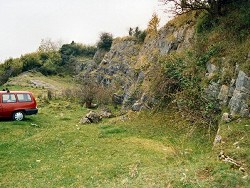
Some 12m of strata, located near the top of the Dartry Formation are exposed in this shallow quarry which is located 200m south- southwest of Cashel Crossroads and 6km southeast of Garrison. The greater thickness of strata is exposed in the linear east face of the quarry
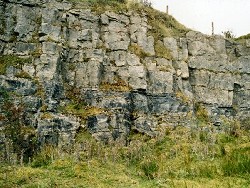 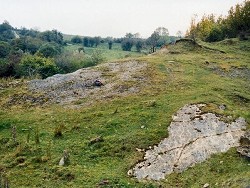 The lowest 0.5m of rock consists of fawn-grey, pink-stained rubbly palaeokarst packstone in which the top 0.1m are intensely karstified and now appear as an intraformational breccia. Above this 'breccia' is a thin dark grey shale that contains an abundant, frequently micrite-coated, macrofauna that includes most commonly solitary corals, and more rarely goniatites, brachiopods, orthocone nautiloids and trilobites. 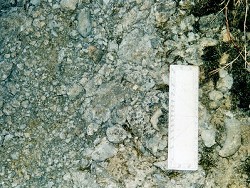 Beyrichoceras sp. Bollandites sp. Bollandoceras cf. micronotum Entogonites borealis Girtyoceras sp. Goniatites sp. Nomismoceras rotiforme The occurrence of Goniatites indicates an assignment to the B2 Zone. Unfortunately due to poor preservation, it is not possible to identify the Goniatites specifically, however, this co-occurrence indicates that E. borealis ranges into at least the Goniatites hudsoni assemblage Zone (B2a) and is therefore a stratigraphically young species of Entogonites. Very little work has been carried out on the abundant solitary corals but it is known that the genus Sychnoelasma is present, a coral that is usually associated with early Vis‚an faunas. This curious occurrence is further exacerbated by the recent discovery of a specimen of the tabulate coral Michelinia megastoma, a species thought to be confined to Arundian and older strata. Based on the goniatite fauna the fossiliferous shale is undoubtedly late Asbian. Above the fossiliferous shale is a thin level of sharply contorted, laminated algal limestone with crude, small desiccation cracks. The bulk of the quarry face is composed of laminated dolomitic grainstones with limestone breccias, the latter commonly developed as lag deposits at the base of channel features in the grainstones. At the top of the face are thinly bedded bioclastic limestones. | |
| Interpretation: | |
All of the sedimentary structures found at Cashel Quarry are indicative of very shallow marine conditions. At the base, the palaeokarst limestone and 'breccia' is produced by subaerial exposure but the origin of the prolific macrofauna in the thin shale is somewhat puzzling in view of the fact that most specimens are either abraded and broken or coated with a thin film of micrite. Both factors indicate a shallow water environment but the micrite coating is usually associated with hypersaline conditions, which would, under normal circumstances, not favour the development of a rich marine benthis community. It seems probable that all components of the macro-fauna are reworked and were transported into a shallow water environment. The development of very shallow water conditions near the top of the Dartry Limestone clearly foreshadow those of the succeeding Meenymore Formation. | |
| Conclusions: | |
This quarry exposes a suite of sediments that are unique in the outcrop of the Dartry Limestone in Northern Ireland, and yields probably the most prolific macrofauna at this level anywhere in the formation. | |
| Notes: | |
For information on other sites in Subarea-1 see; Key Site 1174 - Subarea-1; Derrygonnelly-Marble Arch-Cuilcagh. | |
| Keywords | |
|---|---|
| Minerals: | Micrite |
| Rocks: | Limestone |
| Fossil Groups: | Brachiopod, Coral, Goniatite, Nautiloid, Trilobite |
| Fossil List: | Entogonites borealis , Goniatites sp. |
| Structures: | palaeokarst |
| Relations: | Marine sediments |
| Measurements | |||||
|---|---|---|---|---|---|
| Length: | Width: | Height: | 12 m | ||
| Depth: | Area: | ||||
| Access | |
|---|---|
| Approach: | 200m SSW of Cashel Crossroads and 6km SE of Garrison. |
| References (1) | |||
|---|---|---|---|
| Hodson, F., 1958. Entogonites cf. borealis, an Alaskan goniatite from Ireland. Palaeontology, vol. 1, pp.158-159. | |||
| Map(s): | See 1:50,000 O.S. Sheet 17 (Lower Lough Erne). | ||
| Record type: | ESCR report | ||
| Entered by: | Doughty, P.J. | ||
| Last updated: | 8 Jan 2005 | ||
| Enlander, I., Dempster, M. & Doughty, P., 2026. Cashel Quarry - Carboniferous, County Fermanagh, site details. [In] Earth Science Conservation Review. https://www.habitas.org.uk/escr/site.php?item=187. Accessed on 2026-11-06. |
| Previous Site | Next Site |