
| Previous Site | Next Site |
Earth Science Conservation Review
| Knockmore Cliff | Fermanagh |
| Site number: | 188 | File Number: | H05 |
| ESCC: | EO | ||
| Locality Type: | Cliff | Status: | ASSI |
| Grid Reference: | H083407,H093500 End(s) of linear site, Not Entered | ||
| Google maps: | 54.31545,-7.87244 | ||
| County: | Fermanagh | Council area: | Fermanagh & Omagh District Council |
| Period: | Carboniferous | ||
| Stages: | Asbian, Visean | ||
| Lithostrat: | Dartry Limestone Formation, Knockmore Limestone Member, Tyrone Group | ||
| Site Description | |
|---|---|
 | |
| Highlights: | |
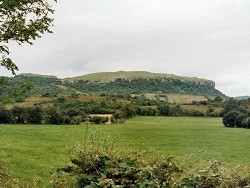
Knockmore hill is one of the most scenically attractive features in this part of Co. Fermanagh and has been selected as the stratotype for the Knockmore Limestone Member of the Dartry Limestone Formation. | |
| Description: | |
Knockmore hill and Knockmore Townland occupy an area of about 1 square kilometre, 3.5km west-southwest of Derrygonnelly. The most spectacular feature of the hill is Knockmore Cliff which is located on the north and east flanks of the hill extending for 1.26km from Buggan Townland (H083 407) in the west to Gortgar (H093 500) at the southeast corner of the hill. Knockmore hill is one of the best examples of an Asbian mud mount that is developed in Co. Fermanagh. For this reason the hill was selected as the Type Section for the Knockmore Limestone Member which consists of two main lithotypes that originated as sediments either in the core, or on the flanks, of line-mud mounds. Up to 130m of core sediments and cover limestones are exposed in Knockmore Cliff. Southwest of the Cliff, bedded limestones are poorly exposed, but linear features concealed by thin till allow their outcrop to be traced accurately. Limestones from the mound core consist almost exclusively of pale grey to fawn micrites that are either unbedded or develop a crude and widely spaced stratification. Stromatactis cavities, infilled with white calcite spar, are common but the fauna is impoverished and is largely restricted to small "reef-facies" brachiopods, in particular smooth athyrids, and occasional fenestellid bryozoa. The mud mounds are non-organic carbonate buildups (accumulations) which never possess a visible organic framework that would have assisted in the process of lime-mud accumulation and retention as the mound grew vertically and spread laterally. The sea-bed topography in the vicinity of some of these mounds at their acme was considerable and led Schwarzacher (1961) to estimate a height of some 120m between the sea-bed and mound summit. Associated with the unbedded mound core micrites are regularly bedded micrites and sedimentary breccias consisting of clasts of pale grey or fawn core micrite in a dark microsparite matrix. Bedded micrites and breccias developed at the margins of the mound core and strata may be inclined at up to 40 deg. away from the core. Fossils are abundant in the bedded micrites and particularly in the breccias where fenestellid bryozoa and a variety of brachiopods abound. In the breccias, bryozoan fronds are characteristically coated with thin layers of micrite and radiaxial microspar and former cavities between clasts and pore spaces are invariably infilled by these dark and light-coloured layers and finally by growth of coarse white calcite spar completely filling the final void. Corals are virtually absent from the Knockmore Member. | |
| Interpretation: | |
The distribution and evolution of lime-mud mounds, and associated bedded limestones, of the Knockmore Limestone Member is believed to have been related to fault-controlled asymmetrical subsidence of a submarine ramp. Rapid upward accumulation of the inorganic lime-mud occurred only on the deeper and sinking parts of the ramp, below the deepest level of storm wave base. Bedded limestones developed at the margins of the mounds and in the case of the breccias represent accumulations of semi-consolidated sediment derived from the mound core sediment. The nature of the sediment substrate and its composition did not encourage colonisation by benthic animals in contrast to the bedded breccias which offered firm anchorage and a nutrient-rich environment. | |
| Conclusions: | |
Knockmore hill is an excellent example of a lime-mud mound, with associated bedded limestones, of the Knockmore Limestone Member of the Dartry Limestone Formation. | |
| Notes: | |
For information on other sites in Subarea-1 see; Key Site 1174 - Subarea-1; Derrygonnelly-Marble Arch-Cuilcagh. | |
| Keywords | |
|---|---|
| Minerals: | Micrite |
| Rocks: | Breccia, Limestone |
| Fossil Groups: | Brachiopod, Polyzoan |
| Relations: | Marine sediments |
| Measurements | |||||
|---|---|---|---|---|---|
| Length: | 1260 m | Width: | Height: | 130 m | |
| Depth: | Area: | ||||
| Access | |
|---|---|
| Approach: | 3.5km WSW of Derrygonnelly. |
| References (1) | |||
|---|---|---|---|
| Schwarzacher, W., 1961. Petrology and structure of some Lower Carboniferous reefs in north-western Ireland. Bulletin of the American Association of Petroleum Geologists, vol. 45, pp.1481-1503. | |||
| Map(s): | See 1:50,000 O.S. Sheet 17 (Lower Lough Erne). | ||
| Record type: | ESCR report | ||
| Entered by: | Doughty, P.J. | ||
| Enlander, I., Dempster, M. & Doughty, P., 2026. Knockmore Cliff, County Fermanagh, site details. [In] Earth Science Conservation Review. https://www.habitas.org.uk/escr/site.php?item=188. Accessed on 2026-11-06. |
| Previous Site | Next Site |