
| Previous Site | Next Site |
Earth Science Conservation Review
| Cloghan Hill | Fermanagh |
| Site number: | 191 | File Number: | H03 |
| ESCC: | EO | ||
| Locality Type: | Inland exposure | Status: | ASSI |
| Grid Reference: | H090360 Centroid | ||
| Google maps: | 54.27322,-7.86183 | ||
| County: | Fermanagh | Council area: | Fermanagh & Omagh District Council |
| Period: | Carboniferous | ||
| Stages: | Asbian, Visean | ||
| Lithostrat: | Cloghan Hill Limestone Member, Dartry Limestone Formation | ||
| Site Description | |
|---|---|
 | |
| Highlights: | |
This lithostratigraphical unit only occurs in Subarea-1 in Co. Fermanagh and was first recognised in, and is confined to, the north side of Cuilcagh Mountain. It succeeds the Knockmore Limestone Member and is overlain by bedded cherty limestones. The member consists of a variable sequence of lithologies including calcareous shales, shaley bioclastic packstones, breccias, bedded micrites and small isolated lime-mud mounds. | |
| Description: | |
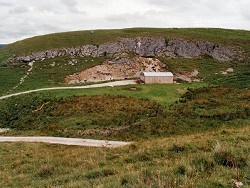
The Cloghan Hill Limestone Member was identified as a new lithostratigraphical unit by the GSNI (1991) during the remapping of the Derrygonnelly-Marble Arch area of Co. Fermanagh. The outcrop of the member is confined to the north side of Cuilcagh Mountain and it is only developed in an area that was predisposed to the accumulation of the major mud mounds of the Knockmore Limestone Member. The type locality is a low 'quarry' face on the west side of Cloghan Hill (beside a long concrete barn) in Marlbank Townland. The member is also exposed in an isolated outlier on Knocks (H101 357), just over 1km east-southeast of the stratotype, and in a larger area in Cullentragh Townland, west of Cloghan Hill. These localities comprise the Type Area of the Cloghan Hill Limestone Member. The Cloghan Hill Member is approximately 60m thick and is characterised by a variable suite of limestones and, more importantly by the occurrence of calcareous shales, thinly bedded shaley nodular limestones and highly crinoidal calcareous shaley siltstones. The laterally variable thickness of both the argillaceous and carbonate lithologies is admirably demonstrable at the stratotype and on the east face of Cullentragh Hill (H088 361) where some 10m of strata, that are exposed 260m east of the triangulation point, straddle the contact between the top of the Knockmore Member and the succeeding Cloghan Hill Member. The cause of these thickness variations is the development of small lenticular mud mounds in the lower part of the member. The mound developed at the stratotype section is about 5m thick and 200m long and is enveloped by highly crinoidal and fossiliferous, yellow-fawn shaley calcareous siltstones and thin bioclastic limestones that coalesce laterally at the extremity of the mound but thin markedly along the mound crest. These mounds did not develop synchronously in the lower part of the Cloghan Hill Member and the base of the member is probably diachronous, even within the Type Area. Argillaceous horizons developed at the crest of these mounds frequently show evidence of synsedimentary brecciation and slumping suggesting that they originated in shallow water and grew upwards into the zone of wave and current influence. Fossils are abundant in all lithologies except for the mound core which, as in the Knockmore Member, comprises unbedded, medium to pale grey micrite with no crinoid debris and only rare examples of small brachipods and fenestellid bryozoa. The argillaceous beds are always highly fossiliferous and contain an abundance of crinoid debris, crushed solitary and compound corals, brachiopods and trilobites that all show evidence of transport, abrasion and sorting. Weathering of these shaley beds produces an extremely friable rock with superb fossil specimens etched out on all surfaces. The highest beds of the Cloghan Hill Member are exposed on the summit, and to the west, of Cullentragh Hill and consist of dark grey thin and poorly bedded, shale-free, bioclastic micrites with occasional in situ silicified bioherms of Siphonodendron up to 1m thick and 9m in diameter. | |
| Interpretation: | |
The high proportion of shales and the argillaceous content of many of the limestones in the Cloghan Hill Member is atypical of the Dartry Limestone Formation in general, with the exception of the Carn Limestone Member. Evidence of current action on the sediments and their benthic faunas indicates persistently shallow water although the inception of mud mound growth also suggests that this occurred in sub-wave base conditions. | |
| Conclusions: | |
Despite the restricted areal distribution of the outcrop of the Cloghan Hill Limestone Member it represents a new lithostratigraphical unit in the upper part of the Dartry Limestone Formation that testifies further to the inherent variability of depositional conditions in the Northwest Basin at this time. | |
| Notes: | |
For information on other sites in Subarea-1 see; Key Site 1174 - Subarea-1; Derrygonnelly-Marble Arch-Cuilcagh. | |
| Keywords | |
|---|---|
| Rocks: | Limestone, Shale, Siltstone |
| Fossil Groups: | Brachiopod, Coral, Crinoid, Trilobite |
| Relations: | Marine sediments |
| Access | |
|---|---|
| Approach: | 3.5km SSE of Belcoo. |
| Map(s): | See 1:50,000 O.S. Sheet 26 (Lough Allen); GSNI (1991) 1:50,000 Sheet 44, 56 and 43 (Derrygonnelly & Marble Arch). | ||
| Record type: | ESCR report | ||
| Entered by: | Doughty, P.J. | ||
| Enlander, I., Dempster, M. & Doughty, P., 2026. Cloghan Hill, County Fermanagh, site details. [In] Earth Science Conservation Review. https://www.habitas.org.uk/escr/site.php?item=191. Accessed on 2026-11-06. |
| Previous Site | Next Site |