
| Previous Site | Next Site |
Earth Science Conservation Review
| Magherameena Quarry, Belleek | Fermanagh |
| Site number: | 224 | File Number: | G95 |
| ESCC: | ED | ||
| Locality Type: | Quarry (disused) | Status: | ASSI |
| Grid Reference: | G980597 Centroid | ||
| Google maps: | 54.4862,-8.03083 | ||
| County: | Fermanagh | Council area: | Fermanagh & Omagh District Council |
| Period: | Carboniferous | ||
| Stages: | Arundian, Chadian, Visean | ||
| Lithostrat: | Ballyshannon Limestone Formation, Magherameena Limestone Member, Tyrone Group | ||
| Site Description | |
|---|---|
 | |
| Highlights: | |
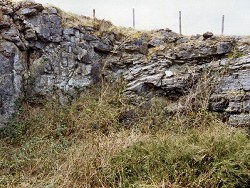
Waulsortian limestones are superbly exposed in Magherameena Quarry in the form of a lenticular mound interbedded in a sequence of bedded limestones and silty shales. | |
| Description: | |
Magherameena Quarry is located 4km east of Belleek on the south side of the A47 Kesh Road and is the stratotype for the eponymous limestone member. Some 10-12m of massive to unbedded micrites in the shape of a lenticular mound are exposed in the quarry, with one extremity being located in the southwest corner. Lying stratigraphically beneath the mound and occupying much of the west wall of the quarry are interbedded limestones and silty shales dipping at about 18 deg. to the south. The limestones are dark blue-grey crinoidal, medium-grained packstones which contain abundant bryozoa but only occasional brachiopods and solitary corals including Cravenia cf. lamellata are found. The microbiota comprises a low diversity assemblage of foraminifera including Earlandia sp., Endothyra sp., Priscella sp., Tetrataxis sp. and Eotextularia diversa, which indicates a mid-Tournaisian to Arundian age, and algae including Girvanella sp., Sphaerinvia piai and a kamaeniid. The margin of this Waulsortian mound is exposed in the southwest corner of the quarry and its relationship to the bedded limestones and shales is clearly allochthonous. The latter bedded strata, adjacent to the edge of the mound, are crumpled and sheared and a breccia, consisting of angular and contorted lumps of limestone in a deformed mudstone matrix, coats the western margin and narrowing edge of the mound limestones. Beds overlying the top of the mound 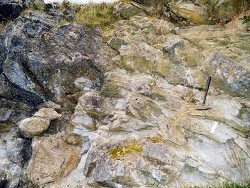 The Waulsortian limestones 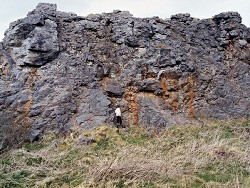 | |
| Interpretation: | |
A discussion relating to the history of the concept of the Waulsortian and its distribution in Ireland is included in Key Site 177 (Subarea-1). This also applies to the Waulsortian mound at Magherameena Quarry. | |
| Conclusions: | |
a) This is the most northerly occurrence of the Waulsortian in Ireland, Great Britain and in western Europe. b) Magherameena Quarry is located about 80km north of the limit formerly imposed on the development of this facies in Ireland and is located over 30km NW of the only other Waulsortian locality in N. Ireland at Bellanaleck, Co. Fermanagh. c) No fossils diagnostic of age have been recovered from Magherameena Quarry. A miospore assemblage obtained from the basal Carboniferous beds in this area contain Lycospora pusilla and are thus of earliest Vis‚an age. | |
| Notes: | |
For information on other sites in Subarea-3 see; Key Site 1176 - Subarea-3; Kesh-Omagh. | |
| Keywords | |
|---|---|
| Rocks: | Crinoidal limestone, Limestone |
| Fossil Groups: | Brachiopod, Coral, Crinoid, Foraminifera, Polyzoan |
| Fossil List: | Earlandia sp. , Endothyra sp. , Priscella sp. |
| Relations: | Marine sediments |
| Access | |
|---|---|
| Approach: | 4km east of Belleek on the south side of the A47 Kesh Road. |
| Map(s): | See 1:50,000 O.S. Sheet 17 (Lower Lough Erne). | ||
| Record type: | ESCR report | ||
| Entered by: | Doughty, P.J. | ||
| Enlander, I., Dempster, M. & Doughty, P., 2026. Magherameena Quarry, Belleek, County Fermanagh, site details. [In] Earth Science Conservation Review. https://www.habitas.org.uk/escr/site.php?item=224. Accessed on 2026-11-06. |
| Previous Site | Next Site |