
| Previous Site | Next Site |
Earth Science Conservation Review
| Ashfield Mountain Bar stream, Slieve Beagh | Tyrone |
| Site number: | 260 | File Number: | H54 |
| ESCC: | EO | ||
| Locality Type: | Stream section | Status: | local interest |
| Grid Reference: | H543475 Centroid | ||
| Google maps: | 54.37372,-7.16445 | ||
| County: | Tyrone | Council area: | Mid Ulster District Council |
| Period: | Carboniferous | ||
| Stages: | Visean | ||
| Lithostrat: | Leitrim Group, Meenymore Formation | ||
| Site Description | |
|---|---|
 | |
| Highlights: | |
Within the outcrop of the lithologically highly variable Meenymore Formation on Slieve Beagh the stream section in Ashfield Mountain Bar contains a wide variety of marine and deltaic/fluviatile sediments. Diagnostic fossils occur at several horizons. | |
| Description: | |
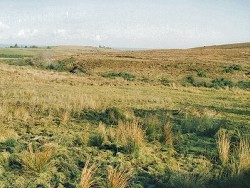
The townland of Ashfield Mountain Bar extends for a distance of over 4.5km from the summit ridge of Slieve Beagh to the Corleaghan Road at Lough McCall (H539 482). The stream section is located in the broad valley (Photograph 98) between the low hills of Greaghnalurgana and Greaghnarawer (H54 47), near the north end of the townland and 4km south of Clogher. Strata exposed in the stream are inclined northwestwards at between 15-25 deg. and young consistently downstream. A litholog of the section indicates that there are over 40m of strata exposed but there are two gaps in the succession and it is not known if these represent soft lithologies or fault zones. The one lithology not recorded in this section, but which does occur in many other sections in this outcrop of the Meenymore Formation on Slieve Beagh, is laminated stromatolitic (cyanobacterial) carbonates. The section commences at the south end of the stream (H5427 4742) and extends downstream (north-northeastwards) for 200m to H5435 4760. Located in the lower part of the sequence, and exposed in a low cliff (H5427 4745) on the west bank of the stream, are some 2m of dark grey ironstone-rich mudstones with 5 beds of limestone. 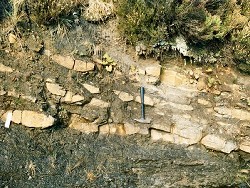 Bollandites cf. castletonense Bollandoceras or Beyrichoceras sp. Nomismoceras vittigerum The microbiota of these beds and of three other limestones located about 7m stratigraphically above the goniatite horizon is impoverished. The lowest limestone of the latter group (0.09m thick) is a coarse-grained spicular packstone with micrite lithoclasts and contains algae and foraminifera including Paraarchaediscus stage angulatus suggesting an Asbian age. The goniatites belong to the late Asbian (B2a) Beyrichoceras goniatite zone. A much more diverse coral-brachiopod fauna is contained in blue- grey and fawn mudstones and claystones that occur (H5429 4750) at the base of the upper section at this site. This horizon is also unusual for the occurrence of a large inverted colony of the coral Lithostrotion portlocki and of large extraclasts, up to 0.17m in diameter, of allochthonous quartz- clastic and fossiliferous limestone. The macrofauna of these mudstones includes the following corals and brachiopods: Corals: Brachiopods: --------------------------------------------------------------- Amplexizaphrentis enniskilleni Antiquatonia sp. Caninia cornucopiae Linoprotonia hemisphaerica Lithostrotion portlocki Schizophoria sp. Rotiphyllum sp. Spirifer sp. Rylstonia benecompacta R. dentata Siphonodendron pauciradiale These blue-grey fossiliferous claystones are about 5m thick and, in addition to the coral-brachiopod fauna, also contain abundant bivalves, bryozoa, Archaeocidaris spines, and crinoid ossicles. An allochthonous block of fine-grained siliceous packstone was recovered from the claystones some 2.5m above the base and processed for conodonts. The fauna included the following forms: Gnathodus bilineatus G. girtyi girtyi G. girtyi collinsoni G. homopunctatus Hibardella sp. Liganodina roundyi Lochreia commutata Mestognathus beckmanni Metalonchodina sp. Neoprioniodus peracutas N. singularis N. spathatus Subbryantodus stipans This fauna represents the Gnathodus bilineatus biozone and confirms the Asbian age as provided by the goniatite fauna. However the presence of G. girtyi collinsoni is unexpected as this sub-species is the biozonal index taxon for the uppermost Brigantian. It must therefore be concluded that collinsoni has a much greater stratigraphical range than published information would suggest. Since the 1970's it has been realised that facies and water depth exerted a marked control on the composition of conodont assemblages. Shallow water environments including tidal lagoon, sabkha and shelf facies are characterised (inter alia) by the presence of Mestognathus. In contrast Gnathodus is considered to be typical of deep(er) water foreslope environments. The association of these genera in the Meenymore Formation at Ashfield Mountain Bar requires transportation and mixing. Because of the allochthonous nature of the limestone blocks that contain the conodonts and the broken and clearly reworked nature of the corals and brachiopods, in the claystones, there seems little doubt that shallow water faunas have been transported into deeper water. An exposure in the north bank of the stream (H5434 4758) near the north end of the section exposes about 1.5m of fluvio-deltaic sediments. These consist of thin bedded fine- to very fine-grained sandstones, parallel laminated with linear groove marks on the base or lenticular with channelised bedforms. Interbedded with the sandstones are medium grey unfossiliferous mudstones and blocky micaceous siltstones and silty mudstones. | |
| Interpretation: | |
The absence of laminated stromatolitic limestones and evaporite beds, and the prevalence of marine faunas, in a variety of sediments, indicates that supratidal environments (sabkha) did not develop at this level in this part of the outcrop of the Meenymore Formation. There is abundant evidence of deposition, in particular of claystones and mudstones, with siderite nodules, in deep water on, and below a steep slope that led to areas of shallow water from which were derived small to very large blocks of shallow water, often algal-coated limestone and fossils. The fossils, in particular fragmented corallites of Siphonodendron, are concentrated, with broken small solitary corals, in thin discontinuous bands. The most unusual occurrence is of an inverted colony of Lithostrotion portlocki which has clearly been transported into a deep water setting. Final confirmation of the allochthonous nature of much of the fossil benthos comes from the mixing of conodonts that are usually considered to be mutually exclusive in terms of the water depths and environments in which they lived. At many other horizons in this outcrop of the Meenymore Formation on Slieve Beagh lithologies consist not of deep water marine sediments but of non-marine, subaerial palaeosols and red-beds and of sabkha carbonates and mudstones. The Meenymore Formation on Slieve Beagh still exhibits the inherent chaotic variability that is so typical of the outcrop throughout the rest of the north of Ireland. | |
| Conclusions: | |
The stream section in Ashfield Mountain Bar exhibits a wide variety of marine and fluvio-deltaic sediments that are typical of the Meenymore Formation. Fossils collected there support the late Asbian age for this formation. | |
| Notes: | |
For information on other sites in Subarea-5 see; Key Site 1178 - Subarea-5; Clogher-Aughnacloy. | |
| Keywords | |
|---|---|
| Rocks: | Limestone, Mudstone, Sand, Sandstone |
| Fossil Groups: | Bivalve, Brachiopod, Conodont, Coral, Crinoid, Foraminifera, Goniatite, Polyzoan |
| Fossil List: | Beyrichoceras sp. , Bollandites cf. castletonense , Bollandoceras sp. , Gnathodus girtyi collinsoni , Lithostrotion portlocki |
| Structures: | cross-bedding |
| Relations: | Deltaic sediments, Fluvial sediments, Marine sediments |
| Access | |
|---|---|
| Approach: | The stream section is located in the broad valley between the low hills of Greaghnalurgana and Greaghnarawer (H54 47) near the north end of the townland, 4km south of Clogher. |
| References (3) | |||
|---|---|---|---|
| Egan, F.W., 1873. Explanatory memoir to accompany Sheet 47 of the maps of the Geological Survey of Ireland, including the country around Armagh. Memoirs of the Geological Survey of Ireland, Dublin. | |||
| Garwood, E.J., 1907. Notes and faunal succession in the Carboniferous Limestone of Westmoreland and neighbouring areas. Geological Magazine, vol. 44, pp.70-74. | |||
| Mitchell, W.I. & Mitchell, M., 1982. The Lower Carboniferous (Upper Visean) succession at Benburb, Northern Ireland. Report of the Institute of Geological Sciences, numb. 82/12. | |||
| Map(s): | GSNI (1983) 1:50,000 Solid Geology of Sheet 46 (Clogher); GSNI (1991) 1:50,000 Solid Geology of Sheet 44, 56 & 43 (Derrygonnelly). | ||
| Record type: | ESCR report | ||
| Entered by: | Doughty, P.J. | ||
| Enlander, I., Dempster, M. & Doughty, P., 2026. Ashfield Mountain Bar stream, Slieve Beagh, County Tyrone, site details. [In] Earth Science Conservation Review. https://www.habitas.org.uk/escr/site.php?item=260. Accessed on 2026-11-04. |
| Previous Site | Next Site |