
| Previous Site | Next Site |
Earth Science Conservation Review
| Rock Road Quarry, Armagh | Armagh |
| Site number: | 274 | File Number: | H84 |
| ESCC: | ED | ||
| Locality Type: | Quarry (disused) | Status: | ESCR |
| Grid Reference: | H871435 Centroid | ||
| Google maps: | 54.33324,-6.66103 | ||
| County: | Armagh | Council area: | Armagh City, Banbridge & Craigavon Borough Council |
| Period: | Carboniferous | ||
| Stages: | Asbian, Visean | ||
| Lithostrat: | Armagh Group | ||
| Site Description | |
|---|---|
 | |
| Highlights: | |
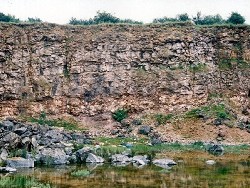
Rock Road Quarry exposes 2 of the principal limestone lithologies that constitute the Asbian succession within the Armagh Group. The quarry is the site of the maximum development of a coral 'conglomerate' bed that is unique in this area. | |
| Description: | |
This large, but shallow, abandoned quarry is located (H871 435) on the southwestern outskirts of Armagh City, 2km SSW of the Mall, on the south side of Rock Road. It extends for over 200m SE of the road but rarely exceeds a depth of 10m. Strata in the quarry are inclined northwards at ~10 deg. and ~25m of limestone are exposed there. The lowest limestones in the section are exposed at the base of the SE face. These consist of about 1.3m of thickly bedded, medium grey, coarse-grained crinoidal microsparite, with patchy purple staining and bioclasts consisting mainly of colonies, frequently inverted, of the coral Lithostrotion aranea. Overlying these limestones at the SE end of the quarry is a bed, 2.1m thick consisting of a coral conglomerate. The bed consists entirely of abundant, intact and abraded heads of cerioid coral colonies together with, less frequently, broken solitary corals 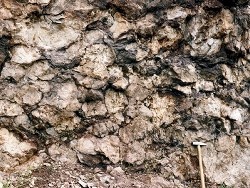 This coral bed is also exposed in the east face of a small quarry (H8724 4324) located 200m SE of the main quarry. Here the bed is 1.2m thick and individual coral heads are now supported by medium grey microsparite rather than by shale. In addition to the cerioid and solitary corals that dominate the assemblage in the main exposure, small colonies and numerous fragments of the fasciculate coral Siphonodendron pauciradiale occur for the first time. Lying stratigraphically above the coral bed and exposed in both faces at the SE end of Rock Road Quarry are 7m of thin to thick bedded, medium grey, very fossiliferous very fine-grained grainstone/packstones. Individual limestone beds show undulose bedding and are separated by irregular laminae of purple-red silty shale up to 0.03m thick. These strata contain abundant brachiopods and corals including: BRACHIOPODS: Gigantoproductus sp., Spirifer sp. CORALS: Caninioid, Clisiophyllum rigidum, Koninckophyllum sp., Lithostrotion portlocki, Siphonodendron martini, Siphonophyllia benburbensis, Syringopora cf. geniculata. This is an Asbian fauna and the occurrence of the alga Koninckopora supports this age determination. The highest beds in the quarry are exposed in the northwestern part, in particular in the SW face and consist of about 15m of pale fawn, pink-stained coarse grainstones with ooliths, peloids and micritised bioclasts. The fauna in these limestones is frequently broken and may be dominated by brachiopod fragments and, in particular, numerous pieces of Koninckopora. | |
| Interpretation: | |
The Asbian strata exposed at Rock Road Quarry, Drumarg Cliff and Annacramph Lane are representative of the limestones that typify the Asbian section of the Armagh Group. Their association with unusual lithologies, accumulations of fossils and sedimentary structures, that are found at all three localities, are unique or extremely rarely exposed in outcrop. Their significance is however considerable in that they all signify shallow water conditions, during Asbian times, accompanied by emergence of the sea bed, erosion of contemporaneous sediments and proximity of a land area from which clastic sediment was transported into an environment in which marine limestones were usually accumulating. Very little can be said, either about the areal extent of these palaeokarst surfaces, limestone conglomerates or rare sandstone beds and there are few data concerning their frequency in the Asbian succession in the Armagh Group in Subarea-6. | |
| Conclusions: | |
The Carboniferous rocks exposed at Rock Road Quarry include lithologies that are commonly represented in the Asbian succession in Subarea-6. The accumulation of coral colonies there is however unique in the Armagh Group. . The development of palaeokarst surfaces and sandstone bodies of Asbian age in the Armagh Group reaches its acme in the Cookstown area (Subarea-7; Key Site 1180). | |
| Notes: | |
For information on other sites in Subarea-6 see Key Site 1179 - Subarea-6; Armagh-Benburb. | |
| Keywords | |
|---|---|
| Rocks: | Conglomerate, Crinoidal limestone, Limestone |
| Fossil Groups: | Brachiopod, Coral |
| Fossil List: | Gigantoproductus sp. , Lithostrotion aranea , Lithostrotion portlocki , Siphonodendron martini , Siphonodendron pauciradiale , Siphonophyllia benburbensis , Spirifer sp. |
| Relations: | Marine sediments |
| Measurements | |||||
|---|---|---|---|---|---|
| Length: | >200 m | Width: | Height: | ||
| Depth: | up to 10 m | Area: | |||
| Access | |
|---|---|
| Approach: | The quarry is located on the southwestern outskirts of Armagh City, 2km SSW of the Mall, on the south side of Rock Road. |
| Map(s): | See 1:50,000 O.S. Sheet 19 (Armagh). | ||
| Record type: | ESCR report | ||
| Entered by: | Doughty, P.J. | ||
| Enlander, I., Dempster, M. & Doughty, P., 2026. Rock Road Quarry, Armagh, County Armagh, site details. [In] Earth Science Conservation Review. https://www.habitas.org.uk/escr/site.php?item=274. Accessed on 2026-11-08. |
| Previous Site | Next Site |