
| Previous Site | Next Site |
Earth Science Conservation Review
| Larrybane Stalactite Cave, Larrybane Bay | Antrim |
| Site number: | 520 | ||
| ESCC: | IC | ||
| Locality Type: | Cave, Cliff, Coastal section | Status: | ASSI |
| Grid Reference: | D055448 Centroid | ||
| Google maps: | 55.23936,-6.34147 | ||
| County: | Antrim | Council area: | Causeway Coast & Glens Borough Council |
| Period: | Quaternary, Cretaceous | ||
| Stages: | Santonian | ||
| Lithostrat: | Ulster White Limestone Formation | ||
| Site Description | |
|---|---|
 | |
| Highlights: | |
Larrybane Stalactite Cave is an exceptionally clear example of a relict sea cave formed during a period of higher relative sea level, probably in part by ice-plucking, and fronted by a raised beach platform. In addition, it has been modified by tufa deposition on a scale unmatched elsewhere on the outcrop of the Ulster White Limestone. | |
| Introduction: | |
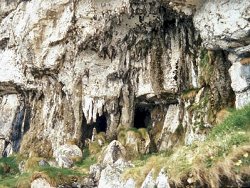
Larrybane Stalactite Cave lies towards the middle of Larrybane Bay and is clearly visible from the small beach just to the east of Larrybane Head. It lies about 7m above HWM on a prominent terrace at the base of the cliff in the central part of the bay. The cave is excavated in the lower part of the cliff, formed entirely in Ulster White Limestone, beneath a significant overhang. There is a spectacular development of tufa in and around the cave, notably in the entrance region where substantial columns prevent access except at two narrow openings. There have been few previous descriptions of this site. The earliest was by Martel (1897); subsequently it was photographed by Robert Welch, probably in the 1890s (K.W.James, pers. comm.) and was listed in the catalogue of Welch photographs by Hackney, James and Ross (1983). The only other account was by Doughty (1977), who described the cave and the circumstances behind its rediscovery. It is mentioned briefly in the geological guidebook by Lyle (1996). | |
| Description: | |
'Larrybane Stalactite Cave', as it was called by Martel (1897), lies towards the middle of Larrybane Bay and is about 7m above HWM, immediately above the '25 Foot Raised Beach' which forms a prominent terrace at the base of the cliff in the central part of the bay. The cliff at this point is formed entirely in Ulster White Limestone and is more than 30m high. There is a significant overhang about 10m above the level of the raised beach and extending up to 5m into the cliff. Towards the eastern end of this overhanging section is a conspicuous grill of large tufa columns, behind which the overhang extends several metres further back into the cliff to form a definite cave-like feature. There are several substantial tufa stalagmite bosses in addition to the large tufa columns; together these tufa deposits block the entrance to the cave almost entirely except for two narrow openings.
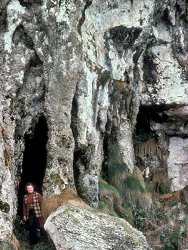 The areas of active tufa deposition near the entrance to the cave and elsewhere along the cliff are covered with a soft crust dominated by the bryophyte Barbula tophacea, sterile leprose lichens such as Lepraria, and occasional liverworts. Where tufa deposition has ceased, this biotic layer has fallen away to reveal the mostly hard and compact tufa beneath; this is sufficiently compact to support the saxicolous lichen Opegrapha saxicola agg. Three other caves are present towards the western end of Larrybane Bay. That furthest to the west is the largest and has two entrances. It was referred to as the 'Fern Cave' by Martel (1897). It has a generally angular shape and contains a limited development of tufa stalactites and cascades. The next cave to the east contains a flowstone cascade and curtains at the inner end which clearly are inactive, being encrusted with mosses, liverworts and leprose lichen crusts. The limestone on the upper part of the walls in this cave is pierced by numerous blind, light-orientated photokarren tubes. The third cave, still further east towards the 'Stalactite Cave', has a bell-shaped section. Photokarst is well-developed in the upper part of this passage also. | |
| Importance: | |
The abandoned sea caves in Larrybane Bay are fine examples of erosional sea caves formed in the Ulster White Limestone at a time of higher relative sea level associated with the incision of the '25 Foot' raised beach. The 'Stalactite' and 'Fern' caves are rather atypical of sea caves in the Ulster White Limestone in that their formation appears to have been dominated by plucking or collapse of blocks along joint and bedding planes, producing rather square, angular sections. This plucking may have been associated with the seasonal break-up and drifting of sea ice which had become anchored to the shore; the presence of groundwater seepage, indicated by the abundant tufa deposits which coat the cliff today, may have been a contributory factor attaching the winter sea ice to this part of the cliff. The other two sea caves at the western end of the bay have a more typical rounded section formed by mechanical corrasion. The area in and around Larrybane Stalactite Cave differs from other exposures of the Ulster White Limestone in its striking development of tufa, which occurs on a scale unmatched elsewhere on the Mesozoic outcrop in Northern Ireland. All of this tufa deposition, including the substantial columns at the entrance, must have formed since relative sea level fell and the sea cave was abandoned. The Stalactite Cave deserves designation as an ASSI on account of the exceptional tufa development, through its clear association with the '25 Foot' raised beach, and for its angular shape indicating a possible role for ice-plucking. In the broader context it is perhaps desirable also to designate the Fern Cave and the two remaining abandoned sea caves as examples both of sea caves which reflect differences in the dominant process of formation (plucking and collapse vs. wave erosion) and for their unusual tubular photokarren. These represent a previously undescribed form of photokarren (Bull and Laverty 1982, Simms 1990) and must have developed since the fall in relative sea level. Hence the abandoned sea caves of Larrybane Bay can provide important data both on rates of deposition of tufa and the rate of dissolution of limestone by endolithic algae. | |
| Interpretation: | |
The location of Larrybane Stalactite Cave, immediately above the 7m bench, is strong evidence that it is an abandoned sea cave associated with the '25 Foot Raised Beach'. There is no evidence for significant enlargement of Larrybane Stalactite Cave by dissolution, hence it cannot be regarded as a true cave in karst terms. This is true also of the other abandoned sea caves described above. The rather angular form of the cave and associated overhang differs from the more rounded shape typical of other sea caves in the Ulster White Limestone and suggests that ice- plucking, associated with the seasonal break-up of sea ice, or collapse along major joints and bedding planes was a significant process in its original development. This would appear to be true also for Larrybane Fern Cave to the east, while the other two abandoned sea caves have a more rounded section typical of erosional sea caves. Sea caves associated with the 25 foot raised beach are common on the north Antrim coast and occur in a variety of lithologies. However, the unusual feature of this site is the extensive development of tufa in and around Larrybane Stalactite Cave. Water seeping through the Ulster White Limestone along joints and bedding planes becomes saturated with calcium carbonate. Upon emerging at the cliff face, loss of carbon dioxide from the water occurs by degassing, causing precipitation of calcium carbonate. Degassing is enhanced where the water film is thinnest, such as where it flows over sharp edges or projecting plant material. Consequently, the presence of abundant bryophytes promotes the precipitation of tufa while, in turn, the presence of the calcium carbonate-rich water supply encourages the growth of Barbula tophacea, a species characteristic of tufa springs. Further evidence for a significant biogenic influence on deposition is seen in the slanting orientation of both stalagmites and stalactites in some of the more dimly lit parts of the cave. This probably arises through enhanced growth of bryophytes on one side in the direction of the light, these then becoming encrusted by tufa. The bluish tinge of the cave pearls, mentioned above, suggests that cyanophytes (blue-green algae) may be involved in their formation. Endolithic algae also are involved in the development of photokarren, some of which show an unusual morphology in the old sea caves to the west of the Stalactite Cave. Photokarren typically take the form of small pinnacles and blades on the more dimly lit walls of caves and orientated towards the light (Bull & Laverty 1982). In temperate regions they appear to be confined to maritime environments (Simms 1990). However, in some parts of these sea caves the photokarren form a series of light-orientated tubes a centimetre or more in diameter and several centimetres depth. Such photokarren tubes have not been observed in other limestones and may be peculiar to the Ulster White Limestone, a consequence of its high albedo reflecting light and so allowing algae to excavate much deeper cavities. Photokarren are fairly delicate structures which form slowly in dimly lit places. Erosion is far too severe in active sea caves for such structures to form and hence their presence in the upper part of the sea caves at the western end of Larrybane Bay indicates that these caves formed, initially, in association with higher relative sea level during formation of the '25 Foot' raised beach, and that the present isolation of all but the lowest parts of these caves from even high Spring tides has allowed the photokarren to develop. | |
| Conclusions: | |
Larrybane Stalactite cave is an excellent example of a relict sea cave, developed in the Ulster White Limestone, whose relationship to the '25 foot' raised beach is unusually clear. It differs from other raised beach sea caves in the exceptional development of tufa, much of it still active, which forms flows and substantial columns in and around the cave mouth, and in its angular shape, perhaps caused by ice-plucking associated with the seasonal break-up of sea ice. It is the finest example of tufa development anywhere on the outcrop of the Ulster White Limestone. | |
| Keywords | |
|---|---|
| Rocks: | Limestone, Tufa |
| Relations: | Coastal processes, Ice-plucking |
| Geomorph: | photokarst, raised beach, sea cave, tufa |
| Access | |
|---|---|
| Management: | |
The main 30m high cliff face in which Larrybane Stalactite Cave is excavated lies well above present sea level and, other than occasional rockfalls, has not experienced significant erosion for several thousand years. Dissolution rates of the Ulster White Limestone cliffs are negligible, and greatly exceeded by the rate of tufa deposition. Marine erosion of the small cliff below the raised beach platform on which the cave is situated is much more evident but presents no immediate threat to the cave. No specific management recommendations are made here. | |
| Uses | |
| Uses: | The area in which Larrybane Stalactite Cave is located is used only for recreation and is part of a National Trust reserve associated with Carrick-a-Rede. Although the western end of Larrybane Bay has been modified extensively by the activities of Larrybane Head Quarry, quarrying has not affected the main part of the bay and the quarry is now disused. |
| References (6) | |||
|---|---|---|---|
| Bull, P.A. & Laverty, M., 1982. Observations on phytokarst Zeitschrift fur Geomorphologie, vol. 26, pp.437-457. | |||
| Doughty, P.S., 1977. The rediscovery of a cave in Cretaceous Chalk near Giant's Causeway, Northern Ireland Studies in Speleology, vol. 3, pp.25-27. | |||
| Hackney, P., James, K.W. & Ross, H.C.G., 1983. A list of the photographs in the R.J.Welch collection in the Ulster Museum. Volume 2: Botany, Geology and Zoology Ulster Museum. | |||
| Lyle, P., 1996. A Geological Excursion Guide to the Causeway Coast, pp.90PP. Environment and Heritage Service, Belfast, N. Ireland. | |||
| Martel, E.A., 1897. Irelande et Cavernes Anglaises. Libraire ch. Delagrave., Paris. | |||
| Simms, M.J., 1990. Phytokarst and photokarren in Ireland Cave Science, vol. 17, pp.131-133. | |||
| Record type: | ESCR report | ||
| Entered by: | E M Porter | ||
| Enlander, I., Dempster, M. & Doughty, P., 2026. Larrybane Stalactite Cave, Larrybane Bay, County Antrim, site details. [In] Earth Science Conservation Review. https://www.habitas.org.uk/escr/site.php?item=520. Accessed on 2026-11-06. |
| Previous Site | Next Site |