
| Previous Site | Next Site |
Earth Science Conservation Review
| Cashel Rock - Mineralogy | Tyrone |
| Site number: | 523 | ||
| ESCC: | EO | ||
| Locality Type: | Inland exposure | Status: | ASSI |
| Grid Reference: | H589801 Approximate | ||
| Google maps: | 54.66602,-7.08716 | ||
| County: | Tyrone | Council area: | Fermanagh & Omagh District Council |
| Period: | Ordovician | ||
| Lithostrat: | Tyrone Volcanic Group | ||
| Site Description | |
|---|---|
 | |
| Highlights: | |
Arguably the best and most accessible example in Northern Ireland of volcanogenic stockwork mineralization, comprising base metal sulphides in a silicified breccia of rhyolite fragments. | |
| Introduction: | |
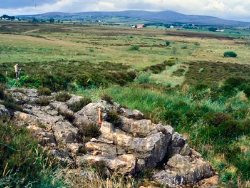
Cashel Rock near Creggan is a very significant site in regional metallogenesis, as it illustrates volcanogenic (possibly Kuroko-style) stockwork mineralization formed in an island arc context during the Ordovician. The site is located in Brackagh South Townland, and being a short distance (c.250m) from the road is readily accessible for field excursions. | |
| Description: | |
  | |
| Importance: | |
Although currently sub-economic, the Cashel Rock locality is the most prospective occurrence of volcanogenic mineralization in the Sperrin Mountains and probably in Northern Ireland as a whole. It has been subject to scientific evaluation that is reported in international literature. | |
| Interpretation: | |
The Tyrone Volcanic Group comprises predominantly volcanic and intrusive granitoid rocks of Ordovician age that were formed in an island arc setting during closure of the Iapetus Ocean. The volcanic sequence comprises basaltic andesite to rhyolitic submarine and subaerial lavas, volcaniclastics with chert horizons and intercalations of graptolitic shales (Hartley, 1933). Arthurs (1976) reported reconnaissance geological and geochemical work in the Sperrins that identified the Tyrone Volcanic Group as metal-enriched. Legg et al. (1985) noted that a prospecting licence was held over the TVG area by Riofinex from 1971 to 1975. Riofinex undertook geophysical and geochemical surveys, trenching, drilling and rock analyses and reported gold assays up to 2.6g/t in pyrite-veined rock float at Cashel Rock. Leyshon and Cazalet (1976) reported on the Riofinex exploration programme and concluded that some of the intrusives are host to significant but sub-economic copper mineralization. Clifford et al. (1992) followed up the exploration undertaken by Riofinex and reported that gold and base metal enrichment is widespread in the Tyrone Volcanic Group. Mineralization occurs in a variety of styles including stratiform enrichment in cherts and iron formation, stockworks in rhyolitic intrusions, and porphyry-type occurrences associated with tonalite plutons (e.g. Formil-Slievemenagh - Key Site 562). Exploration at Cashel Rock established that the sulphide-rich breccia is up to 2m thick and that the mineralized zone, intersected in 14 drillholes, extends over a strike length of at least 200m and to a depth of at least 30m. The best intercept from drilling was 3.63m grading 30.5g/t Au including a 1.23m interval assaying 1.14% Cu and 1.85% Pb. Gold occurs as microscopic particles and is typically associated with pyrite, although some types of pyrite are barren, suggesting several generations. Two samples of sulphide mineral separates from the Cashel Rock prospect were subjected to isotopic analysis in the metallogenic study reported by Earls et al. (1996). The results obtained, +12.3 per mil and +10.2 per mil, are consistent with the derivation of sulphur by reduction of sulphate in Ordovician seawater. | |
| Conclusions: | |
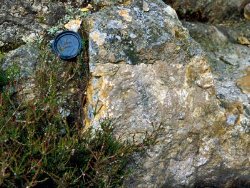
The site illustrates stockwork mineralization formed in an island arc context during the Ordovician. Rocks at the locality are locally rich in sulphides, principally pyrite, chalcopyrite, covellite, galena and iron-rich sphalerite. The site is a valuable educational and scientific resource that should be conserved. | |
| Notes: | |
See also SLNCI Key Site 711 - Cashel Rock. | |
| Keywords | |
|---|---|
| Minerals: | Chalcopyrite, Galena, Pyrite, Sphalerite, Covellite |
| Rocks: | Breccia, Rhyolite |
| Structures: | mineral vein, stockwork |
| Measurements | |||||
|---|---|---|---|---|---|
| Length: | Width: | Height: | |||
| Depth: | Area: | 5 x 7m | |||
| Access | |
|---|---|
| Management: | |
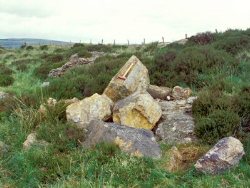
Should mining activity start at the prospect, the boulders and rhyolite exposures may be excavated or become inaccessible, though the mining company could be required to leave an accessible exposure when they have completed extraction operations. Aside from this possibility, the main threat to conservation of the site is from activities of the landowner, such as removal of material, or burial by rubble or agricultural waste. | |
| Threats: | The main threat to conservation of the site is from activities of the landowner, such as removal of material, or burial by rubble or agricultural waste. The best material is in boulders: this is sensitive to collection and to agricultural 'improvement'. |
| Uses | |
| Uses: | Rough grazing and open moorland. A dry-stone wall that bounds a field of managed grassland runs through the site: this wall incorporates some mineralized boulders. |
| Map(s): | OSNI 1:50,000 sheet 13; 1:10,000 sheet XX. | ||
| Record type: | ESCR report | Recorded by: | R. Nawaz and N.R. Moles |
| Entered by: | E M Porter | ||
| Last updated: | 07 MAY 68 | ||
| Enlander, I., Dempster, M. & Doughty, P., 2026. Cashel Rock - Mineralogy, County Tyrone, site details. [In] Earth Science Conservation Review. https://www.habitas.org.uk/escr/site.php?item=523. Accessed on 2026-11-06. |
| Previous Site | Next Site |