
| Previous Site | Next Site |
Earth Science Conservation Review
| Little Deer Park Quarries, Glenarm | Antrim |
| Site number: | 525 | ||
| ESCC: | ED | ||
| Locality Type: | Quarry (disused) | Status: | ASSI |
| Grid Reference: | D329149 Centroid | ||
| Google maps: | 54.96435,-5.92498 | ||
| County: | Antrim | Council area: | Mid & East Antrim Borough Council |
| Period: | Tertiary | ||
| Lithostrat: | Antrim Lava Group, Lower Basalt Formation | ||
| Site Description | |
|---|---|
 | |
| Highlights: | |
Tertiary basalt with zeolite minerals in a readily accessible inactive quarry. | |
| Introduction: | |
Zeolite-bearing basalts are prone to weathering and consequently useful sites are mostly confined to coastal exposures and active quarries, where erosion and extraction expose fresh material. Quarries are ephemeral features of the landscape and when extraction ceases they often become inaccessible or infilled. The disused basalt quarries south-east of Glenarm are one exception in that they remain accessible and are still a source of zeolite mineral specimens. | |
| Description: | |
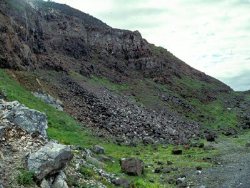
There are several disused basalt quarries near the coastal road south-east of Glenarm. The one referred to here is located around 150m south-west of the coastal rock feature known as Madman’s or Spy Window, in the townland of Little Deer Park, 2km from Glenarm village. Just south of the basalt quarry is a larger limestone quarry, also disused, which at the date of visiting (in 1997) was open to the road and provided a convenient car park. The quarries are connected by a short track that enters the basalt quarry at its south side through a cutting. This cutting exposes the upper surface of the limestone capped with a flint-rich residual soil. In the basalt quarry, the second basalt flow exhibits excellent pipe amygdales where vapour bubbles rose through partially congealed lava. The quarry faces are largely obscured by abundant loose scree of moderately fresh, amygdaloidal basalt. This scree provides good specimens of zeolite minerals notably pink gmelinite, radiating natrolite, and equant crystals of analcime. Less common are chabazite, heulandite, thomsonite, levyne, cowlesite and erionite/offretite (for descriptions of these minerals see Tschernich, 1992). Although not observed in our material, it is possible that garronite and gismondine could occur at this locality, as they have been described from the adjacent Garron Plateau area by Walker and Carmichael (1962A and 1962B). | |
| Importance: | |
Although analcime-zone zeolite-bearing basalts are widely distributed in County Antrim, the Little Deer Park quarries provide an accessible and convenient site where specimen material is abundant. Other features, such as pipe amygdales in the basalts and residual soils developed beneath the lava flows, provide additional interest at the site. For these reasons it has been used as a locality for excursions arranged through the Belfast Geologists’ Society and Irish Geological Association. | |
| Interpretation: | |
Zeolite minerals are alkali-bearing aluminosilicates that contain chemically-bound water molecules. The occurrence of zeolite minerals in amygdales is characteristic of flood basalt lava piles such as the British Tertiary Province and Iceland. Walker (1960 and earlier papers) studied the distribution of zeolite mineral species in the lava piles of Ireland and Iceland, and was the first to demonstrate that zeolite mineralogy related to (a) rock type i.e. whether the host basalt is olivine-bearing or tholeiitic, and (b) depth in the lava pile, i.e. the temperature attained during hydrothermal alteration. The Lower Basalt Formation that is exposed in the Little Deer Park quarries is an olivine basalt and the zeolite mineral assemblage described above is typical of Walker’s analcime zone. The absence of stilbite and mesolite suggests that the assemblage is not within the next deeper zone (scolecite-mesolite), and the presence of heulandite suggests that the assemblage is not within the shallower chabazite zone. Gmelinite, which is particularly abundant in the amygdales at the site, has a restricted geographical distribution (Walker, 1959) largely confined to the eastern coast of County Antrim. This may be related to the circulation of seawater that gained access to the lava pile along faults that parallel the present day coast between Whitehead and Garron Point. | |
| Conclusions: | |
The site is worth conserving because of its ease of access and abundance of specimen material. | |
| Notes: | |
See also SLNCI Key Site 736 - Little Deer Park Quarries. | |
| Keywords | |
|---|---|
| Minerals: | Analcime, Chabazite, Natrolite, Thomsonite, Zeolites, Gmelinite, Heulandite, Levyne, Cowlesite, Erionite, Offretite |
| Rocks: | Olivine Basalt |
| Structures: | amygdales, pipe amygdaloid, zeolitization |
| Access | |
|---|---|
| Management: | |
Although the quarries are currently dormant (site ownership was not established), they could be reactivated in the future to provide fill material for road-building or other construction projects. If this were to happen, ideally an accessible scree of fresh amygdaloidal basalt should be left to provide a continuing resource. | |
| Uses | |
| Uses: | Disused quarries set in mountainous rough pasture used for grazing sheep. |
| Map(s): | OSNI 1:50,000 sheet 9; 1:10,000 sheet XX. | ||
| Record type: | ESCR report | Recorded by: | R. Nawaz and N.R. Moles |
| Entered by: | E M Porter | ||
| Last updated: | 07 MAY 68 | ||
| Enlander, I., Dempster, M. & Doughty, P., 2026. Little Deer Park Quarries, Glenarm, County Antrim, site details. [In] Earth Science Conservation Review. https://www.habitas.org.uk/escr/site.php?item=525. Accessed on 2026-11-06. |
| Previous Site | Next Site |