
| Previous Site | Next Site |
Earth Science Conservation Review
| Lindsay's Leap, Mourne Mountains | Down |
| Site number: | 541 | ||
| ESCC: | ED | ||
| Locality Type: | Quarry (disused) | Status: | ASSI |
| Grid Reference: | J371291 Approximate | ||
| Google maps: | 54.19299,-5.89947 | ||
| County: | Down | Council area: | Newry, Mourne & Down District Council |
| Period: | Tertiary | ||
| Stages: | Eocene, Palaeocene | ||
| Lithostrat: | Granite, Mourne Mountains Granites | ||
| Site Description | |
|---|---|
 | |
| Highlights: | |
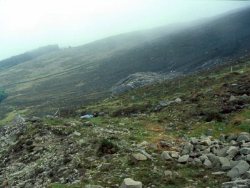
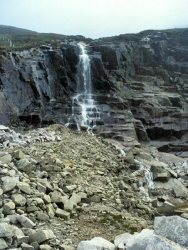
Granite with greisen veins and occasional drusy cavities containing crystals of smoky quartz, feldspars, biotite, stilbite and fluorite. | |
| Introduction: | |
 | |
| Description: | |
The veins are dark green to black in colour, range from a few millimetres to several centimetres in width, and mainly comprise mica and chlorite which has replaced minerals in the pre-existing granite. Occasionally the veins have a narrow central seam of topaz and chlorite, or of quartz, and have cavities containing stilbite. Of additional interest is the occasional occurrence of drusy cavities in the granite within the most recently worked quarry (the easternmost of the group at Lindsay’s Leap). 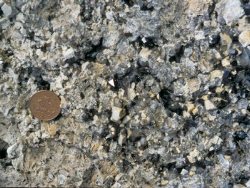 | |
| Notes: | |
See also Key Site 1103 - Mournes - Lindsay's Leap. | |
| Keywords | |
|---|---|
| Minerals: | Biotite, Chlorite, Fluorite, Quartz, Stilbite, Topaz |
| Rocks: | Granite, Greisen |
| Structures: | drusy, mineral vein, vugh |
| Access | |
|---|---|
| Management: | |
Quarrying activity has recently (1999) ceased at this site but abundant spoil material remains. This should be retained and not obscured to maintain the availability of specimen material. |
| Record type: | ESCR report | Recorded by: | R. Nawaz and N.R. Moles |
| Entered by: | E M Porter | ||
| Last updated: | 07 MAY 68 | ||
| Enlander, I., Dempster, M. & Doughty, P., 2026. Lindsay's Leap, Mourne Mountains, County Down, site details. [In] Earth Science Conservation Review. https://www.habitas.org.uk/escr/site.php?item=541. Accessed on 2026-11-06. |
| Previous Site | Next Site |