
| Lichens : Caliciales : Physciaceae | Lichens |
Physconia grisea (Lam.) Poelt
 |
| Physconia grisea |
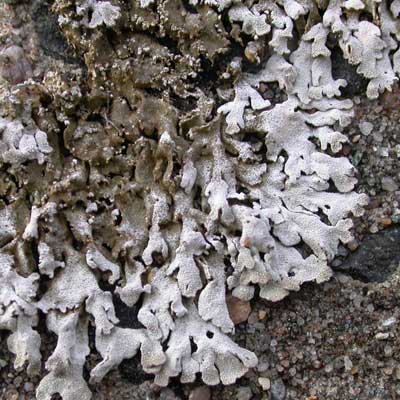
Description: This distinctive foliose species occurs on basic rock and stone, especially where it is enriched by birds. The grey thallus, browner or greener when wet, forms circular or semicircular colonies with fan-shaped lobes arranged like waves lapping the shore. An icing of pruina over the surface of the lobes is common. The main body of the plant appears to be covered in lines of granules which spread along the lobe edges: these are the soredia which help to identify it. The root-like rhizines that attach the lobes are pale, simple structures. Discs are generally rare. P. grisea is also frequent to abundant on dust-enriched, basic-barked wayside trees. It is evenly distributed throughout Ireland.
Key Identification Features:
- Distinguished from Physcia and Phaeophyscia by its attachment to the substratum by rhizinae. These are pale and simple and lack the bottle brush appearance of other species
- It is densely sorediate, with a medulla (the layer just below the surface cortex) never K + yellow.
Original text submitted by Simon Davey
Distribution Map from NBN: Physconia grisea at National Biodiversity Network mapping facility, data for UK.
iNaturalist: Physconia grisea at iNaturalist World Species Observations database.
| Giavarini, Vince J., Simms, Michael J., & Davey, Simon, 2026. Physconia grisea. (Lam.) Poelt. [In] Lichen Ireland. https://www.habitas.org.uk/lichenireland/species.php?item=18941. Accessed on 2026-11-12. |