
| Previous Site | Next Site |
Earth Science Conservation Review
| Black Head, Island Magee | Antrim |
| Site number: | 1075 | File Number: | J49 |
| ESCC: | EC | ||
| Locality Type: | Cliff | Status: | ESCR |
| Grid Reference: | J489935 Centroid | ||
| Google maps: | 54.76776,-5.68641 | ||
| County: | Antrim | Council area: | Mid & East Antrim Borough Council |
| Period: | Tertiary | ||
| Stages: | Eocene, Palaeocene | ||
| Lithostrat: | Antrim Lava Group, Lower Basalt Formation | ||
| Site Description | |
|---|---|
 | |
| Highlights: | |
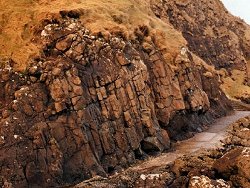
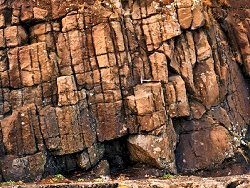
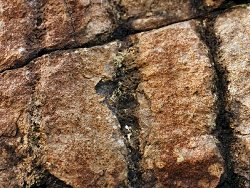
A basaltic lava flow in cliff section below Black Head, Island Magee, displays a spectacular array of vesicle cylinders. | |
| Introduction: | |
Vesicle cylinders were first described and named by Du Toit (1907); they are not uncommon among the Tertiary basalts of the Antrim Plateau, but in the literature they are usually described as pipe vesicles or pipe amygdaloids. | |
| Description: | |
The vesicle cylinders occur in the base of a massive flow which crops out beside the cliff path at the foot of the steps which lead up to the lighthouse.
  | |
| Importance: | |
Isolated examples of a few cylinders occur among the Lower Basalts along the Causeway Coast and fresh occurrences were exposed in the small quarries above the Coast Road, just south of the Glenarm landslip. However, the Black Head exposure is the finest example exposed to date, and though the rock is weathered it still displays the essential features of a vesicle cylinder array. | |
| Interpretation: | |
Unlike pipe vesicles and spiracles which are simple gas cavities in the base of a lava flow where steam and other gases have risen from damp ground below, these vesicle cylinders probably represent a more persistant injection of volatiles into the base of a still molten but immobile flow. Du Toit's (1907) explanation of rising bubbles-trains was accepted by Walker & Parsons (1922) and Fuller (1939) who envisaged the trapping of air beneath the advancing flow. Alternatively the ponded lava absorbed gases and vapours from damp ground below and the resultant melt of slightly lower density rose as a pipe into the flow. It may be that the whole basal layer of the flow became enriched in volatile components as a result of stand-still conditions; perturbations in the top of this layer could have nucleated the rising pipes at more or less equally spaced intervals. The water enriched magma on cooling could then have spontaneously vesiculated to produce a vesicle cylinder. Migration of volatiles towards nucleating vesicles would encourage a pegmatitic crystallisation around the gas/vapour bubble. Zeolite may have crystallised at this stage from a wet magma residuum or have been introduced by circulating hot ground water at a later stage. The pipes would rise vertically through the ponded lava but would be truncated by flowage at a higher level; at this level it is possible that globules of the wet magma were separated from the pipes and carried downstream to form the detached amygdaloidal masses. | |
| Conclusions: | |
Conservation of the locality would preserve the best example of a vesicle cylinder array within a ponded lava flow yet exposed among the Antrim Basalts. | |
| Notes: | |
The cliff and shore section around Blackhead and north to Clogfin Port display many other features of the Antrim Lavas - thin pahoehoe flow units, spatter ramparts around possible feeder (Walker 1959), dyke intrusions, zeolite minerals. Among all these the vesicle cylinder array should be protected from sampling and defacement. | |
| Keywords | |
|---|---|
| Rocks: | Basalt |
| Structures: | pipe amygdaloid, pipe vesicle |
| Relations: | Extrusion |
| Measurements | |||||
|---|---|---|---|---|---|
| Length: | Width: | 2-3 cm | Height: | 2 m | |
| Depth: | Area: | ||||
| Access | |
|---|---|
| Approach: | Access is made from the carpark at Whitehead by following the coastal path (which offers a good section through the Lower Basalts, the underlying Cretaceous Limestone and a few trangressive dykes). Alternatively take the metalled road to the Black Head Light (on foot) and descend the cliff by the steep stairway. |
| Management: | |
Preservation of this site should be complete; sampling would destroy its value and fresh material of a similar nature can be gathered elsewhere. | |
| Threats: | Oversampling |
| Uses | |
| Uses: | The locality is traversed by a scenic/tourist footpath which leads visitors around the cliffs under Black Head. Improvement of this path to accommodate a larger number of visitors could destroy it. |
| References (6) | |||
|---|---|---|---|
| Du Toit, A.L., 1907. Pipe amygdaloids Geological Magazine, vol. 4, pp.4-17. | |||
| Fuller, R.E., 1939. Gravitational accummulation of olivine during the advance of basaltic flows Journal of Geology, vol. 47, pp.303-313. | |||
| Preston, J., 1982. Eruptive Vulcanism, Chapter 28 in Igneous Rocks of the British Isles., pp.351-368 Wiley, New York. | |||
| Walker, G.P.L., 1959. Some observations on the Antrim basalts and associated dolerite intrusions Proceedings of the Geologists Association of London, vol. 70, pp.179. | |||
| Walker, T.L. & Parsons, A.L., 1922. Tubular amygdaloid from Nova Scotia University of Toronto Studies - Geological Studies, vol. 14, pp.5-12. | |||
| Wilson, H.E., 1972. Regional Geology of Northern Ireland. HMSO, Belfast. | |||
| Map(s): | The site can be located on the 1:50,000 O.S. Sheet 15 (Belfast), Discoverer Series. | ||
| Record type: | ESCR report | ||
| Entered by: | Hamilton, M.J. | ||
| Last updated: | 23 Dec 2003 | ||
| Enlander, I., Dempster, M. & Doughty, P., 2026. Black Head, Island Magee, County Antrim, site details. [In] Earth Science Conservation Review. https://www.habitas.org.uk/escr/site.php?item=1075. Accessed on 2026-11-05. |
| Previous Site | Next Site |