
| Previous Site | Next Site |
Earth Science Conservation Review
| Binnawooda Spring | Tyrone |
| Site number: | 220 | File Number: | H27 |
| ESCC: | EO | ||
| Locality Type: | Stream section | Status: | ESCR |
| Grid Reference: | H2476 1 km square | ||
| Google maps: | 54.63206,-7.62835 | ||
| County: | Tyrone | Council area: | Derry City & Strabane District Council |
| Period: | Carboniferous | ||
| Stages: | Arundian, Chadian, Visean | ||
| Lithostrat: | Bin Mountain Sandstone Formation, Claragh Sandstone Formation, Tyrone Group | ||
| Site Description | |
|---|---|
 | |
| Highlights: | |
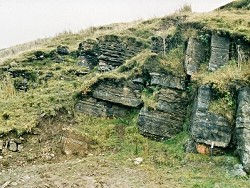
The Binnawooda spring section exposes the contact between the Bin Mountain Sandstone and the underlying Claragh Sandstone. The lowest 21m of the former formation are almost completely exposed. This is the thickest known development of the formation. | |
| Description: | |
The Binnawooda spring section is located on the north flank of Bin Mountain. The section commences in the east bank of the rough farm lane (H2469 7698), a few metres north of the emergence point of the spring and extends southwards, following the farm lane for about 200m. Strata exposed in the north-flowing stream that is fed by the spring consist exclusively of massively bedded, very coarse- grained arkose of the Claragh Sandstone Formation. The top 3m of this formation consist of fawn-grey, green and grey fine to medium-grained sandstones and silty sandstones with thin siltstones. The top of the upper sandstone bed is irregular and appears to have been eroded by the succeeding strata. These consist of 1.13m of grey-green sandy siltstones, siltstones and mudstones with two thick beds of grey micritic packstone and wackestone with bird's eye structures and rhizoliths. These are peritidal sediments that contain an impoverished fauna of foraminifera but do contain the dasyclad alga Koninckopora indicating a Vis‚an age. The base of the Bin Mountain Sandstone Formation and the lowest 1.25m of strata are exposed just north of the spring line in the east bank of the lane. The low cliff forming the backdrop to the spring line exposes nearly 4m of strata consisting mainly of medium grey, fine to medium-grained quartz sandy packstones 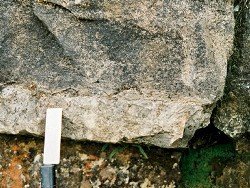 Exposed in the farm lane at the sharp bend just west of the spring line cliff are about 4m of blue-grey, crinoidal, fine to medium-grained, pelletal grainstones with ooliths and micritised grains. The top of these strata is marked by a bed of grey-green bird's eye micrite 0.07m thick. Above this level all the sediments are noticeably sandy and contain abundant bioturbation structures, in particular of Pelecypodichnus, and Planolites and Phycodes traces being less common. A sparse macrofauna occurs throughout the sequence but is most frequently concentrated in thin beds in which gastropods and nautiloids may dominate but which also includes the brachiopods Linoprotonia cf. globosa and Pustula pyxidiformis, the tabulate coral Michelinia megastoma and the colonial rugose coral Dorlodotia pseudovermiculare, which is found at three levels in the upper part of the section. The foraminiferal/algal assemblage obtained from the sandy packstone containing the highest occurrence of D. pseudovermiculare contains rare stunted specimens of the archaediscids Glomodiscus sp., Uralodiscus sp. and Viseidiscus umbogmaenensis indicating an early Arundian age. Microfaunal assemblages from older, lithologically similar strata consistently lack archaediscids but contain Koninckopora sp. (monolaminar) and Biorbis duplex, Endothyra laxa, Eoparastaffella sp. and Florenella stricta indicating a probable late Chadian age. The lowest 12m of strata in the Binnawooda spring section, and at many other outcrops of the Bin Mountain Formation along the north face of Bin and Bolaght Mountains, are characterised by the presence of pebbles and grains of white vein quartz usually between 0.01-0.02m diameter but occasionally up to 0.06m. In most beds the well-rounded pebbles are concentrated in thin layers. | |
| Notes: | |
For information on other sites in Subarea-3 see; Key Site 1176 - Subarea-3; Kesh-Omagh. | |
| Keywords | |
|---|---|
| Rocks: | Limestone, Mudstone, Sand, Sandstone, Siltstone |
| Fossil Groups: | Brachiopod, Coral, Foraminifera, Gastropod, Nautiloid, Trace fossil, Trace fossils |
| Fossil List: | Dorlodotia pseudovermiculare , Eoparastaffella sp., Glomodiscus sp. , Koninckopora sp. (monolaminar) , Linoprotonia cf. globosa , Michelinia megastoma , Pustula pyxidiformis , Uralodiscus sp. |
| Measurements | |||||
|---|---|---|---|---|---|
| Length: | ~200 m | Width: | Height: | ||
| Depth: | Area: | ||||
| Access | |
|---|---|
| Approach: | The north flank of Bin Mountain, in the townland of Binnawooda (H24 77) about 1km NNW of Lough Lee. |
| Record type: | ESCR report | ||
| Entered by: | Crowther, P.R. | ||
| Last updated: | 23 Dec 2003 | ||
| Enlander, I., Dempster, M. & Doughty, P., 2026. Binnawooda Spring, County Tyrone, site details. [In] Earth Science Conservation Review. https://www.habitas.org.uk/escr/site.php?item=220. Accessed on 2026-11-05. |
| Previous Site | Next Site |