
| Previous Site | Next Site |
Earth Science Conservation Review
| Mournes - Dyke No 124 at Samuel's Port, Annalong | Down |
| Site number: | 1108 | ||
| ESCC: | EF | ||
| Locality Type: | Coastal section | Status: | ASSI |
| Grid Reference: | J365181 Centroid | ||
| Google maps: | 54.0944,-5.91363 | ||
| County: | Down | Council area: | Newry, Mourne & Down District Council |
| Period: | Tertiary | ||
| Stages: | Eocene | ||
| Lithostrat: | Granite | ||
| Site Description | |
|---|---|
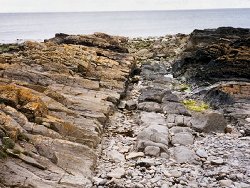 | |
| Highlights: | |
Dyke No. 124 is an unusual member of the Mourne Dyke Swarm. A wide inner member of acid composition shows basification against the earlier marginal basalt intrusion. A later tholeiitic member of the dyke carries xenoliths of gabbro and granite. | |
| Introduction: | |
This dyke is well exposed across the beach, some 2 km S of Annalong. It is about 14 m in width and all but a few are acid in composition. Narrow basalt margins enclose the porphyry and along the southern contact an earlier olivine dolerite and a later tholeiite dyke were emplaced. | |
| Description: | |
The intrusive sequence according to Tomkeieff and Marshall (1935) is an initial emplacement of olivine dolerite, the south dyke, some 1.2 m thick with finer-grained (basaltic) selvedges. A basalt intrusion, the north dyke, some 3 m thick followed, though it is separated from the olivine dolerite by a tholeiite dyke and the age relationship with the south dyke is obscure. The basalt dyke is composite and some 11 m of an acid feldspar porphyry splits the basalt into a 30 cm and 2.7 m thick margin to south and north respectively. The porphyry is reddish in colour and characterised by phenocrysts of anorthoclase and other alkali feldspars; occasional small phenocrysts of hornblende occur but quartz is conspicuous by its absence. The groundmass is compact and felsitic. The two components show some admixing at the internal contacts. A final intrusion of tholeiite is chilled against the olivine dolerite on one side and against the basalt dyke on the other. It is this rock which contains sparse xenoliths of granite and gabbro.
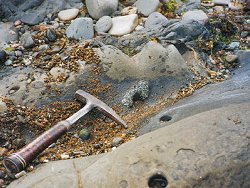 Just north of this composite/multiple dyke occurs a felsite dyke, No.120, with an anomalous northerly trend 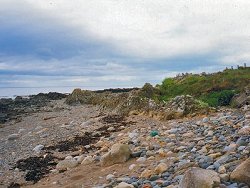 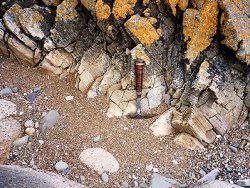 | |
| Importance: | |
A fine example of the intrusion of both acid and basic magma and the best occurrence of gabbro xenoliths in the Mourne Dyke Swarm. | |
| Interpretation: | |
Dyke No. 124 illustrates the co-existence of two contrasting magmas, acid and basic, and their mixing to produce rock of intermediate composition. In this respect it mirrors the magmatic activity during the cone-sheet phase of intrusion. The tholeiite member is the only recorded dyke in the whole swarm to bring up from depth fragments of gabbro, an unusual textural type which shows early separation of olivine, anorthite, and pyroxene followed by the crystallization of the labradorite and its eutectic intergrowth with more pyroxene. | |
| Notes: | |
The outcrop of the porphyry is upstanding and unlikely to be buried by shifting beach sediment. The basalt along the north contact is largely buried beneath sand and pebble. The south margin and the earlier and later members are exposed in a gully well swept by the tides. The xenoliths have been sampled by core drilling and little remains to be seen at the present exposure level. For Mourne Granites general information and reference list see; Key Site 1129 - The Granites - Overview. For general information on the cone-sheet intrusions associated with the Mourne Granites, and the Mourne Mountain dyke swarm, see; Key Site 1131 - Cone-sheet and Dyke Swarm - Overview. | |
| Keywords | |
|---|---|
| Rocks: | Basalt, Gabbro, Porphyry, Tholeiite |
| Structures: | dyke, xenoliths |
| Relations: | Intrusion |
| NonGeol: | Boat slips cross the beach to the north. |
| Measurements | |||||
|---|---|---|---|---|---|
| Length: | Width: | 14m | Height: | ||
| Depth: | Area: | ||||
| Access | |
|---|---|
| Approach: | Leave the Annalong-Kilkeel road at the speed derestriction sign just south of Annalong, Irish Grid Ref. J36701885; here a minor road leads straight to the coast and a small carpark. A 0.5 km walk south brings one to dyke 124. |
| Map(s): | Tomkeieff & Marshall's map and diagrams (1935), are the best reference. | ||
| Record type: | ESCR report | ||
| Entered by: | E M Porter | ||
| Enlander, I., Dempster, M. & Doughty, P., 2026. Mournes - Dyke No 124 at Samuel's Port, Annalong, County Down, site details. [In] Earth Science Conservation Review. https://www.habitas.org.uk/escr/site.php?item=1108. Accessed on 2026-11-06. |
| Previous Site | Next Site |