
| Previous Site | Next Site |
Earth Science Conservation Review
| Mournes - Dunmore Head, Dykes Nos. 60, 61 & 63 | Down |
| Site number: | 1109 | ||
| ESCC: | EF | ||
| Locality Type: | Coastal section | Status: | ASSI |
| Grid Reference: | J388247 Centroid | ||
| Google maps: | 54.15303,-5.87547 | ||
| County: | Down | Council area: | Newry, Mourne & Down District Council |
| Period: | Tertiary | ||
| Stages: | Eocene | ||
| Lithostrat: | Granite | ||
| Site Description | |
|---|---|
 | |
| Highlights: | |
Three members of the Mourne Dyke Swarm at Dunmore Head, carry phenocrysts and aggregates of basic plagioclase which could be cumulate phases and rocks (anorthosites/plagioclasites) originating in a deep-seated basic magma chamber beneath the Mournes. | |
| Introduction: | |
Dykes No.60 and No.63 (Tomkeieff and Marshall 1935) are andesite dykes of Dunmore type which carry xenoliths of anorthosite. No.61 is a conspicuous composite dyke, an earlier injection being crowded with phenocrysts of basic plagioclase which are probably exotic to the host rock. | |
| Description: | |
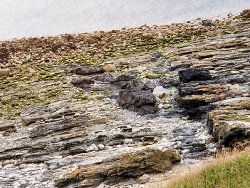
Dyke No.60, 2.3 m wide, is an andesite of Dunmore type, and therefore from the type locality. It is intermediate between the stony 'leidleite' and the andesite variolite and is characterised by numerous plagioclase laths, up to 1.5 mm in length, set in a fine hypohyaline (mostly glassy) groundmass. This dyke contains inclusions or magmatic clots of porphyritic variolite. The xenoliths are extremely coarse-grained and mainly composed of tabular-prismatic basic plagioclase phenocrysts up to 25 mm in length - a glomeroporphyritic assemblage. An anorthitic - bytownitic composition implies an origin in a more basic magma; fragmentation of some crystals occurred during transportation by the enclosing magma, which has a degree of affinity with the host rock. Sparse plagioclase phenocrysts of a similar nature are scattered through the host. Dyke No.63, 3.7 m wide, is also an andesite of Dunmore type and contains similar inclusions to Dyke No.60. One large angular xenolith of anorthosite is also exposed; its hypidiomorphic bytownite/ labradorite laths are closely packed with small patches of a variolitic mesostasis and some evidence of marginal brecciation of the plagioclase. Dyke No.61 is composite with a total width of 9.75 m. An outer component of hypersthene basalt and an inner component of feldspar porphyry, trending 120 deg. are cut by a distinct hypersthene basalt dyke, which trends 155 deg. and follows an independant and cross- cutting fissure. 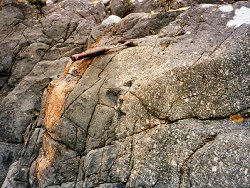 | |
| Importance: | |
The site offers a good cross section of a multiple/composite dyke and is probably the best example of its kind in the whole dyke swarm. The xenoliths and xenocrysts present in the dyke-rock are the only evidence of what accounts for the high gravity anomoly over the Mourne region. | |
| Interpretation: | |
The abundance of basic plagioclase crystals of varying size and their association with xenoliths of anorthosite offer an insight into magmatic processes at considerable depth beneath the Mourne Granites. A large volume of slowly cooling and crystallizing basic magma probably developed cumulus phases, such as basic plagioclase, which accumulated to make anorthositic rocks. The habit of the feldspar and the large size of some crystals would suggest their entrainment by the dyke magma. | |
| Conclusions: | |
The exposure of dyke-rocks at Dunmore Head is critical to a fuller understanding of the Mourne Igneous Centre. | |
| Notes: | |
It is unlikely that this outcrop could be buried under the boulder beach though neighbouring dykes could be obscured in this way. For Mourne Granites general information and reference list see; Key Site 1129 - The Granites - Overview. For general information on the cone-sheet intrusions associated with the Mourne Granites, and the Mourne Mountain dyke swarm, see; Key Site 1131 - Cone-sheet and Dyke Swarm - Overview. | |
| Keywords | |
|---|---|
| Rocks: | Andesite, Anorthosite, Basalt, Porphyry |
| Structures: | dyke |
| Relations: | Intrusion |
| Measurements | |||||
|---|---|---|---|---|---|
| Length: | Width: | D60-2.3m / D61-9.75m / D63-3.7m | Height: | ||
| Depth: | Area: | ||||
| Access | |
|---|---|
| Approach: | Access to the beach is made from Irish Grid Ref. J384246 on the Newcastle-Annalong road. The composite dyke can be clearly seen from the grassy path (National Trust) which descends the glacial moraine to the beach. |
| Map(s): | Tomkeieff & Marshall's map (1935) is the best representation of the whole Mourne dyke swarm and the only map indicating the occurrence of the dykes described above. | ||
| Record type: | ESCR report | ||
| Entered by: | E M Porter | ||
| Enlander, I., Dempster, M. & Doughty, P., 2026. Mournes - Dunmore Head, Dykes Nos. 60, 61 & 63, County Down, site details. [In] Earth Science Conservation Review. https://www.habitas.org.uk/escr/site.php?item=1109. Accessed on 2026-11-06. |
| Previous Site | Next Site |