
| Previous Site | Next Site |
Earth Science Conservation Review
| Mournes - The Diamond Rocks | Down |
| Site number: | 1110 | ||
| ESCC: | EO | ||
| Locality Type: | Crag, Crags | Status: | ASSI |
| Grid Reference: | J332287 Centroid | ||
| Google maps: | 54.19043,-5.95935 | ||
| County: | Down | Council area: | Newry, Mourne & Down District Council |
| Period: | Tertiary | ||
| Stages: | Eocene | ||
| Lithostrat: | Granite | ||
| Site Description | |
|---|---|
 | |
| Highlights: | |
The occurrence of well formed crystals of both common and rare minerals lining cavities within the Quartzose Granite G2 of the Eastern Mournes. | |
| Introduction: | |
The Mourne Mountains have long been known to geologists, mineralogists and collectors for the rare minerals which can be found in the drusy cavities of the granite. | |
| Description: | |
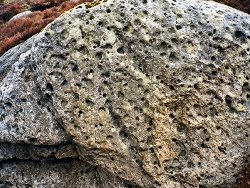
The Diamond Rocks are located near the margin of the Quartzose Granite, G2, just south of Slievenaglogh and west of Slieve Corragh. Conspicuous crags of granite break the smoother heather covered southern slopes of Slievenaglogh between the Mourne Wall and the Brandy Pad. From a distance the granite appears structureless, lacking the rectilinear jointing pattern which normally characterizes it. At close hand the finer-grained rock is full of irregular cavities 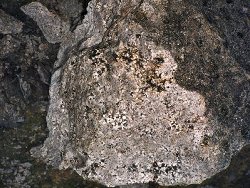 Some cavities yield rarer minerals, reflecting the more unusual composition of the fluids, vapours and gases, responsible for the gas cavities in the igneous rock. Topaz, an aluminium fluorosilicate is the commonest of these accessory minerals. It is colourless and transparent but because of its higher refractive index it has a higher lustre than quartz. It occurs in beautifully terminated prisms about 3-10 mm in size. It has a higher density than the essential minerals of granite and so can be concentrated by panning. Beryl, a beryllium aluminium silicate, is not as abundant as Topaz and cannot be concentrated by panning. It occurs in hexagonal prisms with flat terminations. Some varieties are green and opaque, others pale bluish-green and transparent such as aquamarine. Unusual finds would include Zinnwaldite, a lithium iron mica resembling biotite; Fluorspar, a calcium fluoride, in cubes and octahedra, colourless or deep purple in colour; Iron - titanium oxides, possibly magnetite, titanomagnetite or ilmenite; Stilbite, a sodium-calcium zeolite; Tourmaline, a boro-silicate of iron and aluminium - the black schorl variety; Peridot - a clear green olivine. | |
| Importance: | |
The best example of its kind in the whole of the Mourne Mountains and probably unrivalled elsewhere in the British Isles. | |
| Interpretation: | |
The concentration of such elements as lithium, beryllium, and boron and the presence of gaseous elements such as fluorine, would indicate the trapping of late stage fluids within the granite magma. If the granite intrusions have the ring-dyke structure claimed by Richey (1828) then as the deeper seated magma rising up the ring fracture cooled and crystallized, the late stage fluids would have migrated upwards until their ascent was arrested by the already congealed roof zone of the intrusion, an earlier pulse of the G2 magma (see Harry and Richey 1963). Final solidifation of this fluid-enriched volume of magma produced the miarolitic/drusy granite. | |
| Conclusions: | |
A locality of considerable reknown, visited by geologist and layman alike, for its wealth of essential and accessory granite minerals. | |
| Notes: | |
A word to mineral collectors! There is no need to break open the solid rock, indeed little would be gained by doing so. The disintegration of the granite has littered the area with rock fragments and coarse sand and it is amongst the sandy patches that one will find the more unusual minerals. For Mourne Granites general information and reference list see; Key Site 1129 - The Granites - Overview. For general information on the cone-sheet intrusions associated with the Mourne Granites, and the Mourne Mountain dyke swarm, see; Key Site 1131 - Cone-sheet and Dyke Swarm - Overview. This site is also important for Mineralogy and Metallogenesis. See Key Site 540 - The Diamond Rocks, Mourne Mountains. | |
| Keywords | |
|---|---|
| Minerals: | Beryl, Fluorite, Magnetite, Peridot, Stilbite, Topaz, Tourmaline, Zinnwaldite |
| Rocks: | Granite |
| Structures: | drusy |
| Relations: | Intrusion |
| NonGeol: | Upland Heath within the water catchment area of th |
| Access | |
|---|---|
| Approach: | Access is by walking the Trassey Track to the Hare's Gap and following the Brandy Pad to a point, 365 m to the east, where a large erratic boulder of drusy granite rests just above the path. A 70 m climb uphill brings one to the Diamond Rocks. |
| Map(s): | The site is shown on the 1:50,000 and 1:25,000 Ordnance Survey maps, and on the IGS special sheet (1978). | ||
| Record type: | ESCR report | ||
| Entered by: | E M Porter | ||
| Enlander, I., Dempster, M. & Doughty, P., 2026. Mournes - The Diamond Rocks, County Down, site details. [In] Earth Science Conservation Review. https://www.habitas.org.uk/escr/site.php?item=1110. Accessed on 2026-11-06. |
| Previous Site | Next Site |