
| Previous Site | Next Site |
Earth Science Conservation Review
| Minnis North Mudflow | Antrim |
| Site number: | 114 | ||
| ESCC: | IA | ||
| Locality Type: | Inland exposure, Landslip | Status: | ASSI |
| Grid Reference: | D339135 Centroid | ||
| Google maps: | 54.95152,-5.91003 | ||
| County: | Antrim | Council area: | Mid & East Antrim Borough Council |
| Period: | Cretaceous, Jurassic | ||
| Stages: | Campanian, Cenomanian, Coniacian, Hettangian, Lower Jurassic, Lower Lias, Santonian, Turonian, Upper Cretaceous | ||
| Lithostrat: | Hibernian Greensands Formation, Lias Undivided, Lower, Ulster White Limestone Formation | ||
| Site Description | |
|---|---|
 | |
| Highlights: | |
Lower Lias mudstones exposed by this active mudflow have yielded the richest and most diverse fauna of vertebrates and invertebrates of any Lower Jurassic site in Northern Ireland. Acid disaggregation of blocks from the Hibernian Greensands have also yielded an unexpectedly diverse fauna of fish teeth. | |
| Introduction: | |
The mudflow at Minnis North lies on the A2 Antrim Coast Road northwest of Drumnagreagh Port. Its palaeontological interest is confined to the Jurassic and Cretaceous material derived from major slips in these strata some 40-50 metres above sea level. Jurassic rocks are confined to the lower part of the Lower Lias, more specifically the Hettangian Stage, while the Cretaceous strata span the Cenomanian to Campanian stages. The steep slope down which the mudflow itself descends appears to be developed on the uppermost beds of the Mercia Mudstone Group, of late Triassic age, judging from the presence a short distance to the northwest of another substantial landslip scar exposing typical red silty mudstones. However, evidence for the intervening Penarth Group remains equivocal. Although the site has been described in a number of geomorphological papers (Colhoun et al. 1965, Craig 1981, Hutchinson et al. 1974, McGreal and Craig 1977, Prior 1975, Prior and Stephens 1971, 1972, Prior et al. 1968, 1970, McDonnell 1996), its palaeontological significance has not previously been remarked upon in any published accounts other than passing mention by Ivimey-Cook (1975). | |
| Description: | |
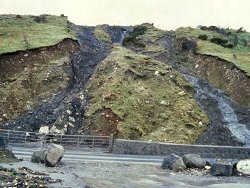
The mudflow at Minnis North lies immediately landward of the A2 Antrim Coast Road. An anastomosing series of chutes descend from a scarp crest some 40-50 metres above the road; three chutes are present on the upper part of the scarp but the two western chutes merge about halfway down and only two are present on the lower part of the scarp.
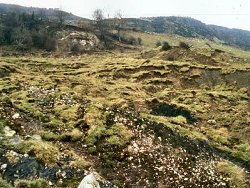 The Upper Cretaceous succession in this area is fairly well developed, including all but one unit (the upper unit of the Lower Glauconitic Sandstone) of the Hibernian Greensand sequence and all of the Ulster White Limestone Formation from the Cloghfin Sponge Beds to the Garron Chalk Member (Fletcher 1977). A broad range of lithologies are represented. Within the Lias succession, which appears to be dominated by blue-grey shaly mudstones, there are indurated horizons of siltstone, fine sandstone, shell lumachelles and bioclastic limestones. Pyritised fossils are not uncommon within the Lias shales. Ammonite evidence indicates that most of the Hettangian stage is represented. The planorbis Zone is well represented by fairly abundant specimens of Caloceras while less common fragments of Schlotheimia angulata, S. extranodosa and a single fragment of S. complanata indicate that the angulata Zone is largely complete. The liasicus Zone is assumed to be present also although this has yet to be confirmed by the discovery of any of the diagnostic ammonites such as Waehneroceras or Alsatites. The Cretaceous succession is more varied lithologically and all stages from the Cenomanian (mantelli Zone) to the Upper Campanian (mucronata Zone) probably are represented. The Hibernian Greensands Formation includes dark green muddy glauconitic sands, readily assignable to the Belfast Marls Member, while paler conglomeratic or bioclastic glauconitic sands probably can be assigned to various units within the Kilcoan Sands Member. Loose blocks from the Ulster White Limestone Formation are conspicuous within the mudflow debris but generally cannot be assigned to any member within the formation. Most are hard white limestones, sometimes with flints or abundant shell debris. Only the Cloghfin Sponge Beds Member can readily be identified in loose blocks on account of its high glauconite content and phosphatised sponge spicules. The mechanism by which fossil material arrives at the foot of the mudflow and is eroded out by the sea poses considerable problems in terms of locating material stratigraphically other than in the broadest sense, i.e. Lower Lias, Hibernian Greensand or Ulster White Limestone. It also prevents any detailed attempt at palaeoecological analysis of the fauna or, in the case of the Lower Lias in particular, any overall palaeoenvironmental interpretations. Although the strata quite obviously are severely disrupted during the descent of the mudflow, some separation of different stratigraphic levels appears to remain. For instance, specimens of Caloceras and Schlotheimia tend to occur in discrete areas rather than randomly scattered through the dumped material. This suggests that different episodes of movement higher up the mudflow are, in fact, sampling different stratigraphic intervals. The site is visited by collectors at frequent intervals, with parties of children from the field centre at Drumaller House, Carnlough, visiting on an almost weekly basis. The Ulster Museum holds a fair selection of material from the site, much of it collected by the late George Barker, which forms the basis of the faunal list appended here. LOWER JURASSIC FAUNA AMMONOIDEA Ammonites are a conspicuous element of the Lower Lias fauna at Minnis North. Psiloceratids, particularly species of Caloceras, are the most abundant. Many are uncrushed and well preserved, preserved either as pyritic casts or in blocks of bioclastic limestone; in the latter case they often lie at various angles to the bedding. Schlotheimia is represented mostly by fragmentary material, also often pyritised. Psiloceras planorbis - scarce; subzonal index for the lower part of the planorbis Zone Psiloceras sampsoni - scarce Caloceras multicostatum - abundant in some of the thicker bioclastic limestones Caloceras intermedium - common Caloceras johnstoni - common; subzonal index for the upper part of the planorbis Zone Schlotheimia angulata - common; the zonal index Schlotheimia extranodosa - common; subzonal index for the lower part of the angulata Zone Schlotheimia cf. complanata - single fragment; subzonal index for upper part of the angulata Zone Waehneroceras sp. - occasional fragments NAUTILOIDEA The nautiloid Cenoceras striatus occurs occasionally. BELEMNOIDEA Two large belemnite phragmocones can tentatively be assigned to Schwegleria or Nannobelus, these being the only belemnite genera known from the Hettangian and lowermost Sinemurian. Belemnites are very rare before the lower Sinemurian. BIVALVIA Bivalves are an abundant element of the fauna although inevitably attracting less attention from collectors than the ammonites or vertebrates. Cardinia appears to be by far the most abundantly represented genus and, although showing considerable variation, specimens probably can be all assigned to a single species. Identified taxa include: cf. Ceratomya, Liostrea hisingeri, Isognomon cf isognomonoides, Mactromya cardioides, Modiolus laevis, Plagiostoma rigidum, Plagiostoma gigantea, and Cardinia listeri. GASTROPODA Gastropods are a significant, though inconspicuous, element of the fauna. Some limestone beds are crowded with small gastropods of several different species although none have, as yet, been identified. ARTHROPODA Arthropods are a rather rare component of the fauna but do attract the attention of collectors. Pseudoglyphea sp. - two specimens, including articulated tail with Discinisca attached Coleia sp. - three specimens Glyphea cf. tomesi ECHINOIDEA Echinoids are a much neglected group within the Lower Lias. Disarticulated plates and spines of Eodiadema bechei may occur abundantly on the surface of some of the thin platy lumachelles but are easily overlooked. Miocidaris lobatum is much less common but is represented by a crushed test and a few plates and spines OPHIUROIDEA Ophiuroids are rarely recorded from the Lower Lias but often occur in fair abundance in the form of disarticulated ossicles. Only a single arm fragment of Palaeocoma escheri has been found at this site. CRINOIDEA A common element of Lower Lias faunas, usually in the form of disarticulated columnals. These are not uncommon in some of the bioclastic limestones and can be assigned to Isocrinus psilonoti. One specimen of the cup and proximal arms has also been found at this site. PORIFERA Corals are a relatively scarce and rather unusual element of the fauna. Colonial forms are represented by Heterastrea murchisoni while solitary forms are slightly more common and represented by the small Montlivaltia haimei. VERTEBRATA Ichthyosaur vertebrae are not uncommon and typically less than 5 cm in diameter. A small ichthyosaur skull, together with a few cervical vertebrae and ribs, has also been recovered partly enclosed in a limestone nodule. This specimen is associated with several crushed and partly pyritised Psiloceras planorbis and hence is relatively well localised stratigraphically. A few other ichthyosaur jaw fragments and other bones have also been found. Plesiosaur bones appear to be less common than those of ichthyosaurs but several vertebrae, partly enclosed in limestone nodules, appear to be from the same individual. Most marine reptile bones appear to be from the shales, with some from shelly limestones although these are often rather worn. Some of the articulated material already mentioned is partly enclosed in limestone nodules while a few isolated bones are partly enclosed in small pyrite nodules. PLANTAE Coalified driftwood occurs occasionally, both in the shales, where it may be partly pyritised, and in some of the limestones. UPPER CRETACEOUS FAUNA The fauna of the Upper Cretaceous sediments at Minnis North has been much less extensively sampled than that of the Lower Lias. In part this is a consequence of the difficulty of extraction of many of the fossils in the Ulster White Limestone but it also reflects the absence or inconspicuous nature of the more collectable elements, such as ammonites and vertebrates. PORIFERA Most of the sponges recovered at Minnis North are from the richly glauconitic chalk near the base of the Ulster White Limestone Formation but a few are from higher in the succession, either in hard limestone or in flint nodules. cf. Acrochordonia sp. Entonia sp. (borings in belemnite) Etheridgia mirabilis euretid sp. indet. Hallirhoa sp. Jerea sp. (mould in flint) Mirabilis sp. Rhizopoterium sp. Wollenmania sp. CEPHALOPODA Specimens of Belemnitella mucronata are not uncommon, although usually in a fragmentary state. ECHINOIDEA A large specimen of Echinocorys, with test preserved, is from richly glauconitic chalk near the base of the succession. ANNELIDA The serpulid Rotularia sp. is not uncommon in some blocks of glauconitic sandstone from the Hibernian Greensands. VERTEBRATA Vertebrate remains are not immediately apparent in any of the Upper Cretaceous lithologies at Minnis North but acid digestion of loose blocks of a conglomeratic sandstone from the Hibernian Greensands has yielded a rich and diverse fauna of fish teeth to Dr Charlie Underwood. Two styles of preservation are evident; worn, dark and mineralised teeth are thought to represent reworked remains (indicated by R in the following faunal list) while pale, unworn and fragile teeth are considered as autochthonous (indicated by A in the following faunal list). Dr Underwood has identified the following taxa: HYBODONTIDS ? Polyacrodus illingsworthi R SYNECHODONTIFORMES Synechodus sp. R HETERODONTIFORMES Heterodontus canaliculatus [lateral teeth] R, Heterodontus ?lonzensis [lateral and anterior teeth] R, Heterodontus sp. [anteriolateral tooth] A ORECTOLOBIFORMES orectolobid indet. (? Cederstroemia) R, ?Cantioscillium decipiens R LAMNIFORMES and CARCHARINIFORMES 'lamniformes' indet. R, A, Squalicorax falcatus R - abundant, ?Pseudocorax sp. R, Cretolamna appendiculata R, A, Paranomotodon angustidens R, A - very common. BATOIDEA Turoniabatis cappetteri [single tooth fragment] A HOLOSTEANS Semionotid indet. R, ?Pycnodont indet. R, Teleost indet. A, Enchodont indet. R, A. | |
| Importance: | |
The mudflow at Minnis North is of major importance not only as a classic landform but also on account of fossil material obtained from the slumped debris. It represents the richest Lower Jurassic fauna known from Northern Ireland and the only one to yield significantly articulated vertebrate material. Only a relatively small proportion of the macrofauna has yet been identified and a more intensive investigation of smaller elements of the fauna, such as gastropods, and of the microfauna will undoubtedly increase the faunal list greatly. The Cretaceous interest of the site is confined largely to the rich vertebrate fauna obtained from the Hibernian Greensand by acid digestion. This represents the only significant Cretaceous fish fauna from Northern Ireland and includes several species unknown from Britain. According to Dr Underwood the fish fauna has significant affinities with faunas in Kent and Belgium but bears little similarity to fish faunas from the Cretaceous of Yorkshire despite the relative proximity of the latter area. | |
| Interpretation: | |
Because of the high degree of disturbance which the Lower Jurassic and Upper Cretaceous sediments experience at Minnis North before they can be sampled, no detailed interpretation can be made of the succession or its environments of deposition. Nonetheless, some general statements can be made drawing on particular lines of evidence from the fossils and from lithologies recovered from the mudflow. These indicate that within the preserved Hettangian succession a variety of environments were represented. The presence of well preserved articulated vertebrate material suggests at least one period of sea floor anoxia during the early part of the Hettangian (planorbis Subzone), as is the case in parts of the British Isles and north-west Europe (Hallam 1987). The pyritic preservation of many of the specimens of Caloceras also indicate an anoxic to dysaerobic benthic environment. In contrast, other elements of the benthic fauna show that well-oxygenated conditions prevailed on the sea floor for much of the time. The corals Heterastrea and Montlivaltia provide evidence for periods of clear water with little sedimentation. In stark contrast to this the articulated crinoid, ophiuroid and miocidarid remains must owe their preservation to catastrophic burial by sudden influxes of sediment. Some of the poorly fossiliferous limestones probably represent secondary, diagenetic features but the more bioclastic units clearly represent significant environmental events. The thin, platy shell lumachelles with echinoid debris probably represent short periods of non-deposition, with taphonomic feedback leading to the dominance of the ostreid Liostrea hisingeri until sedimentation resumed again. The much thicker limestones with abundant shell debris and intact psiloceratids at angles to the bedding may represent tempestite, or storm lag, deposits. With the exception of the vertebrate remains recovered by Dr. Underwood, the fauna from the Upper Cretaceous rocks at Minnis North contributes little new evidence to our understanding of late Cretaceous palaeoenvironments in Northern Ireland. | |
| Conclusions: | |
Although profoundly disrupted by mass movement processes, the fauna recovered from the mudflow at Minnis North indicates that a diverse suite of environments is represented in the Hettangian Stage, the Hibernian Greensands and the Ulster White Limestone Formation of the late Cretaceous. The Lower Jurassic fauna which the site has yielded is among the richest in Northern Ireland. | |
| Notes: | |
For general information and references on the Palaeontology of Northern Ireland see Key Site 109 - Palaeontological sites of N. Ireland - Introduction For other site specific information and references on the Palaeontology of Northern Ireland see Key Site 110 - Ballycastle Pellet Chalk, Key Site 111 - Ballypalady Plant Bed, Key Site 112 - Carrick Lough, Bunnahone Lough and the Sillees River, Key Site 113 - Faragandoo, Key Site 115 - Moyola River, Key Site 116 - Mullynaskeagh Clay Pit, Key Site 117 - Murlough Bay, Key Site 118 - Portnaloub, Key Site 119 - Sillees River, Glenasheevar, Key Site 120 - Tircrevan Burn, and Key Site 121 - Tullyconnell. | |
| Keywords | |
|---|---|
| Rocks: | Greensand, Limestone, Mudstone, Sand |
| Fossil Groups: | Ammonite, Annelid, Arthropod, Belemnite, Bivalve, Crinoid, Echinoderm, Fish, Gastropod, Nautiloid, Plant, Sponge |
| Geomorph: | mudflow |
| Access | |
|---|---|
| Approach: | The mudflow at Minnis North lies immediately landward of the A2 Antrim Coast Road northwest of Drumnagreagh Port. |
| Management: | |
The active nature of the Minnis North mudflow does represent a potential hazard to traffic using the coast road. The foot of the mudflow is cleared at regular intervals to minimise potential disruption to traffic caused by a significant build-up of debris on the landward side of the road. The cleared material is dumped on the seaward side of the road where active marine erosion is a major factor in exposing the contained fossil fauna. The highly disrupted surface drainage of the bowl slip behind the main active chute causes significant ponding during wet weather, contributing to the build-up of pore water pressure within the underlying clays and thereby maintaining the activity of the mudflow. Any attempt to drain the bowl slide would impact significantly on the activity of the mudflow and greatly reduce the amount of material reaching the sea. | |
| Uses | |
| Uses: | The area directly affected by mass movement is far too disrupted to be of any practical value to agriculture, although the land immediately adjacent is low-grade agricultural land used for rough grazing. |
| References (13) | |||
|---|---|---|---|
| Colhoun, E.A., Common, R. & Cruikshank, M.M., 1965. Recent bog flows and debris slides in the north of Ireland Scientific Proceedings of the Royal Dublin Society, vol. A2(10), pp.163-174. | |||
| Craig, D., 1981. Weather and mudslide activity in east County Antrim, Northern Ireland Weather, pp.58-63. | |||
| Hallam, A., 1987. Mesozoic marine organic-rich shales Special Publications of the Geological Society of London, numb. 26 In Marine Petroleum Source Rocks, pp.251-261. | |||
| Hutchinson, J.N., Prior, D.B. & Stephens, N., 1974. Potentially dangerous surges in an Antrim mudslide Quarterly Journal of Engineering Geology, vol. 7, pp.363-376. | |||
| Ivimey-Cook, H.C., 1975. The stratigraphy of the Rhaetic and Lower Jurassic in East Antrim. Bulletins of the Geological Survey of Great Britain, numb. 50, pp.51-70. | |||
| McDonnell, B., 1996. East Antrim ESCR Report (Minnis North Mudflow) (Unpublished Report) School of Geosciences, Queen's University, Belfast. | |||
| McGreal, W.S. & Craig, D., 1977. Mass movement activity: an illustration of differing responses to groundwater conditions from two sites in Northern Ireland Irish Geography, vol. 10, pp.28-35. | |||
| McKenna, J., Carter, R.W.G. & Bartlett, D., 1992. Coast erosion in northeast Ireland: Part 2, cliffs and shore platforms. Irish Geography, vol. 25 pt. 2, pp.111-128. | |||
| Prior, D,B., Stephens, N. & Douglas, G.R., 1970. Some examples of mudflow and rockfall activity in north-east Ireland Institute of British Geographers Special Publication, vol. 3, pp.129-139. | |||
| Prior, D.B., 1975. A mudslide on the Antrim coast, 24th November 1974 Irish Geography, vol. 8, pp.55-62. | |||
| Prior, D.B. & Stephens, N., 1971. A method of monitoring mudflow movements Engineering Geology, vol. 5, pp.239-246. | |||
| Prior, D.B. & Stephens, N., 1972. Some movement patterns of temperate mudflows: examples from northeast Ireland Bulletin of the Geological Society of America, vol. 83, pp.2533-2544. | |||
| Prior, D.B., Stephens, N. & Archer, D.R., 1968. Composite mudflows on the Antrim coast of northeast Ireland Geografiska Annaler, vol. 50A, pp.65-78. | |||
| Record type: | ESCR report | Recorded by: | Michael J. Simms, Department of Geology, Ulster Mu |
| Entered by: | E M Porter | ||
| Enlander, I., Dempster, M. & Doughty, P., 2026. Minnis North Mudflow, County Antrim, site details. [In] Earth Science Conservation Review. https://www.habitas.org.uk/escr/site.php?item=114. Accessed on 2026-11-06. |
| Previous Site | Next Site |