
| Previous Site | Next Site |
Earth Science Conservation Review
| Sillees River, Glenasheevar | Fermanagh |
| Site number: | 119 | ||
| ESCC: | EO | ||
| Locality Type: | Stream section | Status: | ASSI |
| Grid Reference: | H041538 Centroid | ||
| Google maps: | 54.43319,-7.9368 | ||
| County: | Fermanagh | Council area: | Fermanagh & Omagh District Council |
| Period: | Carboniferous | ||
| Stages: | Asbian | ||
| Lithostrat: | Leitrim Group, Meenymore Formation | ||
| Site Description | |
|---|---|
 | |
| Highlights: | |
This is one of only four sites, of any age, in Northern Ireland which has yielded well-preserved and articulated fish remains. Although the fish fauna so far recovered is monospecific, the abundance of material and the presence of terrestrial plant remains suggest the site may reward further investigation. | |
| Introduction: | |
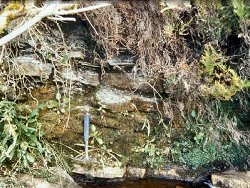
The locality lies several hundred metres south of the Derrygonnelly-Garrison road on a tributary of the Sillees River draining east-north-east from Lough Naman. The streams in this area of low hills and blanket bog are, in places, incised into the gently-dipping Carboniferous rocks beneath. At the particular locality from which the fish have been obtained, the stream flows east for a short distance down the dip of an exposed limestone bed before swinging south-south-eastwards, roughly along strike, for 10 metres or so before turning eastwards once again to descend slightly less steeply than the prevailing dip. Although fish were first recorded from the site in 1963, only one brief account has been published in which the sole element of the fish fauna, Elonichthys serratus, was described together with notes on the palaeoenvironment of deposition of the fish bearing horizon (Gardiner and Mason 1974). Essentially the same notes are included in unpublished accounts by Mason (1971, 1974). | |
| Description: | |
The clearest exposure of the fish-bearing horizons is found along the strike section of the stream, where about 1.5 metres of strata are exposed above the limestone which forms the 'water slide' at the upstream corner. This section comprises a series of rather soft, sometimes blocky, grey mudstones alternating with harder, dark-grey, laminated limestones from 0.1-0.14 metres thick. Within the mudstones harder lenticles do occur and this fact may account for the significant lack of correspondence found between the section as measured in August 1997 (see below) and that measured by Gardiner and Mason (1974). Downstream of the second corner these laminated limestones and mudstones soon descend beneath the stream bed and a short distance further downstream a massive dolomite bed more than a metre thick is exposed above them. The fish fauna at this locality was first discovered by R.L.Wilson in 1963, during an undergraduate field exercise from the Queen's University of Belfast. Subsequent collecting was undertaken by Howard Brunton, of the British Museum (Natural History), and Tom Mason, now of Armagh Planetarium. Subsequently the locality and its fish fauna formed the subject of part of a short paper by Gardiner and Mason (1974). The succession lies within the lower part of the Meenymore Formation, part of the Leitrim Group. Gardiner and Mason (1974) obtained specimens of the goniatite Beyrichoceras micronotum Phillips from strata some 6 metres below the fish-bearing beds, indicating a B2 Zone age and a position in the late Asbian. They estimated the fossiliferous horizon to lie about 40 metres above the top of the main escarpment-forming limestones, which in this area is the Dartry Limestone Formation of the Tyrone Group. At least four distinct units of laminated and sometimes silty micrite were visible in August 1997, although the section in Gardiner and Mason's (1974) paper depicts seven. 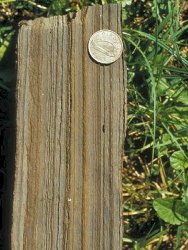 The following succession below was measured in August 1997: 10. Grey, blocky mudstone, 0.50m 9. Grey, argillaceous micrite, 0.05m 8. Indurated, dark-grey, laminated, organic-rich micrite; conspicuously undulated. Scales and intact specimens of Elonichthys serratus, 0.09m 7. Grey, blocky mudstone, 0.12m 6. Indurated, dark-grey, laminated, organic-rich micrite; weakly undulated with softer shale partings at intervals. Scales and intact specimens of Elonichthys serratus, 0.06m 5. Indurated, dark-grey, laminated micrite, 0.14m 4. Weakly indurated, rather poorly laminated pale grey mudstone, 0.06m 3. Indurated, dark-grey, laminated, organic-rich micrite, 0.10m 2. Poorly indurated, rather pale grey mudstone with some harder lenticles, 0.34m 1. Yellow-weathering dolomite band, 0.08m Comments made by Gardiner and Mason (1974) that the fish from this site were uncommon and mostly fragmentary, together with the fragmentary nature of material already in the collections of the Ulster Museum, contradicts observations made during the course of this survey. Only one short visit in August 1997 resulted in the discovery of several virtually intact palaeoniscids, parts of several others, and abundant disarticulated debris. 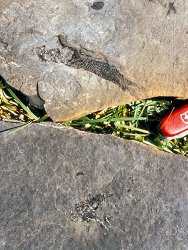 | |
| Importance: | |
This small exposure is relatively isolated within a considerably faulted outcrop of Lower Carboniferous strata. Consequently it is difficult to ascertain its precise relationship to and significance for the overall succession within the Meenymore Formation. On palaeontological grounds the site is of very considerable importance as one of only three localities from which well-preserved, articulated fossil fish material has been obtained in Northern Ireland, and one of only a handful of such sites in Ireland as a whole. In general the facies and its restricted fauna shows greater affinities with correlative successions in Scotland. Although the biota recovered from this site to date is extremely limited, it includes terrestrial elements and hence its potential significance may extend considerably further. | |
| Interpretation: | |
Gardiner and Mason (1974) discussed briefly the palaeoecology of Elonichthys serratus and the environment of deposition of the laminated micrites. This can be refined in the light of observations made during the present survey. The sequence as a whole represents a marginal marine environment with evaporitic periods and occasional marine incursions. The presence of goniatites only six metres below the fish-bearing horizons indicates that fully marine conditions prevailed across the area only shortly before deposition of the laminated micrites. However, an unequivocally marine fauna is absent from the laminated micrites, which instead contain a very depauperate fauna. The only fossils recovered other than the numerous palaeoniscid remains are a single ?sphenopterid pinnule and two indeterminate small plant ?stems. This suggests proximity to some landmass, while the monospecific fish fauna suggests quasi-marine, probably brackish, conditions, a situation broadly in accordance with that proposed by Gardiner and Mason (1974). The well-laminated nature of the micrites indicates a virtual absence of benthic infauna or epifauna which, together with their slightly bituminous nature, suggests benthic anoxia on at least a local scale. This anoxia, which may have arisen either from temperature or salinity stratification of the water column, and the lack of benthos arising from it has been a major factor contributing to the exceptional preservation of the fish at this site. | |
| Conclusions: | |
A small, isolated exposure of the Lower Carboniferous Meenymore Formation has yielded an abundant, though monospecific, fish fauna from laminated bituminous carbonates. Only two other sites in Northern Ireland have yielded well-preserved, articulated fish remains. The future significance of this site may be enhanced by the presence of terrestrial material. | |
| Notes: | |
For general information and references on the Palaeontology of Northern Ireland see Key Site 109 - Palaeontological sites of N. Ireland - Introduction For other site specific information and references on the Palaeontology of Northern Ireland see Key Site 110 - Ballycastle Pellet Chalk, Key Site 111 - Ballypalady Plant Bed, Key Site 112 - Carrick Lough, Bunnahone Lough and the Sillees River, Key Site 113 - Faragandoo, Key Site 114 - Minnis North Mudflow, Key Site 115 - Moyola River, Key Site 116 - Mullynaskeagh Clay Pit, Key Site 117 - Murlough Bay, Key Site 118 - Portnaloub, Key Site 120 - Tircrevan Burn, and Key Site 121 - Tullyconnell. | |
| Keywords | |
|---|---|
| Rocks: | Limestone, Micritic limestone, Mudstone |
| Fossil Groups: | Fish, Plant |
| Paleoenv: | marginal marine |
| Measurements | |||||
|---|---|---|---|---|---|
| Length: | Width: | Height: | 1.5m | ||
| Depth: | Area: | ||||
| Access | |
|---|---|
| Management: | |
Other than natural erosion perhaps causing minor slumping of the bank to cover the fossiliferous horizons, the site is largely unthreatened and there would be no advantage in attempts to clean the section up. The main threat derives from the potential activities of irresponsible commercial fossil collectors. At present the site is known by only a few individuals and there has never been any attempt to work the site intensively. However, should it become more widely known, particularly to collectors elsewhere in the UK, it would be only a matter of time before damage to the site occurred. The relatively isolated nature of the site also means that any 'quarrying' by such collectors could go unnoticed. The best management policy for this site would appear to be to maintain the present level of 'secrecy'. | |
| Threats: | Commercial fossil collectors. |
| Uses | |
| Uses: | The site is located within an area of rough moorland in which small scale peat cutting has occurred in the past. Cattle are occasionally grazed on the land adjacent to the site. A substantial forestry plantation lies a short distance to the south. |
| References (1) | |||
|---|---|---|---|
| Gardiner, B.G. & Mason, T.R., 1974. On the occurrence of the palaeoniscid fish Elonichthys serratus in the Visean of County Fermanagh, with a note on the Enniskillen and Egerton collections. Proceedings of the Royal Irish Academy, vol. 74(B), pp.31-36. | |||
| Record type: | ESCR report | Recorded by: | Michael J. Simms, Department of Geology, Ulster Mu |
| Entered by: | E M Porter | ||
| Enlander, I., Dempster, M. & Doughty, P., 2026. Sillees River, Glenasheevar, County Fermanagh, site details. [In] Earth Science Conservation Review. https://www.habitas.org.uk/escr/site.php?item=119. Accessed on 2026-11-08. |
| Previous Site | Next Site |