
| Previous Site | Next Site |
Earth Science Conservation Review
| Scrabo Hill - Triassic | Down |
| Site number: | 1200 | ||
| ESCC: | ED | ||
| Locality Type: | Quarry (disused) | Status: | ASSI |
| Grid Reference: | J479725 Centroid | ||
| Google maps: | 54.57957,-5.71256 | ||
| County: | Down | Council area: | Ards & North Down Borough Council |
| Period: | Tertiary, Triassic | ||
| Stages: | Middle Triassic, Palaeogene, Scythian | ||
| Lithostrat: | Scrabo Sill, Sherwood Sandstone Group | ||
| Site Description | |
|---|---|
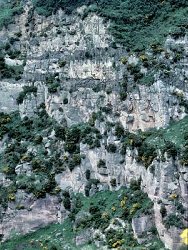 | |
| Highlights: | |
The sections exposed in the South Quarry at Scrabo provide good examples of sedimentary structures in the Sherwood Sandstone Group together with Palaeogene dolerite sills and the associated contact metamorphism and mineralisation. | |
| Introduction: | |
The South Quarry at Scrabo is 2.25km SW of Newtownards, Co. Down. The quarry is sited on the SE side of Scrabo Hill. Scrabo Hill is composed of a Palaeogene dolerite intrusion, the Scrabo Sill which intruded the Sherwood Sandstone Group (Plate 10a). Portlock inferred that the basalt of Scrabo Hill was an outlier of the Antrim lava flows and were thus extrusive in origin. Hull et al. (1871) described the quarry but assigned the sandstones to the Lower Keuper Sandstone. Lamplugh et al. (1904) recognised the igneous rocks as an intrusive mass or sill and described them as a small laccolite but continued to assign the sandstones to the Keuper. The age and mineralogy of the sandstones was discussed by Reynolds (1928) together with consideration of the Triassic palaeogeography. A vertebrate footprint, ascribed to the reptile Chirotherium, was described by Ashley (1946) and Swinton (1960). Recent studies have included details of the volcanic activity and the contact metamorphic mineralisation (Bazley, 1975; Preston, 1962, 1963). The area was resurveyed and an explanatory memoir published in 1991 (Smith et al.). | |
| Description: | |
The Sherwood Sandstone Group is particularly well exposed in the South Quarry at Scrabo beneath the intrusive sill complex. The thicker beds, in the order of 1m thick, are graded commonly from medium-grained at the base through finer-grained to laminated towards the top. The sand grains are well sorted, between 0.05- 2mm in diameter, including mainly quartz and up to 40% feldspar (Preston, 1963). Micas, zircons and tourmaline are present in minor amounts together with accessory minerals such as staurolite which may, as Reynolds (1928) has postulated, have come from a northern source. Haematite and limonite commonly act as weak cements in the sandstones leaving a porosity of up to 10% except where calcite is also present. The sandstones close to the Palaeogene dolerite intrusions have been metamorphosed and have a paler buff appearance. The contact metamorphic minerals and effects are recorded by Preston (1962, 1963) and Bazley (1975). Planar cross-bedded sandstones are common 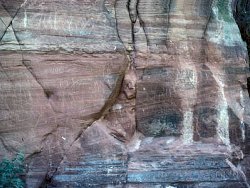 In the fine-grained sandstones and siltstones, linguoid and rectilinear ripples are preserved and some are draped with mud indicating a shallow-water depositional environment with variable energy levels. Under these conditions trace fossils tend to be preserved. Those found at Scrabo include a reptilian footprint Chirotherium lomasi (Ashley, 1946; Swinton, 1960) and invertebrate traces such as worm and shrimp burrows. The presence of some well-rounded sand grains and the survival of cracked and curled mudstone flakes suggests the additional influence of aeolian deposition which increases towards the top of the group. In the South Quarry, exposures of a vent agglomerate lie beneath the undisturbed Scrabo Sill, indicating that a period of explosive igneous activity preceded the sill and dyke emplacement. The vent agglomerate is composed primarily of angular blocks of Triassic sandstone containing mudstone partings together with some basaltic rocks and these are set in a soft friable greenish yellow tuffaceous matrix. Along parts of the vent wall, brecciation of the Triassic wall rocks is noticeable and this has been interpreted as an explosion breccia (Preston, 1962). Near its contacts the vent has thermally metamorphosed the Triassic sandstone and this is manifested in the bleached appearance of the sandstone. Mineralisation has been recorded in both the vent and adjacent country rock although this is most apparent on joint faces in the sandstone wall rocks. Amongst the minerals recorded are apatite, haematite and sphene with more rarely sphalerite, magnetite and rutile (Preston, 1962). | |
| Importance: | |
This is one of the best exposures of the Triassic Sandstone Group in N. Ireland and is of national importance. There is abundant evidence of the environment of deposition of the sandstones. This quarry provided the only example of a reptilian footprint from the Triassic of N. Ireland. The detailed relationships between the Palaeogene igneous rocks can be used to determine the history of igneous activity. The contacts between the igneous and sedimentary rocks provide examples of contact metamorphic mineralisation. Added to this the Sherwood Sandstone Group forms extensive aquifers and potential hydrocarbon reservoirs, which altogether make it important to conserve this site. | |
| Interpretation: | |
The sandstones exposed in the South Quarry at Scrabo provide excellent sedimentary structures to enable the depositional environment during this part of the Triassic to be determined. There is evidence for sub-aerial, shallow water and aeolian deposition. The age of the sandstones has been the subject of debate but it is now clear that they are the Sherwood Sandstone Group. The history of Palaeogene igneous activity can be determined by examining the outcrops of vent agglomerate, sills and dykes. | |
| Conclusions: | |
Exposed at this site is a rare section through the Sherwood Sandstone Group. Because of the sedimentary structures, contact metamorphic minerals, complex relationships of the igneous rocks and the discovery in the quarry of a rare reptilian footprint, this site should be conserved. | |
| Notes: | |
For information on other Triassic sites see Key Site 1197 - Brown's Bay, Island Magee Key Site 1198 - Cloghfin Port, Island Magee Key Site 1199 - Collin Glen Key Site 1201 - Milltown Key Site 1202 - Drapersfield Quarry Key Site 1203 - Lissan Water Key Site 1204 - Curraghlane. For general information on the Triassic System in N. Ireland see Key Site 1192 - The Triassic System in N. Ireland - Introduction. | |
| Keywords | |
|---|---|
| Minerals: | Apatite, Hematite, Limonite, Magnetite, Rutile, Sphalerite, Sphene, Staurolite, Tourmaline, Zircon |
| Rocks: | Agglomerate, Dolerite, Sand, Sandstone |
| Fossil Groups: | Trace fossil |
| Fossil List: | Chirotherium lomasi |
| Structures: | breccia, cross-bedding, dessication cracks, dyke, ripple marks, sill |
| Relations: | Aeolian sediment, Intrusion, Shallow water sediments |
| Access | |
|---|---|
| Approach: | 2.25km SW of Newtownards. Access to the quarry is by a path from the carpark, just to the south of the Golf Course. |
| Management: | |
The site lies in Scrabo Country Park and is presumably safe from development. Any suggestions of re-opening the quarry as a source of building stone would probably result in new discoveries and would be of scientific benefit. | |
| Uses | |
| Uses: | Recreation; field teaching. |
| References (9) | |||
|---|---|---|---|
| Ashley, H., 1946. Cheirotherium footprint found at Scrabo Hill, County Down. Irish Naturalists Journal, vol. 8, pp.332. | |||
| Bazley, R.A.B., 1975. The Tertiary Igneous and Permo-Triassic rocks of the Ballyalton Borehole, County Down. Bulletins of the Geological Survey of Great Britain, vol. 50, pp.71-90. | |||
| Hull, E., Warren, J.L. & Leonard, W.B., 1871. Explanatory memoir to accompany sheets 37, 38 and part of 29 including the country around Bangor, Newtownards, Comber and Saintfield in the County of Down. Memoirs of the Geological Survey of Ireland. | |||
| Lamplugh, G., Kilroe, J.R., M’Henry, A., Seymour, H.J., Wright, W.B. & Muff, H.B., 1904. The Geology of the Country Around Belfast. Memoirs of the Geological Survey of Ireland. | |||
| Preston, J., 1962. Explosive volcanic activity in the Triassic Sandstone of Scrabo Hill, Co. Down Irish Naturalists Journal, vol. 14, pp.45-51. | |||
| Preston, J., 1963. An 'orbicular' quartzite at Scrabo Hill Irish Naturalists Journal, vol. 14, pp.149-153. | |||
| Reynolds, D.L., 1928. The petrography of the Triassic sandstone of north-east Ireland Geological Magazine, vol. 65, pp.448-473. | |||
| Smith, R.A., Johnston, T.P. & Legg, I.C., 1991. Geology of the country around Newtownards Memoirs of the Geological Survey Northern Ireland, pp.42 PP. | |||
| Swinton, W.E., 1960. A Chirotherid from Scrabo Hill, County Down. Irish Naturalists Journal, vol. 13, pp.145-146. | |||
| Record type: | ESCR report | ||
| Entered by: | E M Porter | ||
| Enlander, I., Dempster, M. & Doughty, P., 2026. Scrabo Hill - Triassic, County Down, site details. [In] Earth Science Conservation Review. https://www.habitas.org.uk/escr/site.php?item=1200. Accessed on 2026-11-08. |
| Previous Site | Next Site |