
| Previous Site | Next Site |
Earth Science Conservation Review
| Port Calliagh-Ballycastle | Antrim |
| Site number: | 1210 | ||
| Locality Type: | Coastal section | Status: | ASSI |
| Grid Reference: | D109420,D120416 End(s) of linear site, Not Entered | ||
| Google maps: | 55.21304,-6.25772 | ||
| County: | Antrim | Council area: | Causeway Coast & Glens Borough Council |
| Period: | Cretaceous | ||
| Stages: | Campanian, Maastrichtian | ||
| Lithostrat: | Ballycastle Chalk Member, Ballymagarry Chalk Member, Port Calliagh Chalk Member, Tanderagee Chalk Member, Ulster White Limestone Formation | ||
| Site Description | |
|---|---|
 | |
| Highlights: | |
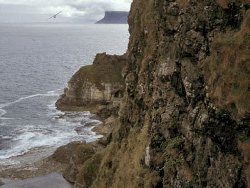
The section contains excellent exposures of the Ulster White Limestone Formation and includes the type sections for the Port Calliagh Chalk and Ballycastle Chalk members. The section includes the youngest Cretaceous strata in Northern Ireland. | |
| Introduction: | |
The Mesozoic rocks from Port Calliagh to Ballycastle outcrop on the north coast of Antrim immediately NW of Ballycastle. The area was mapped and an explanatory memoir produced by Symes et al. (1888). Welch and Wright (1902) listed foraminifera found in chalk powder from hollow flints at Ballycastle Harbour quarries. More recent studies have been by Wilson and Robbie (1966), Wood (1967) and Fletcher (1977). | |
| Description: | |
The Cretaceous rocks exposed here include the Senonian and Maastrichtian Ballymagarry Chalk to Ballycastle Chalk members of the Ulster White Limestone Formation. This description is limited to the Port Calliagh Chalk and Ballycastle Chalk members which have their type sections here. In 1967 Wood termed the strata in this section as the Ballycastle White Limestone. This was divided by Fletcher (1977) into the lower Port Calliagh Chalk Member and the Ballycastle Chalk Member. The Port Calliagh Chalk Member conformably intervenes between the Tanderagee Chalk Member and the Ballycastle Chalk Member. The member is 12.4m thick and comprises six separate beds each delineated by weathered out bedding planes. Bed A, 0.97m thick, has a distinctive complex flint band in the lower half and occasional flat flints just below the terminal bedding plane. Bed B, 1.12m thick has three flint bands. Bed C, 0.84m thick, has occasional flints in the top 0.35m. Bed D, 1.55m thick, has a semi-continuous flint band in the middle and large irregular nodules in the lower half. Bed E, 3.65m thick, has eight prominent flint bands and large corpulent belemnites above the highest flints. Bed F, 4.27m thick is characterised by the tabular flint levels, often bifurcating, and very large nodules in the lower half and by the occasional occurrence of green coated chalk pebbles with sponge impressions approximately 1.3m beneath the terminal bedding plane. The youngest Cretaceous strata preserved in N. Ireland are exposed in the cliffs and sea platform immediately to the west of Ballycastle Pier. The base of the Ballycastle Chalk Member is defined by a prominent weathered out bedding plane which occurs at the top of the conspicuous tabular flint-bearing unit (Port Calliagh Bed F). The basal bed forms the roof of the main cave on the first headland and eastwards towards Ballycastle the higher beds pass down to sea-level. Bed A, 2.36m thick, has a central band of very large flints. Bed B, 2.75m thick, is characterised by a narrow band of tabulate flints in the middle, a rich brachiopod bed beneath the prominent belt of flint nodules in the upper half, and occasional flints on the basal bedding plane. Bed C, 1.82m thick, contains flint nodules on a wavy bedding plane 0.46m above the base. Bed D, 1.53m thick, has a prominent semi- continuous flint band in the middle. Bed E, 1.50m thick, is characterised by tabular flint along the basal bedding plane and a prominent carious flint band in the upper half. Bed F, 1.93m thick, is characterised by two wavy bedding planes in the lowest third occasionally with sandy lenticles and carious flints. Bed G, 1.83m thick, has three bands of carious flint nodules. | |
| Importance: | |
Between Port Calliagh and Ballycastle the youngest beds of the Cretaceous in N. Ireland are exposed. The site includes the type section for the Port Calliagh Chalk and the Ballycastle Chalk members. The site is therefore of national importance and should be conserved. | |
| Interpretation: | |
These uppermost members of the Ulster White Limestone are known from the Rathlin Basin, the western part of the Londonderry Shelf and the Lagan Valley. Elsewhere they have been removed by pre- Palaeogene basalt erosion. Wood (1967) gave an outline of the biostratigraphy of this succession and demonstrated the presence of a concurrent range zone of Belemnella and Belemnitella, with the proportion of Belemnitella in the assemblage decreasing along with a corresponding increase in Belemnella in the Port Calliagh Chalk Member. In the Ballycastle Chalk Member Belemnitella is present in the lower beds but rare above. The base of the member falls within the Belemnella lanceolata Zone and the remainder in the Belemnella occidentalis Zone. As stated above, the uppermost flints in the Ballycastle Chalk Member are carious. Similar developments can be seen at a different stratigraphic level nearby but their identical position relative to the local Palaeogene erosion surface indicates that the abnormality is due to Palaeogene weathering effects. | |
| Conclusions: | |
This site provides the type section for the youngest Maastrichtian strata in N. Ireland together with the youngest Campanian strata. The history of chalk sedimentation in this part of the Ulster White Limestone Formation can best be determined here and the site should be conserved. | |
| Notes: | |
For general information on the Cretaceous System in N. Ireland see Key Site 1194 - The Cretaceous System in N. Ireland - Introduction. For information on other Cretaceous sites see Key Site 1207 - White Rocks - Cretaceous, Key Site 1208 - White Park Bay, Key Site 1209 - Dunnaglea-Larry Bane Bay, Key Site 1211 - Capecastle Quarry, Key Site 1212 - Garron Point-Cloghastucan, Key Site 1213 - Glenarm Quarry, Key Site 1214 - Creggan Quarry, Key Site 1215 - Portmuck, Island Magee, Key Site 1216 - White Head, Key Site 1217 - Clarehill Quarry, and Key Site 1218 - Kilcoan, Island Magee. | |
| Keywords | |
|---|---|
| Rocks: | Flint, Limestone |
| Fossil Groups: | Belemnite, Brachiopod |
| Fossil List: | Belemnella sp., Belemnitella sp. |
| Relations: | Marine sediments |
| Measurements | |||||
|---|---|---|---|---|---|
| Length: | ~1200 m | Width: | Height: | ||
| Depth: | Area: | ||||
| Access | |
|---|---|
| Approach: | NW of Ballycastle. Access to the site is via a precipitous cliff path at Port Calliagh and along the path from the car park at Ballycastle Pier. |
| Restrictions: | The path was officially closed at the time of inspection. There is some danger of rockfalls from overhanging parts of the section. |
| References (5) | |||
|---|---|---|---|
| Fletcher, T.P., 1977. Lithostratigraphy of the Chalk (Ulster White Limestone Formation) in Northern Ireland. Report of the Institute of Geological Sciences, vol. 77/14. | |||
| Symes, R.G., Egan, F.W. & McHenry, A., 1888. Explanatory Memoir to accompany Sheets 7 and 8. Memoirs of the Geological Survey of Ireland. | |||
| Welch, R. & Wright.J., 1902. Some Cretaceous foraminifera from North Antrim. Irish Naturalists Journal, vol. 11, pp.178-180. | |||
| Wilson, H.E. & Robbie, J.A., 1966. Geology of the country around Ballycastle. Memoirs of the Geological Survey Northern Ireland. | |||
| Wood, C.J., 1967. Some new observations on the Maestrichtian Stage in the British Isles. Bulletins of the Geological Survey of Great Britain, vol. 27, pp.271-288. | |||
| Record type: | ESCR report | ||
| Entered by: | E M Porter | ||
| Enlander, I., Dempster, M. & Doughty, P., 2026. Port Calliagh-Ballycastle, County Antrim, site details. [In] Earth Science Conservation Review. https://www.habitas.org.uk/escr/site.php?item=1210. Accessed on 2026-11-08. |
| Previous Site | Next Site |