
| Previous Site | Next Site |
Earth Science Conservation Review
| Creggan Quarry | Antrim |
| Site number: | 1214 | ||
| ESCC: | ED | ||
| Locality Type: | Quarry (disused) | Status: | ESCR |
| Grid Reference: | D277187 Approximate | ||
| Google maps: | 54.99982,-6.00442 | ||
| County: | Antrim | Council area: | Mid & East Antrim Borough Council |
| Period: | Cretaceous | ||
| Stages: | Campanian | ||
| Lithostrat: | Creggan Chalk Member, Ulster White Limestone Formation | ||
| Site Description | |
|---|---|
 | |
| Highlights: | |
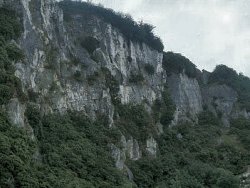
This site is the type locality for the Campanian Chalk Member of the Ulster White Limestone Formation and is illustrative of chalk sedimentation in the Larne-Lough Neagh Basin. | |
| Introduction: | |
This site is 1.25km NW of Carnlough, Co. Antrim. The area was mapped and an explanatory memoir produced by Symes and McHenry (1886). The most recent study was by Fletcher (1977). | |
| Description: | |
This description is confined to the Creggan Chalk Member for which it is the type section. The Cloghastucan Chalk Member is overlain by a thin limestone unit replete with fragments of Inoceramus shell. The abundance and persistence of these fragments over a large proportion of the Irish outcrop are the most useful criteria for recognising this member. Reid (1964) and Wolfe (1968) recognised two basic types of sediment in the Ulster White Limestone, gritty Inoceramus chalk and White chalk, but though the lowest members are generally of the gritty type, Inoceramus rich sediments are known in much higher members. The Creggan Chalk Member is the highest of the Inoceramus rich early members, where the scattered prisms may form up to 20% of the sediment. The upper part of the unit contains several green- coated pebble horizons which, towards the more positive areas, coalesce to form one highly conspicuous hardground. The highest of these horizons is the top of the Creggan Chalk Member. At Creggan Quarry the basal contact with the Cloghastucan Chalk Member is conformable despite an increased waviness in the bedding. The lower limit is defined as the point of sudden increase in large Inoceramus fragments occurring 0.23m above the Oweynamuck Flint Band. The upper limit, 3.45m above the base, is taken at the highest of several levels of green pebble concentrations. Small flints, many of burrow-fill type, are scattered throughout; they do not form definite bands and are more concentrated in the lower levels. The terminal pebble bed includes rolled and heavily mineralised fossils, particularly belemnites and echinoid steinkerns, and exhibits many of the features of a hardground. The member is disconformably overlain by the Boheeshane Chalk Member and the non-sequence between them represents a major part of the late pilula and earliest quadrata zones. | |
| Importance: | |
This is the type section of the Creggan Chalk Member of the Ulster White Limestone Formation. It provides the thickest sequence in the member. It is of national importance and should be conserved. | |
| Interpretation: | |
In other areas the underlying members may all be gradually over- lapped thus demonstrating that the basal contact is in general disconformable. In the marginal areas where attenuation reduces the thickness of the Creggan Chalk Member, the terminal bed is capped by a prominent stromatolitic biostrome. The Creggan Chalk Member is more widely spread than earlier members and in many areas it forms the basal unit of the Ulster White Limestone Formation. The overlap on to the Hibernian Greensands Formation has resulted in a mixing of sediments, so that a glauconitic facies is developed. The non-glauconitic sequences of the Creggan Chalk Member are restricted to the deepest parts of the Cretaceous basins. | |
| Conclusions: | |
The quarry at Creggan is the type section for the Campanian Creggan Chalk Member of the Ulster White Limestone Formation. It is illustrative of chalk sedimentation in the Larne-Lough Neagh Basin and allows for comparison with these beds elsewhere. It should be conserved. | |
| Notes: | |
For general information on the Cretaceous System in N. Ireland see Key Site 1194 - The Cretaceous System in N. Ireland - Introduction. For information on other Cretaceous sites see Key Site 1207 - White Rocks - Cretaceous, Key Site 1208 - White Park Bay, Key Site 1209 - Dunnaglea-Larry Bane Bay, Key Site 1210 - Port Calliagh-Ballycastle, Key Site 1211 - Capecastle Quarry, Key Site 1212 - Garron Point-Cloghastucan, Key Site 1213 - Glenarm Quarry, Key Site 1215 - Portmuck, Island Magee, Key Site 1216 - White Head, Key Site 1217 - Clarehill Quarry, and Key Site 1218 - Kilcoan, Island Magee. | |
| Keywords | |
|---|---|
| Rocks: | Flint, Limestone |
| Fossil Groups: | Belemnite, Echinoderm |
| Fossil List: | Inoceramus sp. |
| Relations: | Marine sediments |
| Paleoenv: | hardground |
| Access | |
|---|---|
| Approach: | 1.25km NW of Carnlough. Access to the site is from the Gortnagory Road. |
| Threats: | Use as a landfill site. |
| References (4) | |||
|---|---|---|---|
| Fletcher, T.P., 1977. Lithostratigraphy of the Chalk (Ulster White Limestone Formation) in Northern Ireland. Report of the Institute of Geological Sciences, vol. 77/14. | |||
| Reid, R.E.H., 1964. The Lower (pre-Belemnitella mucronata) White Limestone of the east and north-east of County Antrim. Irish Naturalists Journal, vol. 17, pp.105-129. | |||
| Symes, R.G & McHenry, A., 1886. Explanatory memoir to accompany sheet 14. Memoirs of the Geological Survey of Ireland. | |||
| Wolfe, M.J., 1968. Lithification of a carbonate mud:Senonian Chalk in Northern Ireland. Sedimentary Geology, vol. 2, pp.263-290. | |||
| Record type: | ESCR report | ||
| Entered by: | E M Porter | ||
| Enlander, I., Dempster, M. & Doughty, P., 2026. Creggan Quarry, County Antrim, site details. [In] Earth Science Conservation Review. https://www.habitas.org.uk/escr/site.php?item=1214. Accessed on 2026-11-06. |
| Previous Site | Next Site |