
| Previous Site | Next Site |
Earth Science Conservation Review
| Straduff Quarry - Carboniferous | Tyrone |
| Site number: | 250 | File Number: | H36 |
| ESCC: | EA | ||
| Locality Type: | Quarry (disused), Quarry (working) | Status: | ASSI |
| Grid Reference: | H343666 Centroid | ||
| Google maps: | 54.54703,-7.46996 | ||
| County: | Tyrone | Council area: | Fermanagh & Omagh District Council |
| Period: | Carboniferous | ||
| Stages: | Westphalian | ||
| Lithostrat: | Drumlish Conglomerate Formation, Slievebane Group | ||
| Site Description | |
|---|---|
 | |
| Highlights: | |
The stratotype section reveals a unique section through the lower part of the Drumlish Conglomerate Formation. | |
| Description: | |
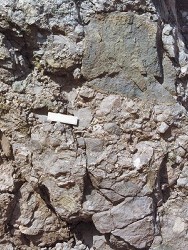
Straduff Quarry is located on the south side of the B4 Omagh-Kesh road, 7km east of the village of Lack. It is excavated in the NE corner of a rock-cored drumlin and quarrying operations continue intermittently. The present faces of the quarry are approximately 75m wide and 120m long, but nowhere exceed a depth of 10m. Strata in the quarry are inclined at a few degrees either side of the vertical and sedimentary structures, including grading and channelling, show that the sequence youngs to the south. The quarry exposes about 70m of strata in the lower part of the Drumlish Formation comprising massive to virtually unbedded coarse cobble and pebble, clast- to matrix-supported conglomerates. Background clast dimensions rarely exceed 0.1-0.2m, the exception being very large blocks, often exceeding 0.5m, of green or purple (depending on the oxidation state of their matrix) vesicular and microphenocrystic trachybasalt or trachyandesite lava. Bedding is clearly defined by thin layers of very hard, purple-grey calcareous, fine-grained sandstone, siltstone and red-purple shale that intervene between the beds of conglomerate in places. Straduff Quarry is located towards the NE end of the formation outcrop, the main part of which occurs some 10km to the SW. Although there are abundant exposures in that area none of them compares with the stratotype section. | |
| Interpretation: | |
The sediments that now form the Drumlish Conglomerate Formation are the product of an episode of intense and sustained erosion of basement rocks. Rapid uplift of metamorphic basement in Northern Ireland commenced in early Westphalian B (Duckmantian Stage) times. Deposition of alluvial fan conglomerates succeeded, with an abrupt contact, the fine-grained mudrocks and pedogenic deposits that characterised the depositional environments of the underlying alluvial plain facies of the Tullanaglare Formation. The production of such a thick and consistently coarse suite of conglomerates and pebbly sandstones indicates a persistent and marked topographic contrast, between the source area of detritus and the alluvial fans, that was periodically regenerated. All the evidence suggests that the margins between the depositional basin and the detrital source area was fault controlled and that basin subsidence was rapid and sustained. The episode of tectonic activity responsible for the initiation of this localised basin, in Northern Ireland, is precisely contemporaneous with a period of dextral transtension in the Maritime Provinces of NE Canada (Bradley, 1982) and with propagation of new rifts in east Greenland and the Arctic (Stemmerik et al., 1991). Through time, the upward decrease in clast size and coarseness of the matrix reflects the diminishing effects of local source areas on the sediment input to individual alluvial fans, and the gradual reduction in fault movement at the basin margins (Mitchell, 1992). Although volcanic rocks are not associated with the Westphalian B Cumberland Group in NE Canada, basalt and rhyolite lavas are interbedded with conglomerates, of this age, in Rhode Island and Massachusetts (Skehan et al., 1979). In Great Britain tectonic activity during Westphalian B times is relatively subdued and produces only muted effects on the sedimentary succession. In particular uplift on the Wales-Brabant Massif instigated the deposition of the first red-beds in the English Midlands and, in Coal Measure sequences, caused seam splitting and localised thickness variations (Besly, 1988). | |
| Conclusions: | |
In the British Isles the Westphalian B Drumlish Conglomerate Formation is a unique lithological association that is not replicated elsewhere in the Carboniferous. The section in Straduff Quarry is unique in the formation outcrop in terms of the thickness of strata exposed. | |
| Notes: | |
For information on other sites in Subarea-4 see; Key Site 1177 - Subarea-4; Fintona Block. This site is also important for Structural Geology. See Key Site 658 - Straduff Quarry. | |
| Keywords | |
|---|---|
| Rocks: | Conglomerate, Sand, Sandstone |
| Paleoenv: | alluvial fan |
| Measurements | |||||
|---|---|---|---|---|---|
| Length: | 120 m | Width: | 75 m | Height: | |
| Depth: | up to 10 m | Area: | |||
| Access | |
|---|---|
| Approach: | Straduff Quarry is located on the south side of the B4 Omagh-Kesh road, 7km east of the village of Lack. |
| References (8) | |||
|---|---|---|---|
| Besly, B.M., 1988. Palaeogeographic implications of late Westphalian to early Permian red beds, Central England. In Sedimentation in a Synorogenic Basin Complex: the Upper Carboniferous of Northwest Europe., pp.200-221 Blackie, Glasgow and London. | |||
| Bradley, D.C., 1982. Subsidence in Late Paleozoic basins in the northeastern Appalachians. Tectonics, vol. 1, pp.107-123. | |||
| Fowler, A. & Robbie, J.A., 1961. Geology of the country around Dungannon. Memoirs of the Geological Survey Northern Ireland, HMSO, Belfast. | |||
| Mitchell, W.I., 1992. The origin of Upper Palaeozoic sedimentary basins in Northern Ireland and relationships with the Canadian Maritime Provinces. Special Publications of the Geological Society of London, vol. 62 In Basins on the Atlantic Seaboard: Petroleum Geology, Sedimentology and Basin Evolution., pp.191-202. | |||
| Sevastopulo, G.D., 1981. The Upper Carboniferous. In A Geology of Ireland., pp.173-87 Scottish Academic Press, Edinburgh. | |||
| Simon, J.B., 1984. Sedimentation and tectonic setting of the lower Old Red Sandstone of the Fintona and Curlew Mountain districts. Irish Journal of Earth Sciences, vol. 6, pp.213-228. | |||
| Skehan, J.W., Murray, D.P., Hepburn, J.C., Billings, M.P., Lyons, P.C. & Doyle, R.G., 1979. The Mississippian and Pennsylvanian systems in the United States - Massachusetts, Rhode Island and Maine. Professional Papers of the United States Geological Survey, vol. 1110A, pp.A1-A31. | |||
| Stemmerick, L., Vigran, J.O. & Piasecki, S., 1991. Dating of late Palaeozoic rifting events in the North Atlantic: New biostratigraphic data from the uppermost Devonian and Carboniferous of East Greenland Geology, vol. 19, pp.218-221. | |||
| Map(s): | See 1:50,000 O.S. Sheet 18 (Enniskillen). | ||
| Record type: | ESCR report | ||
| Entered by: | Doughty, P.J. | ||
| Enlander, I., Dempster, M. & Doughty, P., 2026. Straduff Quarry - Carboniferous, County Tyrone, site details. [In] Earth Science Conservation Review. https://www.habitas.org.uk/escr/site.php?item=250. Accessed on 2026-11-08. |
| Previous Site | Next Site |