
| Previous Site | Next Site |
Earth Science Conservation Review
| Killuney Stream | Armagh |
| Site number: | 262 | File Number: | H84 |
| ESCC: | EO | ||
| Locality Type: | Stream section | Status: | ESCR |
| Grid Reference: | H8946 1 km square | ||
| Google maps: | 54.35537,-6.63109 | ||
| County: | Armagh | Council area: | Armagh City, Banbridge & Craigavon Borough Council |
| Period: | Carboniferous | ||
| Stages: | Tournasian | ||
| Lithostrat: | Annaclare Group, Killuney Conglomerate Formation, Retreat Siltstone Formation | ||
| Site Description | |
|---|---|
 | |
| Highlights: | |
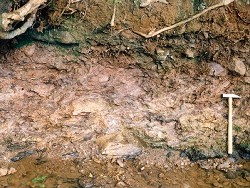
The base Carboniferous unconformity is exposed in this stream and is overlain by strata that are representative of, firstly the Killuney Conglomerate Formation and secondly, and higher in the sequence, by the Retreat Siltstone Formation, of the Annaclare Group. | |
| Description: | |
The Killuney Stream section is located 1.9km ENE of the Mall, in Armagh City, and is located entirely within Killuney Townland, ESE of Little Castle Dillon. The section of the stream included in this site is about 400m long and extends downstream from the basal unconformity at H8962 4608 to the stream culvert at the old Portadown Road. Exposures of both formations occur intermittently but the gradational section between them is concealed. The stream is incised to depths of between 1-3m into the glacial till and exposures usually occur both in the river bed and in the lower part of the stream banks. (i) KILLUNEY CONGLOMERATE FORMATION The unconformity between the Lower Palaeozoic rocks of the Down-Longford Massif and the basal Carboniferous is exposed some 400m ESE of the stream culvert at H8962 4608. Interbedded fine-grained greywackes and slates of probably Ordovician age dip southwards at 15 degrees, beneath the unconformity and the basal Carboniferous breccia is inclined northwestwards at 25 degrees.. The breccia is grey to fawn colour, stained a dull purple-red and is poorly sorted and matrix supported. The matrix is very coarse- grained and consists of reworked chips of pale green siltstone and sub-angular to sub-rounded grains of purple-red greywacke. Larger clasts up to 0.04m diameter are composed entirely of flat pieces of pale green siltstone and rounded pebbles of medium- grained, pale grey or purple micaceous greywacke. Flat clasts in particular show a well-defined imbrication. The breccia is cemented by coarse-grained, white calcite spar. The breccia is overlain, in exposures further downstream, by purple-red conglomerates and sandstones. These sediments are arranged in fining upwards minor cycles which commence in a basal conglomerate, becoming pebbly sandstones, sandstones and, at the top, a thin horizon rarely more than 0.1m thick of red-purple laminated siltstones and mudstones. There is an overall gradual decrease in grain size between successively higher cycles so that near the inferred junction with the overlying Retreat Siltstone Formation, conglomerates and pebbly sandstones are absent and grey to green sandstones, with thin siltstones and mudstones dominate the sequence. Clasts in the conglomerates and sandstones consist almost entirely of reworked Carboniferous sandstone with very few examples of Lower Palaeozoic greywacke. (ii) RETREAT SILTSTONE FORMATION Conglomerates and purple-red sandstones of the Killuney Formation are succeeded by a mixed suite of arenaceous and argillaceous sediments that are grouped together as the Retreat Siltstone Formation. The junction between these two formations is concealed in the Killuney Stream but each can be easily recognised in outcrop by the consistent difference in their colours, the former in shades of purple and red and the latter consisting almost exclusively of grey and greens. Conglomerates do occur in the Retreat Formation but represent only a very small part of the total sequence. In the Killuney Stream there is an exposure gap of ~100m covering the beds lying stratigraphically either side of the formation contact, in total about 35m of strata. The lowest beds of the Retreat Formation cropping out in the stream consist of flaggy beds of pink-purple mottled, medium-grained sandstones which pass upwards, in outcrops located further downstream, into beds of grey coarse-grained, calcareous sandstone between 0.07-0.2m thick, thin grey-green gritty sandstones and occasional purple- red sandstone. A section of strata in the north bank of the stream (H8937 4625) exposes 2.4m of strata comprising grey sandstones, purple and green laminated fine- to coarse-grained sandstones, green blocky mudstones and grey laminated calcareous siltstones. The lowest 0.5m of the section consist of beds of unfossiliferous pale grey micritic limestone, quartzose silty limestone and sandstones and sandy limestone with thin layers of fragmented laminated algal (cyanobacterial) limestone. In other sections of the Retreat Siltstone it is quite common to find sandstone-filled desiccation cracks in the mudstones and a non-diagnostic fauna including bivalves, gastropods and ostracods in dark grey to purple-grey siltstones. The third formation of the Annaclare Group in this area, the Ballynahone Micrite Formation, is not exposed in this stream section. | |
| Interpretation: | |
The 3 formations of the Annaclare Group represent the sedimentary deposits of a single depositional cycle. In the classic model, these represent a consistent and gradual evolution from a terrestrial environment, to brackish and fluvial conditions culminating at the top, in the youngest strata, in a peritidal (quasi-marine) environment. The gradual upward change in the colour of the rocks from red-purple to grey-green, in their increasing fineness and degree of sorting and in the later dominance of limestones over clastic sediments reflects a decrease in the influence of the terrestrial environment and heralds the increasing influence of the sea. Marine transgression in Ireland moved gradually northwards in Tournaisian times and from south to north the effects of diachronism are evident in the progressively younger age of the rocks, in particular of the timing of the arrival of the sea and the age of the first undoubted marine sediments. It seems likely that upstanding areas of land existed initially in late Tournaisian times in the north of Ireland. These included the Down-Longford Massif in south Co. Armagh and Co. Down and areas north of the Sperrin Mountains. Whether or not these land areas still existed by the time the marine transgression reached, for example, the Armagh area, is not known. Red-beds of the Killuney Conglomerate Formation were deposited subaerially, on a land surface. Coarse debris in this formation indicates either rapid erosion of higher ground or reworking of pre-existing coarse-grained alluvium. Because the formation is relatively thin and fines-upwards rapidly the author suspects that the early Carboniferous topography on the Down-Longford Massif was subdued and topographic variation may be the cause of variations in the thickness of the formation. The bulk of the sediments of the Retreat Siltstone Formation reflect deposition by water, either from rivers in the case of the coarse sandstones and gritty beds or in lakes as the finer fraction of mudstones and siltstones. Periodic emergence of fluvial and lacustrine surfaces permitted their colonisation by plants resulting in the formation of root beds and providing the miospore assemblages that are common in the argillaceous strata. Transitory marine incursions led to the formation of thin limestone beds but these conditions only began to dominate this area sometime later. Limestones and shales of the Ballynahone Micrite Formation are marine sediments. They were deposited in shallow water, peritidal conditions when higher concentrations of salts created an environment in which only a specialised benthos could survive. Truly marine animals such as corals, bryozoa and most brachiopods could not tolerate these conditions and never colonised that sea- bed at that time. Algae, in contrast, flourished in the hot brines and their former existence may be seen in the cyano- bacterial coating of oncolites and as flat-laminations in some limestones. Whether or not open marine conditions existed in the Armagh area in Tournaisian times is not known as the sedimentary record of these times ends with the Ballynahone formation and is succeeded disconformably (?) by the Arundian Armagh Group. | |
| Conclusions: | |
The sedimentary rocks that are typical of the first and second formations of the Annaclare Group are admirably demonstrated at the Killuney stream section which is the type section of the Killuney Conglomerate and Retreat Siltstone formations. | |
| Notes: | |
For information on other sites in Subarea-6 see; Key Site 1179 - Subarea-6; Armagh-Benburb. | |
| Keywords | |
|---|---|
| Rocks: | Conglomerate, Greywacke, Sand, Sandstone, Siltstone |
| Fossil Groups: | Bivalve, Gastropod, Microfossil, Microfossils |
| Structures: | dessication cracks |
| Measurements | |||||
|---|---|---|---|---|---|
| Length: | ~400 m | Width: | Height: | ||
| Depth: | Area: | ||||
| Access | |
|---|---|
| Approach: | 1.9km ENE of the Mall, in Armagh City, located entirely within Killuney Townland. |
| References (1) | |||
|---|---|---|---|
| Riley, N.J., 1993. Dinantian (Lower Carboniferous) biostratigraphy and chronostratigraphy in the British Isles. Journal of the Geological Society of London, vol. 150, pp.427-446. | |||
| Map(s): | GSNI (1984) 1:50,000 Solid Geology of Sheet 47 (Armagh). | ||
| Record type: | ESCR report | ||
| Entered by: | Doughty, P.J. | ||
| Enlander, I., Dempster, M. & Doughty, P., 2026. Killuney Stream, County Armagh, site details. [In] Earth Science Conservation Review. https://www.habitas.org.uk/escr/site.php?item=262. Accessed on 2026-11-06. |
| Previous Site | Next Site |