
| Previous Site | Next Site |
Earth Science Conservation Review
| Annacramph Lane | Armagh |
| Site number: | 278 | File Number: | H84 |
| ESCC: | EO | ||
| Locality Type: | Inland exposure | Status: | ESCR |
| Grid Reference: | H88634956 Centroid | ||
| Google maps: | 54.38687,-6.6362 | ||
| County: | Armagh | Council area: | Armagh City, Banbridge & Craigavon Borough Council |
| Period: | Carboniferous | ||
| Stages: | Asbian, Visean | ||
| Lithostrat: | Armagh Group | ||
| Site Description | |
|---|---|
 | |
| Highlights: | |
The occurrence of sandstones in the Armagh Group is very rare. The Annacramph lane section exposes a sequence composed of interbedded clastic sediments, limestone boulder breccias and limestones. | |
| Description: | |
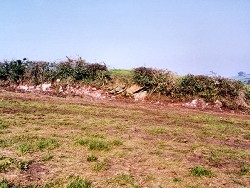
The lane section in Annacramph Townland (H8863 4956) is located some 4.35km NNE of the Mall, in Armagh, on the west side of the B77 Armagh-Loughgall road, and leads to an abandoned farmhouse. Rock is exposed only on the north side of the lane, beneath the field boundary in a low cliff with a maximum height of 1.5m and length of 25m. About 8m of strata are exposed in the section inclined westwards at 25 deg. Limestones and associated lithologies form the lower and upper parts of the section, either side of 1.3m of bedded sandstones. Below the sandstones are 3m of bedded pale to medium grey, pale pink and orange-brown stained medium-grained packstones and fine grainstones. The lowest bed in the section contains the following algae and foraminifera: ALGAE: Calcisphaeres, Kamaeniids FORAMINIFERA: Earlandia sp., Endothyra sp., Mediocris sp., Omphalotis sp., Palaeotextularia ex. gr. longiseptata, Palaeospiroplectammina sp., Paraarchaediscus sp. stage angulatus, P. cf. ninae, P. stilus, Priscella sp., Pseudoammodiscus sp., Pseudotaxis sp., Tetrataxis sp., Valvulinella sp. This sample is not older than Asbian because of the presence of bilaminar palaeotextulariids. Close to the base of this lower section is a conglomerate, 1.47m thick, which consists of fining upwards clasts of grey packstone in a matrix composed of very coarse sand grains with discrete pebbles of vein quartz up to 0.02m in diameter. In the centre of the section are bedded sandstones about 1.3m thick. The lowest beds are non-calcareous, pale grey, purple stained and fine- to medium-grained. These are overlain by 0.22m of very soft, thinly laminated very fine-grained sandstones, fawn siltstones and red-brown mudstone laminae. The base of the succeeding massively bedded, brown, parallel laminated, very coarse-grained calcareous sandstone channels into the underlying beds and its upper surface is, in turn, deeply eroded by the base of the succeeding limestone conglomerate. 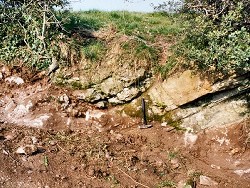 Immediately overlying the top of the sandstone is 1.6m of massive, limestone boulder conglomerate that fines upwards. Large fragments of thick-shelled valves of Gigantoproductus occur at the base of the conglomerate. The lowest blocks of limestone are up to 0.4m diameter and consist of pale grey grainstone that are separated by thin layers of very coarse quartz sand. Some 0.5m above the base of the conglomerate is a lens of purple-brown soft mudstone 0.12m thick. The succeeding 1.2m of strata consist of pale to medium grey breccia comprising angular chips and sub-rounded pebbles of fawn grainstone and pale grey, fine-grained packstone/wackestone set in a very coarse-grained sand matrix. The top of the breccio-conglomerate is overlain by 0.4m of brown- grey, medium-grained grainstone with rounded packstone intraclasts. The top bed of the section outcrops in the lane and comprises 0.5m of dull medium grey, very crinoidal, medium to coarse-grained grainstone/packstone. Both of the upper limestone beds contain the alga Koninckopora and examples of the foraminifera Paraarchaediscus sp. stage angulatus indicating an undoubted Asbian age. | |
| Interpretation: | |
The Asbian strata exposed at Rock Road Quarry, Drumarg Cliff and Annacramph Lane are representative of the limestones that typify the Asbian section of the Armagh Group. Their association with unusual lithologies, accumulations of fossils and sedimentary structures, that are found at all three localities, are unique or extremely rarely exposed in outcrop. Their significance is however considerable in that they all signify shallow water conditions, during Asbian times, accompanied by emergence of the sea bed, erosion of contemporaneous sediments and proximity of a land area from which clastic sediment was transported into an environment in which marine limestones were usually accumulating. Very little can be said, either about the areal extent of these palaeokarst surfaces, limestone conglomerates or rare sandstone beds and there are few data concerning their frequency in the Asbian succession in the Armagh Group in Subarea-6. | |
| Conclusions: | |
The unusual lithologies that occur at Annacramph Lane are very rare in the Armagh Group. As far as can be determined they originated from the exposure, rapid erosion and redeposition of marine limestones as channelised conglomerates. The development of palaeokarst surfaces and sandstone bodies of Asbian age in the Armagh Group reaches its acme in the Cookstown area (Subarea-7; Key Site 1180). | |
| Notes: | |
For information on other sites in Subarea-6 see Key Site 1179 - Subarea-6; Armagh-Benburb. | |
| Keywords | |
|---|---|
| Rocks: | Conglomerate, Limestone, Sand, Sandstone |
| Fossil Groups: | Alga, Brachiopod, Foraminifera |
| Fossil List: | Palaeotextularia ex. gr. longiseptata , Paraarchaediscus stage angulatus |
| Measurements | |||||
|---|---|---|---|---|---|
| Length: | 25 m | Width: | Height: | 1.5 m | |
| Depth: | Area: | ||||
| Access | |
|---|---|
| Approach: | 4.35km NNE of the Mall in Armagh City, on the west side of the B77 Armagh-Loughgall road. |
| Map(s): | See 1:50,000 O.S. Sheet 19 (Armagh). | ||
| Record type: | ESCR report | ||
| Entered by: | Doughty, P.J. | ||
| Enlander, I., Dempster, M. & Doughty, P., 2026. Annacramph Lane, County Armagh, site details. [In] Earth Science Conservation Review. https://www.habitas.org.uk/escr/site.php?item=278. Accessed on 2026-11-03. |
| Previous Site | Next Site |