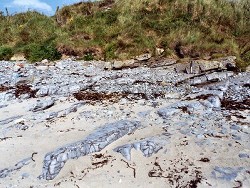
Beach exposure at west end of Ameracam Lane, west of Cranfield, near Greencastle, south Co.Down, showing interbedded thin to thick beds of silty calciturbidites and thin shales and calcareous siltstones of the Carlingford Limestone Group.
Description:
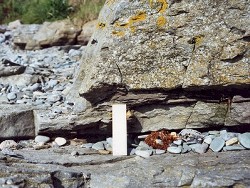
Between 1.0-1.5m of strata, inclined westwards at 15 deg., are exposed at this locality, west of Charleys Rock, which at present is the most easterly exposure of Carboniferous rocks on the coast; it appears that Charleys Rock itself is now concealed by beach sand. The dominant lithologies are interbedded medium to dark grey calciturbidites up to 0.4m thick, thin, dark grey very calcareous siltstones that weather a dull brown colour and very thin shales showing abundant burrows of Phycodes and Pelecypodichnus. The limestones are graded with a basal lag comprising up to 5cm of coarsely crinoidal debris which frequently erodes into the underlying argillaceous sediments.
Detail of beach exposure showing erosive base of thick limestone beds into underlying calcareous siltstones (ruler 0.14m).
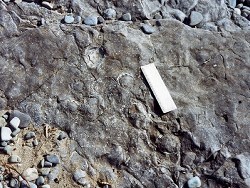
The top surface of the limestones are frequently crowded with a transported assemblage of very large, tumid specimens of the brachiopod Linoprotonia, occasional small and crushed solitary corals and large examples of disarticulated crinoid columnals up to 1cm diameter.
Limestone bedding surface showing abundant large brachiopods of Linoprotonia sp. in the Carlingford Limestone Group (ruler 0.14m).
The coral fauna is particularly abundant and includes the following forms: Michelinia megastoma, Siphonodendron martini, Siphonophyllia garwoodi, and Syringopora cf. ramulosa.
A well preserved microbiota of algae and foraminifera occurs in coarse-grained grainstones, with very fine-grained quartz sand, at this locality and includes the following forms:
ALGAE: Girvanella sp., Koninckopora minuta, Nannopora anglica, and Salebra sp.
The presence of Glomodiscus and involutus stage Paraarchaediscus indicates a mid- to late-Arundian age. Other inland localities in south Co. Down show that the limestones consist mainly of coarse grainstones and oolites and contain a very similar microbiota that also includes the foraminifera Dainella micula which suggests an early- to mid-Arundian age. The main conclusion is that all faunal elements point to a mid-Arundian age for the Carlingford Limestone Group.
At Soldiers Point (J2577 1060) 100m west of the previous locality the limestones are intruded by a very fine-grained, 0.25m thick, basic dyke trending to the NW. On the seaward side of this dyke is a wide bedding surface of pale-medium grey limestone that displays a large inverted colony of S. martini and, 1m south of this colony, a well-preserved specimen of the brachiopod Delepinea carinata. The highest strata exposed on the western side of the outcrop at Soldiers Point are coarse-grained quartz sandstones up to 10cm thick and blue-grey crinoidal packstones. The fauna of corals and brachiopods collected at this site indicates an Arundian age. In particular the field identification of D. carinata is critical as this species is restricted to the middle part of the Arundian in England and Wales (Fauna C of Mitchell, 1989) and in Ireland to the Bundoran Shale Formation and top part of the Ballyshannon Limestone Formation. The solitary coral S. garwoodi ranges through the Arundian but the colonial species S. martini only occurs commonly in the late Arundian (Fauna D). A middle- to late-Arundian age is therefore probable for this fauna.
Notes:
For information on other sites in Subarea-11 see Key Site 1184 - Subarea-11; Cranfield-Greencastle.
West end of Ameracam Lane, west of Cranfield, near Greencastle, Co.Down.
References (1)
Mitchell, M., 1989. Biostratigraphy of Visean (Dinantian) rugose coral faunas from Britain. Proceedings of the Yorkshire Geological Society, vol. 47, pp.233-247.
Record type:
ESCR report
Entered by:
Doughty, P.J.
Enlander, I., Dempster, M. & Doughty, P., 2026. Ameracam Lane, Carlingford Lough - Carboniferous, County Down, site details. [In] Earth Science Conservation Review. https://www.habitas.org.uk/escr/site.php?item=295. Accessed on 2026-11-03.