
| Previous Site | Next Site |
Earth Science Conservation Review
| Carganamuck Quarry | Armagh |
| Site number: | 279 | File Number: | H84 |
| ESCC: | EA | ||
| Locality Type: | Quarry (working) | Status: | ESCR |
| Grid Reference: | H878498 Centroid | ||
| Google maps: | 54.3897,-6.64842 | ||
| County: | Armagh | Council area: | Armagh City, Banbridge & Craigavon Borough Council |
| Period: | Carboniferous | ||
| Stages: | Brigantian, Visean | ||
| Lithostrat: | Armagh Group | ||
| Site Description | |
|---|---|
 | |
| Highlights: | |
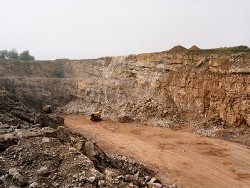
Brigantian limestones and shales of the Armagh Group are superbly displayed in Carganamuck Quarry. An excellent example of a palaeokarst surface is developed there. Abundant corals and brachiopods may be collected from the quarry. | |
| Description: | |
Carganamuck Quarry is located on the south bank of the Callan River 4.25km north of the Mall in Armagh City. It is about 300m long but rarely exceeds 50m in width and is currently operating only at its SW end. Bedding in the quarry is inclined to the NW at 10 deg. and limestone bedding surfaces dip beneath the channel of the Callan River, about 100m north of the current working face. Near the top of the high north face is a palaeokarst horizon. 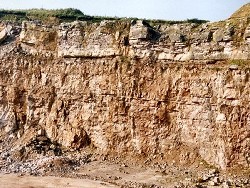 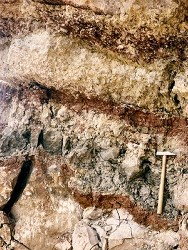 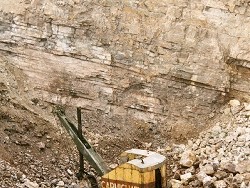 ALGAE: Calcifolium sp., Draffania biloba, Kamaeniid FORAMINIFERA: Archaediscus moelleri, Cribrostomum sp., Earlandia sp., Endostaffella sp., Endothyra sp., E. ex. gr. phrissa, Eostaffella mosquensis, Gigasbia sp., Globoendothyra sp., Howchinia bradyana, Paraarchaediscus sp., Planoarchaediscus concinnus, Pseudoammodiscus sp., Tetrataxis sp., Valvullinella sp. The presence of Howchinia bradyana indicates an age no older than late Asbian. The lack of Koninckopora and Brigantian index taxa favours an earliest Brigantian age. Bedding in the limestones located stratigraphically above the palaeokarst surface tends to be more variable in thickness and consists frequently of very coarse skeletal packstones and fine grainstones. Thin purple-red shales develop commonly between beds of these upper limestones. Incipient development of transitory palaeokarst surfaces also appears to have occurred regularly at and above the major palaeokarst horizon and many bedding surfaces of these limestones are leached, highly irregular and are smeared with purple clay and reworked bioclasts. 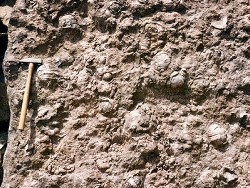 A prolific macrofauna is present in the limestones in this quarry and is dominated by large brachiopods and corals as follows: BRACHIOPODS: Gigantoproductus sp. nov. aff. elongata, Gigantoproductus sp. nov. aff. meharezensis, Gigantoproductus sp. SOLITARY CORALS: Dibunophyllum bipartitum, D. konincki Limestone bedding surfaces are occasionally crowded with brachiopods of which the very large specimens of Gigantoproductus are spectacular. Of special interest is the presence of strong fluting on their convex pedicle valves which suggests a Brigantian, possibly late Brigantian, age. The pervasive pale purple colour of many of the limestones and most of the shales may be derived from groundwater percolating downwards from the overlying Triassic red-beds, which are now exposed on the north bank of the Callan River, 300m from the quarry. | |
| Conclusions: | |
The Brigantian strata that occur at the top of the Armagh Group in Subarea-6 outcrop over a relatively small part of the whole Carboniferous outcrop. Nevertheless they are superbly exposed in Carganamuck Quarry and yield an abundance of well preserved specimens of brachiopods and corals. In Northern Ireland it is unusual to find large exposures of Brigantian strata that yield such superb fossils. | |
| Notes: | |
For information on other sites in Subarea-6 see Key Site 1179 - Subarea-6; Armagh-Benburb. | |
| Keywords | |
|---|---|
| Rocks: | Limestone |
| Fossil Groups: | Alga, Brachiopod, Coral, Foraminifera |
| Fossil List: | Howchinia bradyana |
| Structures: | palaeokarst |
| Relations: | Marine sediments |
| Measurements | |||||
|---|---|---|---|---|---|
| Length: | ~300 m | Width: | ~50 m | Height: | |
| Depth: | Area: | ||||
| Access | |
|---|---|
| Approach: | The quarry is located on the south bank of the Callan River 4.25km north of the Mall in Armagh City. |
| Map(s): | See 1:50,000 O.S. Sheet 19 (Armagh). | ||
| Record type: | ESCR report | ||
| Entered by: | Doughty, P.J. | ||
| Enlander, I., Dempster, M. & Doughty, P., 2026. Carganamuck Quarry, County Armagh, site details. [In] Earth Science Conservation Review. https://www.habitas.org.uk/escr/site.php?item=279. Accessed on 2026-11-06. |
| Previous Site | Next Site |