
| Previous Site | Next Site |
Earth Science Conservation Review
| Tardree Mountain | Antrim |
| Site number: | 524 | ||
| ESCC: | ED | ||
| Locality Type: | Quarry (disused) | Status: | ASSI |
| Grid Reference: | J192941 Centroid | ||
| Google maps: | 54.78107,-6.14733 | ||
| County: | Antrim | Council area: | Antrim & Newtownabbey Borough Council |
| Period: | Tertiary | ||
| Lithostrat: | Antrim Lava Group, Interbasaltic Formation, Tardree Rhyolite Complex | ||
| Site Description | |
|---|---|
 | |
| Highlights: | |
Tertiary rhyolite with micro-crystals of tridymite in vugs. | |
| Introduction: | |
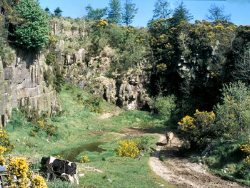
The site is a disused quarry on the south side of Tardree Mountain, reached by a farm lane off the Barnish Road. Emeleus and Preston (1965) record that the locality was noted by Lasaulx (1880) as an occurrence of tridymite in small vuggy cavities within rhyolite. Also of interest is the good columnar jointing displayed in the quarry face. | |
| Description: | |
A detailed description of the lithologies and field relationships of the Tardree Complex is given by Old (1975), who includes the Complex within the Interbasaltic Formation of the Antrim Lava Group. The Complex comprises rhyolite lavas and associated volcanic vent rocks including obsidian, tuffs and agglomerate. The latter are represented at Sandy Braes, a key site in the Igneous/Tertiary Block (see Key Site 517 - Sandy Braes), which is located less than 2km northeast of Tardree Mountain (see also Key Site 537 - Sandy Braes [Mineralogy/Metallogenesis Block]). The disused quarry locality referred to here is one of a number of sites in the Complex where rhyolite is exposed (see Emeleus and Preston, 1969, p.27). It was selected in preference to these other sites because of the presence of tridymite crystals in drusy cavities that permeate the rhyolite (Lasaulx, 1880). These crystals are small, generally 1mm or less in length, requiring the use of a hand-lens to appreciate their crystal form. The disused quarry is an appropriate site for conservation as it is readily accessible and contains relatively fresh quarry spoil, and as large-scale features are visible in the quarry walls. | |
| Importance: | |
Rhyolite is a relatively uncommon rock type in the north of Ireland, and the Tardree area is the largest and best-exposed instance. The occurrence of felsic (‘acid’) lavas within the predominantly basaltic Tertiary lava pile is of scientific and educational interest, and provides a conceptual link with the Tertiary granites and related intrusive rocks of the Mourne Mountains, Slieve Gullion and Carlingford. The occurrence of tridymite, which is characteristically associated with felsic volcanic rocks, is important although not unique in Northern Ireland. In addition to its occurrence at Tardree, tridymite has been identified in contact metasomatic rocks associated with Tertiary dolerite plugs at Tievebulliagh and Tieveragh (Emeleus and Preston, 1965). However, in these cases the tridymite is a fine-grained constituent of rock, rather than occurring as crystals in cavities. | |
| Interpretation: | |
Tridymite is one of the SiO2 polymorphs, others being quartz and cristobalite. Tridymite belongs to the orthorhombic system and commonly occurs as wedge-shaped crystals of two or more individuals, including the trillings from which it derives its name. The ß2 variety of tridymite is the stable form of silica from 870° to 1470°C. It is characteristic of acid volcanic rocks where it is often found in cavities associated with sanidine, a high temperature form of alkali feldspar. There is some doubt whether it crystallises from magma or forms as a ‘metamorphic’ mineral due to pneumatolytic (high temperature, gaseous) alteration of glass or previously crystallized quartz (Deer et al., 1966). | |
| Conclusions: | |
This site is recommended for conservation for mineralogical and petrological reasons. It represents an accessible example of jointed rhyolite rock containing drusy cavities lined with the SiO2 polymorph, tridymite, which does not occur well-crystallised elsewhere in the north of Ireland. | |
| Notes: | |
The site is complementary to the Sandy Braes Mineralogy/Metallogenesis site (Key Site 537). | |
| Keywords | |
|---|---|
| Minerals: | Tridymite |
| Rocks: | Rhyolite |
| Structures: | columnar jointing, drusy, vugh |
| Access | |
|---|---|
| Approach: | The site is reached by a farm lane off the Barnish Road. Access arrangements should be made with the landowner. |
| Management: | |
Management of the site is needed to (i) curtail dumping of waste in the quarry, (ii) prevent excessive growth of vegetation that would restrict access or obscure the quarry faces, and (iii) allow occasional working of the spoil to ensure that fresh material is available. Provision of an interpretation board should be considered. | |
| Threats: | Dumping of waste and excessive growth of vegetation in the quarry. |
| Uses | |
| Uses: | The disused quarry has been used for dumping and storage of wastes including materials of agricultural, industrial and domestic origin (slurry, building materials, refuse). The surrounding area comprises arable and pasture farmland, mixed woodland and commercial forestry plantations. |
| Map(s): | OSNI 1:50,000 sheet 14; 1:10,000 sheet XX. | ||
| Record type: | ESCR report | Recorded by: | R. Nawaz and N.R. Moles |
| Entered by: | E M Porter | ||
| Last updated: | 07 MAY 68 | ||
| Enlander, I., Dempster, M. & Doughty, P., 2026. Tardree Mountain, County Antrim, site details. [In] Earth Science Conservation Review. https://www.habitas.org.uk/escr/site.php?item=524. Accessed on 2026-11-08. |
| Previous Site | Next Site |