
| Previous Site | Next Site |
Earth Science Conservation Review
| Scawt Hill - Mineralogy | Antrim |
| Site number: | 536 | ||
| ESCC: | EO | ||
| Locality Type: | Crag, Crags | Status: | ASSI |
| Grid Reference: | D337090 Centroid | ||
| Google maps: | 54.91118,-5.91524 | ||
| County: | Antrim | Council area: | Mid & East Antrim Borough Council |
| Period: | Tertiary, Cretaceous | ||
| Stages: | Eocene, Palaeocene, Santonian | ||
| Lithostrat: | Antrim Lava Group, Ulster White Limestone Formation | ||
| Site Description | |
|---|---|
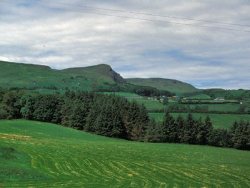 | |
| Highlights: | |
Calc-silicates associated with Tertiary dolerite plug intruded into Ulster White Limestone. | |
| Introduction: | |
Scawt Hill is described by Dr. J. Preston in Key Site 1130 - Scawt Hill, within the Igneous/Tertiary Block, though it is primarily a mineralogical site. As Dr. Preston states, Scawt Hill achieved international recognition through the research and publications of C.E. Tilley (1928-1947) on its newly discovered and rare calc-silicate minerals. High temperature, low pressure metamorphism of pure calcium carbonate rock with discreet bodies of silica impurity (flint nodules) has produced rocks containing larnite, spurrite and other unusual minerals, while assimilation of carbonate rock by the marginal dolerite has produced a sequence of pyroxenites of progressively more alkaline composition. | |
| Description: | |
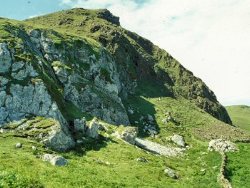 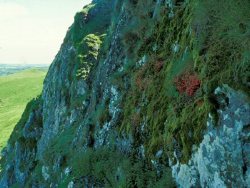 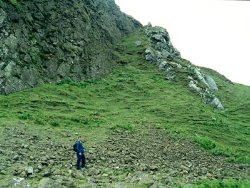 | |
| Conclusions: | |
Scawt Hill is eminently worthy of ESCR designation, but this is largely for its historical importance rather than its present value as an educational site. Indeed, visits by students or non-specialists should be discouraged, and only the most ardent, agile and well-equipped geologists would gain much from visiting the locality. In this respect, Carneal (Key Site 528) is a useful complimentary site worthy of designation. | |
| Notes: | |
See also Key Site 1130 - Scawt Hill. | |
| Keywords | |
|---|---|
| Minerals: | Larnite, Scawtite, Spurrite |
| Rocks: | Dolerite, Limestone, Pyroxenite |
| Structures: | plug |
| Access | |
|---|---|
| Management: | |
Hill outcrop with scree material sensitive to collecting. Mainly of historical interest. |
| Record type: | ESCR report | Recorded by: | R. Nawaz and N.R. Moles |
| Entered by: | E M Porter | ||
| Last updated: | 07 MAY 68 | ||
| Enlander, I., Dempster, M. & Doughty, P., 2026. Scawt Hill - Mineralogy, County Antrim, site details. [In] Earth Science Conservation Review. https://www.habitas.org.uk/escr/site.php?item=536. Accessed on 2026-11-08. |
| Previous Site | Next Site |