
| Previous Site | Next Site |
Earth Science Conservation Review
| Glebe House, Rathmullan, Minerstown | Down |
| Site number: | 553 | ||
| ESCC: | ID | ||
| Locality Type: | Spoil, Spoil heaps | Status: | local interest |
| Grid Reference: | J475375 Approximate | ||
| Google maps: | 54.26551,-5.73614 | ||
| County: | Down | Council area: | Newry, Mourne & Down District Council |
| Site Description | |
|---|---|
 | |
| Highlights: | |
Mineralized spoil from former lead mining. | |
| Introduction: | |
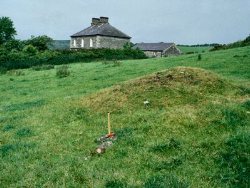
Lead mining in this area may date from Norman times when John de Courcy owned the land, and had a castle built on the mound at Rathmullan. On geological survey maps dating from the 1880s, a mine is marked near Glebe House c.200m northwest of the motte. The lode is indicated as trending northwest-southeast, and comprising barite and fibrous gypsum through which abundant galena is distributed in veins and patches. Other galena occurrences are noted nearby. A former resident of Glebe House, Mrs Helen Perkes, who now lives in Minerstown, recalls that there used to be a mine shaft ('well') in the field in front (south) of Glebe House. She remembers a story of terrifying 'rumblings' being heard one night, which was most likely a collapse within the mine. There was another shaft immediately behind the house, which is marked by a flat-topped ridge of spoil extending from a 3m2 depression. | |
| Description: | |
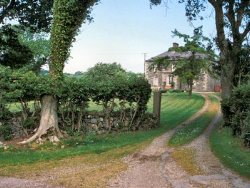
Glebe House, which is currently occupied by Mrs Eleanor Hughes, is an attractive stone building with cornerstones of Mourne granite.
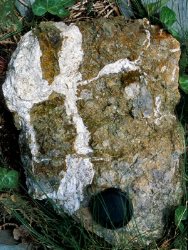  Mineralized cobbles, comprising massive barite with galena, have also been found within a wall c.100m north of Glebe House, northwest of Rathmullan Parish Church. On the hillside nearby is a deep well (recently covered) which provided water for the Church and Hall: the well is said to have been the shaft for a silver mine. (Silver would have occurred in small amounts within galena, and both silver and lead were often produced from the same ore.) It is probable that material from this mine has since been incorporated into stone walls and buildings in the area. No other evidence of the former mining activity has survived. | |
| Conclusions: | |
Conservation of the wall at the entrance to the drive in front of Glebe House, which contains a dozen or so barite-bearing boulders/cobbles, is imperative. | |
| Keywords | |
|---|---|
| Minerals: | Barytes, Dolomite, Galena |
| Rocks: | Shale, Siltstone |
| Structures: | hydrothermal vein |
| Access | |
|---|---|
| Management: | |
The current owner is aware of the scientific interest of this material, and of the grassed-over spoil heap to the rear of Glebe House. To expose some of the mineralized spoil, partial excavation of this heap should be considered. |
| Record type: | ESCR report | Recorded by: | R. Nawaz and N.R. Moles |
| Entered by: | E M Porter | ||
| Last updated: | 07 MAY 68 | ||
| Enlander, I., Dempster, M. & Doughty, P., 2026. Glebe House, Rathmullan, Minerstown, County Down, site details. [In] Earth Science Conservation Review. https://www.habitas.org.uk/escr/site.php?item=553. Accessed on 2026-11-06. |
| Previous Site | Next Site |