
| Previous Site | Next Site |
Earth Science Conservation Review
| McIlroy's Port - Palaeogene | Antrim |
| Site number: | 640 | File Number: | D40 |
| ESCC: | EC | ||
| Locality Type: | Coastal section | Status: | ASSI |
| Grid Reference: | D453028 Centroid | ||
| Google maps: | 54.85229,-5.73764 | ||
| County: | Antrim | Council area: | Mid & East Antrim Borough Council |
| Period: | Tertiary | ||
| Stages: | Eocene, Palaeocene | ||
| Lithostrat: | Antrim Lava Group, Lower Basalt Formation | ||
| Site Description | |
|---|---|
 | |
| Highlights: | |
An explosive volcanic vent sited in a composite flow has effected a thermal metamorphism of the wall rock. | |
| Introduction: | |
Walker (1959b) described a small vent at McIlroy's Port which cuts through a thick composite flow in the Lower Basalt Formation. The lower picritic component of the flow contains basaltic pegmatites which yield the only known occurrence of the mineral sodalite in Ireland. Unpublished research by Kitchen and Preston has added mineralogical detail to this locality. | |
| Description: | |
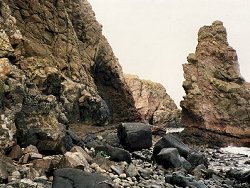
The composite flow, the best example in County Antrim according to Walker (1959), is well exposed for 1 km along the coastal cliffs either side of McIlroy's Port. Adjacent to the south wall of the vent it has an upper component of olivine basalt some 15 m thick and a lower component of olivine-rich, picritic, basalt about 3 m thick. The flow peters out north and south of the vent but the picritic base increases in thickness in either direction until it forms the entire mass of the headland east of Castlerobin Bay beyond which it is downfaulted below sea level. The internal contact of the flow is sharp and shows no sign of chilling and just south of the vent a thin layer of augite, 2 mm thick, marks its course; at its northern end a form of layering is developed; each layer separated by sharp internal contacts from its neighbour. The upper component of olivine basalt is composed of strongly zoned plagioclase, micro-phenocrysts of olivine usually altered to serpentinous material, occasional micro-phenocrysts of augite, and granular pyroxene. A little pigeonite occurs, sometimes mantling the augite. The picrite basalt has corroded phenocrysts of olivine up to 3 mm dia. which make up some 30% of the rock. The groundmass is a fine-grained assemblage of labradorite plagioclase, brown augite, with a little olivine and magnetite. Variations in grainsize give the rock a streaky/banded appearance. Within the picritic member Walker (op.cit.) found numerous irregular patches and veins of alkali pegmatite up to 5 cm thick and confined to a zone about 30 cm in thickness. These pegmatites contain sodalite, the first recorded occurrence of this mineral in Ireland. Typically the pegmatite is made of circa 70% titanaugite and 10-20% sodalite with minor amounts of plagioclase and magnetite and accessory apatite. Other patches may contain an aegerine-augite, strongly coloured and zoned, and associated with idiomorphic sodalite. The picritic-basalt often shows granular aegerine-augite enclosed by plagioclase and sodalite marginal to the pegmatites. More recent work by Kitchen and Preston using an electron probe micro-analyser records the presence of melilite, nepheline, perovskite, apatite and spinel in these pegmatite bodies. The volcanic vent which interrupts the composite flow has been largely excavated by the sea. Boulder beach, vegetated above HWM, masks the outcrop but to N and S the vent walls are well exposed in cliff section. 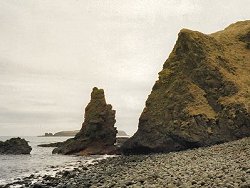 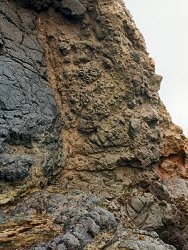 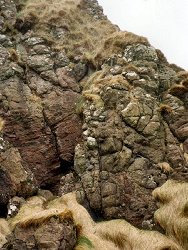 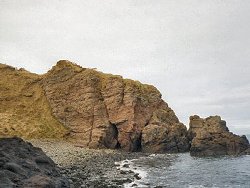 South of McIlroy's Port a conspicuous dolerite dyke intrudes Cretaceous White Limestone and overlying basalt flows; the dolerite forms three raised beach stacks and its vertical western contact is beautifully sectioned in the sea cliffs. Walker (1948) notes the development of andradite garnet, apatite, magnetite, soda-diopside, ilmenite, sphene, calcite, and zeolites in the metamorphosed amygdales of the adjacent basalts. The White Limestone is disturbed and baked close to the dyke. The basalt flows just west of this dyke are thin pahoehoe units which exhibit ropy lava surfaces and pipe vesicular bases. Abundant amygdales in the flow tops yield zeolites, notably gmelinite which characterizes the alkali-rich hydrothermal mineralization affecting the basalt lavas. | |
| Importance: | |
A unique site for the only known occurrence of sodalite in Ireland. A composite olivine-rich - olivine-poor flow, better exposed than other known examples among the Antrim Basalts. A good locality for the occurrence of pahoehoe flows and the soda-rich zeolites characteristic of Island Magee. Well exposed bounding walls to an explosion vent. | |
| Interpretation: | |
The composite flow with its sharply defined internal contact is probably a consequence of gravity settling of early formed olivine in the feeder vent prior to eruption. A thickness of 15 m is strongly suggestive of ponding in the vicinity of the vent. Successive flow units of varying density could have produced a flow folding at the interface giving rise to layering and to apparent increase in olivine content upwards. The pegmatites are restricted to the vicinity of the vent. Walker (1959b) regards them as the final dregs of volatile-rich magma. A metamorphic texture in the groundmass of the basalt flows in the vicinity of the vent points to recrystallization of original amygdales in these flows to coarse-grained assemblages of alkali minerals which resemble pegmatites. The vent is of explosive origin; bedded structures within the vent breccia at its northern contact could indicate a prolonged history of activity with volcanic exhalations penetrating the wall-rock and effecting a high degree of thermal metamorphism in the adjacent basalts. | |
| Conclusions: | |
CONCLUSION This site is well worth conserving for both teaching and research purposes. The whole coastal strip from Portmuck to Castlerobin Bay would make a fine geological trail. | |
| Notes: | |
Some zeolite minerals can be identified in the field but the sodalite and associated minerals would require optic or x-ray techniques. This site is also important for Mineralogy and Metallogenesis. See Key Site 538 - McIlroy’s Port to Portmuck, Island Magee. | |
| Keywords | |
|---|---|
| Minerals: | Andradite, Melilite, Nepheline, Sodalite, Spinel |
| Rocks: | Agglomerate, Basalt |
| Structures: | amygdales, volcanic vent, zeolitization |
| Relations: | Extrusion |
| NonGeol: | Sea cliffs, marginal farmland and sheep grazing. |
| Measurements | |||||
|---|---|---|---|---|---|
| Length: | 1000 m | Width: | Height: | ~18 m | |
| Depth: | Area: | ||||
| Access | |
|---|---|
| Approach: | Access is a problem. To avoid trespassing it is possible to walk below the White Limestone cliffs from Portmuck but only at low tide. A cliff top footpath is overgrown and difficult to follow. A farm lane (with the farmer's permission) could be used which branches off the Brown's Bay-Mullaghboy Road and leads directly to McIlroy's Port. |
| References (6) | |||
|---|---|---|---|
| Emeleus, C.H. & Preston, J., 1969. Field excursion guide to the Tertiary volcanic rocks of Ireland., pp.70 Queen's University, Belfast. | |||
| Walker, G.P.L., 1948. A preliminary note on the metamorphic rocks of the Portmuck area, County Antrim Irish Naturalists Journal, vol. 9, pp.165-168. | |||
| Walker, G.P.L., 1959. The amygdale minerals in the Tertiary lavas of Ireland - II. The distribution of gmelinite Mineralogical Magazine, vol. 32, pp.202-217. | |||
| Walker, G.P.L., 1959. Some observations on the Antrim basalts and associated dolerite intrusions Proceedings of the Geologists Association of London, vol. 70, pp.179. | |||
| Walker, G.P.L., 1960. The amygdale minerals in the Tertiary lavas of Ireland - III. Regional distribution Mineralogical Magazine, vol. 32, pp.503. | |||
| Map(s): | See the 1:50,000 O.S. Sheet 9 for site location. For relevant geology see Walker (1959b). | ||
| Record type: | ESCR report, J. Preston l, J. Preston list | ||
| Entered by: | Allen, M.D.B. | ||
| Enlander, I., Dempster, M. & Doughty, P., 2026. McIlroy's Port - Palaeogene, County Antrim, site details. [In] Earth Science Conservation Review. https://www.habitas.org.uk/escr/site.php?item=640. Accessed on 2026-11-06. |
| Previous Site | Next Site |