
| Previous Site | Next Site |
Earth Science Conservation Review
| Mournes - Bloody Bridge Cone-sheet | Down |
| Site number: | 1102 | ||
| ESCC: | EF | ||
| Locality Type: | Coastal section | Status: | ASSI |
| Grid Reference: | J389276,J390271 End(s) of linear site, Not Entered | ||
| Google maps: | 54.17904,-5.8726 | ||
| County: | Down | Council area: | Newry, Mourne & Down District Council |
| Period: | Tertiary, Silurian | ||
| Stages: | Eocene, Silurian Undifferentiated | ||
| Lithostrat: | Granite | ||
| Site Description | |
|---|---|
 | |
| Highlights: | |
Member of the Mourne Granite cone-sheet system. | |
| Introduction: | |
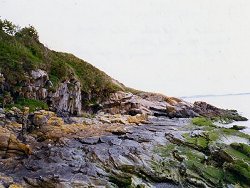
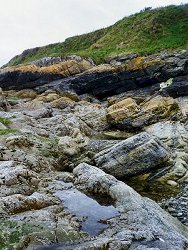
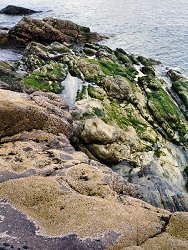
A quartz porphyry sheet intruded into the Silurian hornfels dips westwards underneath the neighbouring granites of the Eastern Mournes.
  | |
| Description: | |
The Bloody Bridge porphyry is a relatively coarse-grained granitic rock with large phenocrysts of quartz and alkali feldspar. The quartz is somewhat smaller in size than the feldspar, rounded, embayed and full of minute bubbles. The feldspar is also rounded and partly altered to kaolinite and fine-grained mica. Anorthoclase and microcline have been identified. An acid plagioclase, albite- oligoclase, is also present, as are small prisms of hornblende along with small grains of iron ore, biotite and epidote. The groundmass of the porphyry varies from microgranitic to micrographic-spherulitic; quartz was often the last mineral to crystallize filling the final mesostasial cavities. Quartz is thus present in three generations of crystals. The chilled margins are of finer grain size with smaller phenocrysts. A later and finer-grained porphyry invades the main sheet and shows chilled contacts against it. 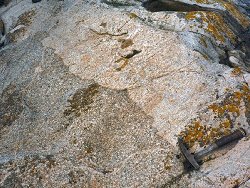 | |
| Importance: | |
A well exposed portion of the principal cone-sheet associated with the Mourne Granites which contrasts markedly with the Glasdrumman Port section in being multiple instead of composite and in establishing an age relationship with the Mourne Dyke Swarm. | |
| Interpretation: | |
The structural disposition of this porphyry sheet marks it as a member of the cone-sheet system which encircles the Mourne Granite ring-dyke intrusions. Multiple intrusion of acid magma indicates the repeated use of the one cone-sheet fracture. | |
| Notes: | |
For Mourne Granites general information and reference list see; Key Site 1129 - The Granites - Overview. For general information on the cone-sheet intrusions associated with the Mourne Granites, and the Mourne Mountain dyke swarm, see; Key Site 1131 - Cone-sheet and Dyke Swarm - Overview. | |
| Keywords | |
|---|---|
| Rocks: | Hornfels, Porphyry, Quartz porphyry |
| Structures: | cone-sheet |
| Relations: | Intrusion |
| Access | |
|---|---|
| Approach: | Access to the S contact of this cone-sheet is hazardous; an attempt could be made from the Bloody Bridge Car park by taking the path down to the rocky shore from its northernmost corner. Relatively easy access to the centre and upper, N contact can be found by following the main road towards Newcastle and a little used footpath over a gap in the low stone wall just N of the cottage in wooded ground, at J38852722. This path descends steeply to the rocky shore and care must be taken to avoid the deep trench on its S side. The rock platform is high above sea level. |
| Map(s): | Tomkeieff & Marshall (1935) mark its position and width, Plate XIX. The shore section between HWM and LWM from just S of Broad Cove, Irish Grid Ref. J389276 to just N of Bloody Bridge River, J38952715 would include the whole exposure. | ||
| Record type: | ESCR report | ||
| Entered by: | E M Porter | ||
| Enlander, I., Dempster, M. & Doughty, P., 2026. Mournes - Bloody Bridge Cone-sheet, County Down, site details. [In] Earth Science Conservation Review. https://www.habitas.org.uk/escr/site.php?item=1102. Accessed on 2026-11-06. |
| Previous Site | Next Site |