
| Previous Site | Next Site |
Earth Science Conservation Review
| Mournes - Glasdrumman Port Cone-sheet | Down |
| Site number: | 1111 | ||
| ESCC: | EF | ||
| Locality Type: | Coastal section | Status: | ASSI |
| Grid Reference: | J382232,J380223 End(s) of linear site, Not Entered | ||
| Google maps: | 54.13973,-5.88533 | ||
| County: | Down | Council area: | Newry, Mourne & Down District Council |
| Period: | Tertiary | ||
| Stages: | Eocene | ||
| Lithostrat: | Granite | ||
| Site Description | |
|---|---|
 | |
| Highlights: | |
Well exposed example of a composite cone-sheet; both hanging and footwall contacts against the country rock show an inward dip under the Mournes. Internal contacts show magma mixing and hybridization. | |
| Introduction: | |
This is the best locality for demonstrating the occurrence of a cone- sheet. It has aroused interest since 1833 when Patrickson described it and again in 1894(B) when Cole remarked on the mixing of xenoliths at the internal contacts. Early workers described the acid component as eurite and the basic margins as basaltic andesite. Tomkeieff and Marshall (1935) give a detailed map and section and Bailey and McCallien (1956) used it to illustrate their two magma mixing hypothesis. | |
| Description: | |
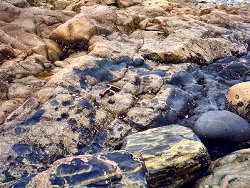
This inclined sheet is made of two distinct rock types; its margins are of hornblende-olivine basalt which enclose the later central member of quartz-feldspar porphyry. The marginal component presents chilled contacts against the Silurian grits; angular xenoliths of the country rock are enclosed in the basalt. The lower margin shows a chilled internal contact of basalt against basalt at the southern end of the outcrop implying that the early intrusion of basaltic magma was not a single episode of intrusion. In places the basalt is xenoporphyritic; xenocrysts of quartz and turbid alkali feldspar, up to 2.5 cm in size, show marginal assimilation by the host magma. In some instances the xenocrysts are surrounded by an acidified zone of basalt, rich in hornblende and albitized plagioclase laths. The central member is a pink, coarser-grained quartz-feldspar-porphyry with granophyric affinities. Feldspar phenocrysts may be 25 mm in size, hornblende is plentiful, and the groundmass shows both spherulitic and granophyric textures. At its margins with the basalt the rock is often crowded with basaltic inclusions which characteristically show a lobate or crenulate boundary. The host rock to these inclusions is an hybridized porphyry enriched in hornblende and biotite and of a medium grey colour. The internal contact between basalt and porphyry is sharp but unchilled; in places a narrow melanocratic rim of augite and hornblende adheres to the basic component. 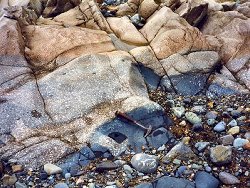 The outcrop occurs between high and low water marks and at its southern end, the Sherby Rocks, sends off a composite offshoot which has steeper contacts with the country rock. Northwards its course is sinusoidal; a small exposure in Spences River occurs above high water mark and from there the outcrop traverses the shore towards Jenkin's Point and again swings inland to meet the exposures of composite dykes 88 and 89. These two offsets of the same intrusion are steeper dipping but probably connected with the cone-sheet. | |
| Importance: | |
The best example of the Mourne cone-sheet system which demonstrates the structural disposition and the nature and contemporaneity of the intruded magmas. A fine excursion locality. | |
| Interpretation: | |
The presence of cone-sheet intrusions around the Mourne Granites is an indication of pressure build-up in the volcanic hearth below the granites in contrast to the conditions which resulted in cauldron subsidence and ring-dyke intrusion. The structural disposition of the cone-sheets points to a focus of volcanic pressure about 5 km below the centre of the granite complex; a depth in agreement with Cook and Murphy's (1952) geophysical evidence for an underlying mass of basic igneous rock. The xenolithic nature of the internal contact has been explained in various ways. Cole (1894) believed the basalt had been extensively remelted by the porphyry magma; the basic blocks carried away by the invading eurite (porphyry) became in many cases little 'lava lakes' and remained fluid long after the acid member of the cone-sheet had solidified. Phenocrysts of quartz and feldspar floated into this palingenic melt. It is worth stressing that Cole appreciated the liquid-liquid boundaries around these xenoliths. Tomkeieff & Marshall (1935) could not accept Cole's explanation. The basalt magma must have picked up xenocrysts from an acid igneous rock not necessarily related to the porphyry of the cone-sheet. In turn it was eviscerated by the porphyry magma which broke off numerous xenoliths of the basalt and assimilated them to produce the hybrid porphyry. Bailey and McCallien (1956) quoted the Glasdrumman cone-sheet as evidence of basic magma chilling against acid magma; the lobate/crenulate boundaries of the basic xenoliths in the porphyry were then, as Cole realized, liquid-liquid interfaces. | |
| Conclusions: | |
A fine excursion locality for studying a cone-sheet intrusion and a classic locality for a two contrasting magma-mix. | |
| Notes: | |
For Mourne Granites general information and reference list see; Key Site 1129 - The Granites - Overview. For general information on the cone-sheet intrusions associated with the Mourne Granites, and the Mourne Mountain dyke swarm, see; Key Site 1131 - Cone-sheet and Dyke Swarm - Overview. | |
| Keywords | |
|---|---|
| Rocks: | Basalt, Porphyry |
| Structures: | cone-sheet, magma mixing |
| Relations: | Intrusion |
| Access | |
|---|---|
| Approach: | Access to site is via the farm lane off the Newcastle-Annalong road opposite Glasdrumman House, Irish Grid Ref. J37502184. |
| Management: | |
The beach from George's Quay to Glasdrumman Port would require little active management. The tide would maintain the rock exposures in clean condition. Tipping on the beach occurs at the end of the access lane; this will need to be monitored. | |
| Threats: | Reworking of the boulders may obscure certain sections from time to time. |
| Map(s): | Tomkeieff & Marshall (1935) give a detailed map and section. | ||
| Record type: | ESCR report | ||
| Entered by: | E M Porter | ||
| Enlander, I., Dempster, M. & Doughty, P., 2026. Mournes - Glasdrumman Port Cone-sheet, County Down, site details. [In] Earth Science Conservation Review. https://www.habitas.org.uk/escr/site.php?item=1111. Accessed on 2026-11-06. |
| Previous Site | Next Site |