
| Previous Site | Next Site |
Earth Science Conservation Review
| Drummahon Lane | Tyrone |
| Site number: | 230 | File Number: | H27 |
| ESCC: | EO | ||
| Locality Type: | Inland exposure | Status: | ASSI |
| Grid Reference: | H228761 Centroid | ||
| Google maps: | 54.63302,-7.64692 | ||
| County: | Tyrone | Council area: | Derry City & Strabane District Council |
| Period: | Carboniferous | ||
| Stages: | Arundian, Visean | ||
| Lithostrat: | Bundoran Shale Formation, Skea Sandstone Member, Tyrone Group | ||
| Site Description | |
|---|---|
 | |
| Highlights: | |
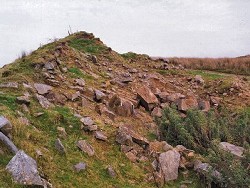
The occurrence of coarse conglomerates at this locality is unique in the outcrop of the Skea Sandstone Member. Fossiliferous limestone blocks show that strata in the upper part of the Ballyshannon Formation were exposed at this time and eroded to provide detritus for this member. | |
| Description: | |
The Drummahon Lane section occurs on the western side of the eponymous townland in the area known as Labbynakeely and is located 600m east of the B72 Ederny - Castlederg Road. Rock is exposed at many places along this steep scarp feature but construction of the farm lane and excavation of shallow pits on the NW side of the lane, at the crestline of the steep scarp, revealed some startling lithologies. The most commonly occurring rock type, both in outcrop and as loose blocks is of a conglomerate.
 Dorlodotia briarti Micheliniamegastoma Siphonodendron martini Siphonophyllia garwoodi Syringopora sp. The occurrence of these corals indicates a mid-to late Arundian age and in the Kesh-Omagh area they are restricted to the top of the Ballyshannon Limestone and the Bundoran Shale Formation. The orange-stained, gritty and coarse-grained nature of the matrix of this conglomerate is identical to the basal sandstone bed of the Skea Member, overlying the 0.18m clay horizon, at the stratotype section at Shanvin, 3km to the SSW. | |
| Interpretation: | |
NTERPRETATION/ | |
| Conclusions: | |
CONCLUSION The composition and size of clasts in this conglomerate indicate a more proximal location to the source of the detritus and that this included both metamorphic rocks and newly exposed fossiliferous limestones, including possibly the Ederny Member, of the Ballyshannon Formation. Although orange-stained very fine conglomerates and very coarse-grained sandstones do occur within the northern part of the outcrop of the Skea Member, coarse conglomerates are confined to this locality along the Drummahon Lane. | |
| Notes: | |
For information on other sites in Subarea-3 see; Key Site 1176 - Subarea-3; Kesh-Omagh. | |
| Keywords | |
|---|---|
| Minerals: | Dolomite |
| Rocks: | Conglomerate, Limestone, Sand, Sandstone |
| Fossil Groups: | Coral, Nautiloid |
| Fossil List: | Dorlodotia briarti , Michelinia megastoma , Siphonodendron martini , Siphonophyllia garwoodi , Syringopora sp. |
| Access | |
|---|---|
| Approach: | 600m east of the B72 Ederny - Castlederg Road at Labbynakeely, Drummahon Townland. |
| Map(s): | See 1:50,000 O.S. Sheet 12 (Strabane). | ||
| Record type: | ESCR report | ||
| Entered by: | Doughty, P.J. | ||
| Last updated: | 8 Jan 2005 | ||
| Enlander, I., Dempster, M. & Doughty, P., 2026. Drummahon Lane, County Tyrone, site details. [In] Earth Science Conservation Review. https://www.habitas.org.uk/escr/site.php?item=230. Accessed on 2026-11-06. |
| Previous Site | Next Site |