
| Previous Site | Next Site |
Earth Science Conservation Review
| Tullyratty, near Castleward | Down |
| Site number: | 531 | ||
| ESCC: | EM | ||
| Locality Type: | Mine (disused), Spoil heaps | Status: | ESCR |
| Grid Reference: | J566485 Centroid | ||
| Google maps: | 54.36154,-5.59084 | ||
| County: | Down | Council area: | Newry, Mourne & Down District Council |
| Site Description | |
|---|---|
 | |
| Highlights: | |
Hydrothermal vein minerals including galena and sphalerite in spoil at a former mine trial. | |
| Introduction: | |
According to a correspondent who in 1837 reported on lead mines in Lecale to the Down Recorder, lead ore was first found at Tullyratty in the summer of 1828. Over a two year period, a mine was developed to a depth of 31 metres and about 30 tons of ore were recovered (Burnett, 1988). The ore was assayed in Liverpool and London, but although rich in lead the silver content was disappointingly low. Several further attempts were made to re-commence mining at Tullyratty in 1842 and 1853. In 1842 the Down Recorder reported that 12 men were employed and a further 12 were about to be engaged, and that lead ore was abundant and yielded silver in a proportion of one part per thousand by weight. | |
| Description: | |
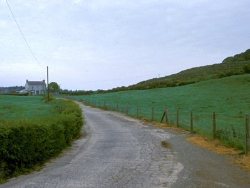
The former mine site is adjacent to a farmhouse owned by Richard and Nora Sharvin. On the flank of Slievetriplog hill some 50m northeast of the farm buildings, a ruined stone house is purported to have been the mine house, and a small stone shed on the hillslope 20m to the north was the powder house. Apparently there were two shafts, a decline near the mine house with a circular horse walk for haulage nearby, and another shaft across the road to the southwest of the farm. A metal ladder and tools were left in a 40 foot deep shaft when this was infilled by Mr Sharvin's grandfather. 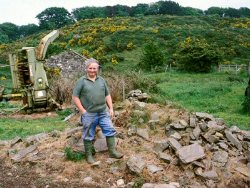 | |
| Importance: | |
In contrast to Whitespots, Tullyratty was not an economically viable mine. However, together with the nearby Dickson’s Island site, Tullyratty is important as a representative of the many small lead-bearing vein occurrences in the Lower Palaeozoic rocks of the north of Ireland. | |
| Interpretation: | |
By analogy with Castleward (Key Site 530) and Whitespots (Key Site 529), ore deposition is regarded as a result of mixing of high temperature, low salinity, deep-seated hydrothermal fluids with hypersaline connate brines during the Carboniferous (Moles et al., 1997). Structural reactivation and multiple fluid pulses were responsible for the larger base metal vein deposits such as Whitespots, whereas minor vein occurrences such as Tullyratty and Castleward record just some of these events. | |
| Conclusions: | |
This site is worth formal conservation. It has mineralized spoil, buildings and structures related to former mining activity, and the landowner welcomes visitors and encourages conservation of mining heritage. Although the mineralization has not as yet been the subject of detailed scientific research, this may well be undertaken in the future and conservation of the spoil material is important. | |
| Keywords | |
|---|---|
| Minerals: | Chalcopyrite, Galena, Sphalerite |
| Rocks: | Siltstone |
| Structures: | hydrothermal vein |
| Access | |
|---|---|
| Management: | |
The owner has taken care to preserve spoil from the mine in a heap behind the farmhouse. | |
| Threats: | Sensitive to collecting. |
| Uses | |
| Uses: | The site is adjacent to an active farm complex. The spoil is located in pasture. The powder house is in unmanaged scrub, although the access path to this building has recently (1999) been cleared. |
| Map(s): | OSNI 1:50,000 sheet 21; 1:10,000 sheet XX. | ||
| Record type: | ESCR report | Recorded by: | R. Nawaz and N.R. Moles |
| Entered by: | E M Porter | ||
| Last updated: | 07 MAY 68 | ||
| Enlander, I., Dempster, M. & Doughty, P., 2026. Tullyratty, near Castleward, County Down, site details. [In] Earth Science Conservation Review. https://www.habitas.org.uk/escr/site.php?item=531. Accessed on 2026-11-08. |
| Previous Site | Next Site |